
Federation Square
Melbourne's civic heart is an angular, sandstone-and-glass public square opposite Flinders Street Station, hosting Fed Square's own galleries, ACMI, big screens, and year-round festivals, markets, and free events.
Victoria · 14 Places · Best March
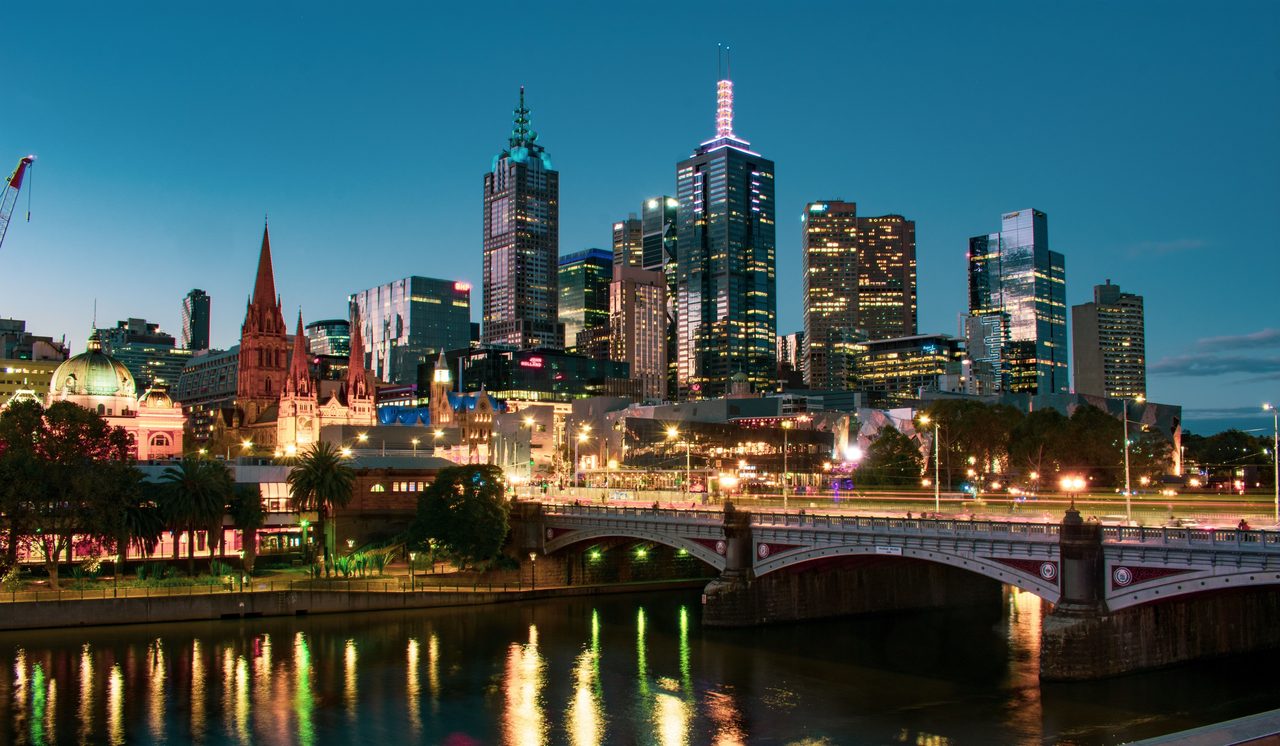
Melbourne is Victoria's capital and Australia's second-largest city, known for its laneway culture, world-class coffee scene, and status as the country's sporting and cultural capital. A dense tram network, the Yarra River, and a patchwork of distinct inner-city neighbourhoods give Melbourne a different character from harbour-side Sydney.
Melbourne sits on the Yarra River near the top of Port Phillip Bay, laid out around a compact CBD grid threaded with narrow laneways that hide cafes, bars, and street art rather than being mere shortcuts. The city runs on the world's largest urban tram network, with a free zone looping the CBD and Docklands, and prides itself on a coffee culture that predates and outlasted the global cafe boom. Melbourne is also Australia's sporting capital: the Melbourne Cricket Ground hosts AFL grand finals and Boxing Day Test cricket, and the Australian Open fills Melbourne Park every January. Inner suburbs each have a distinct identity, from bohemian Fitzroy and Collingwood's warehouse bars to seaside St Kilda and the gardens of South Yarra, while the Royal Botanic Gardens and the Tan running track line the Yarra just south of the CBD. Melbourne's weather is famously changeable, giving rise to the local saying that the city can see four seasons in one day, and its cultural calendar of festivals, live music, and gallery openings runs through every one of them.
Jump straight to the experience you're planning.
The 14 destinations our editors recommend — from iconic landmarks to under-the-radar finds.
Melbourne's civic heart is an angular, sandstone-and-glass public square opposite Flinders Street Station, hosting Fed Square's own galleries, ACMI, big screens, and year-round festivals, markets, and free events.
The MCG is Australia's largest stadium and the spiritual home of Australian Rules football and cricket, seating over 100,000 for AFL Grand Finals and hosting the Australian Sports Museum and behind-the-scenes stadium tours on non-event days.
Melbourne's largest open-air market has traded since 1878, with hundreds of stalls selling fresh produce, meat, deli goods, and souvenirs across heritage sheds, plus the seasonal Queen Victoria Night Market.
Australia's oldest and most visited public gallery, NGV International holds an international collection spanning old masters to contemporary art inside a landmark bluestone building with a famous water-wall entrance.
A 38-hectare landscaped garden on the Yarra River's south bank, planted since 1846 with themed collections, ornamental lakes, and resident native birdlife, a short walk from the Shrine of Remembrance.
An 88th-floor observation deck 285 metres above Southbank inside the gold-crowned Eureka Tower, with 360-degree views over the CBD, Port Phillip Bay, and the Dandenong Ranges, plus the optional glass-cube Edge ledge.
Pick a length, follow the route. Each itinerary balances headline sights with breathing room.
Three tiers, every traveller covered — from cost-conscious to flagship hotels.
Hostels, budget hotels, and guesthouses offer affordable stays without sacrificing experience.
Boutique hotels and well-located accommodations provide comfort and convenience at reasonable prices.
World-class resorts and premium hotels deliver unforgettable experiences.
Melbourne's flagship five-star tower on the Yarra River, part of the Crown Melbourne entertainment and casino complex.
Check rates on Booking.comSky-high five-star hotel occupying the upper floors of one of Melbourne's tallest towers, with a 64th-floor infinity pool.
Check rates on Booking.comLow-rise luxury hotel facing the Treasury Gardens, close to Parliament House and the theatre district.
Check rates on Booking.comGrand riverside hotel next to Southgate, well known for the Chuan Spa and a Yarra-view high tea.
Check rates on Booking.comCafés, neighbourhood gems, and tasting menus worth the table reservation.
Book a food tour in Melbourne We may earn a commission from bookings made through this link.
Melbourne's public transport network — trams, trains, buses and the SkyBus airport service — runs on the tap-on/tap-off myki fare system, with contactless bank cards and phones also accepted on trams and buses. The city's trams are its defining feature, including a Free Tram Zone that covers the entire CBD and Docklands, making a car unnecessary for a CBD-based visit.
Daily spend by tier in AUD, broken out by category.
| Category | Budget | Mid-range | Luxury |
|---|---|---|---|
| Accommodation | AUD 40 (approx. USD 28) | AUD 150 (approx. USD 107) | AUD 400+ (approx. USD 284+) |
| Food (per day) | AUD 32 (approx. USD 23) | AUD 60 (approx. USD 43) | AUD 140 (approx. USD 99) |
| Transportation | AUD 8 (approx. USD 6) | AUD 15 (approx. USD 11) | AUD 30 (approx. USD 21) |
| Activities | AUD 20 (approx. USD 14) | AUD 35 (approx. USD 25) | AUD 80 (approx. USD 57) |
| Daily total | AUD 100 (approx. USD 71) | AUD 260 (approx. USD 185) | AUD 650+ (approx. USD 462+) |
Best time Shoulder Worth avoiding
Average daytime temperature in °C. Figures are for Australia.
Melbourne's genuinely changeable climate means no month is risk-free for a sudden cool change or shower, but autumn and spring offer the best balance of mild weather, garden colour, and manageable crowds.
The AFL Grand Final (late September, MCG) and the Australian Open (January) both draw large crowds and push accommodation prices up across the city; book well ahead if visiting during either window.
Carry a light waterproof layer year-round — Melbourne's rapid weather changes are the most common thing that catches visitors off guard, more than any crime risk
Use SPF50+ sunscreen, a hat and sunglasses in summer; sunburn is a common visitor health issue even on a day that starts cloudy
Keep bags zipped and belongings in sight at Queen Victoria Market, Federation Square, and on crowded trams during peak hours
Only use official taxis or the Uber, DiDi, or Ola apps for late-night transport rather than unmarked cars offering rides
Stay within the signed Free Tram Zone boundaries if travelling without a tapped myki or contactless card, to avoid a fare-evasion fine
Emergency services number is 000 for police, fire, and ambulance; mobile SOS also reaches 112
Entry requirements follow Australia rules. Most visitors need an ETA (subclass 601) or eVisitor (subclass 651) visa, both free and applied for online before arrival. Requirements vary by nationality, so check the official Australian Department of Home Affairs website before traveling.
The currency in Melbourne is the Australian Dollar (AUD). ATMs are widely available across the city, and contactless card payment is accepted almost everywhere, including on public transport via the myki fare system. Cash is rarely needed.
English is the main language spoken in Melbourne. As one of the world's most multicultural cities, many other languages are also widely spoken in different neighbourhoods, but English is used in all tourism, transport, and official signage.
The top attractions in Melbourne include the Melbourne Cricket Ground (MCG), Queen Victoria Market, the National Gallery of Victoria, the Royal Botanic Gardens, and the street art laneways around Hosier Lane. Each reflects a different side of the city, from sport and history to art and green space.
Three to four days covers the CBD laneways, key museums, and Queen Victoria Market. A full week allows time to add a Great Ocean Road or Yarra Valley day trip, explore inner suburbs like Fitzroy and St Kilda, and catch a live sporting event.
Melbourne is a mid-to-high cost city by international standards for accommodation and dining, but the Free Tram Zone, many free galleries, and low-cost market food mean budget travelers can still visit comfortably on around AUD 100 per day.