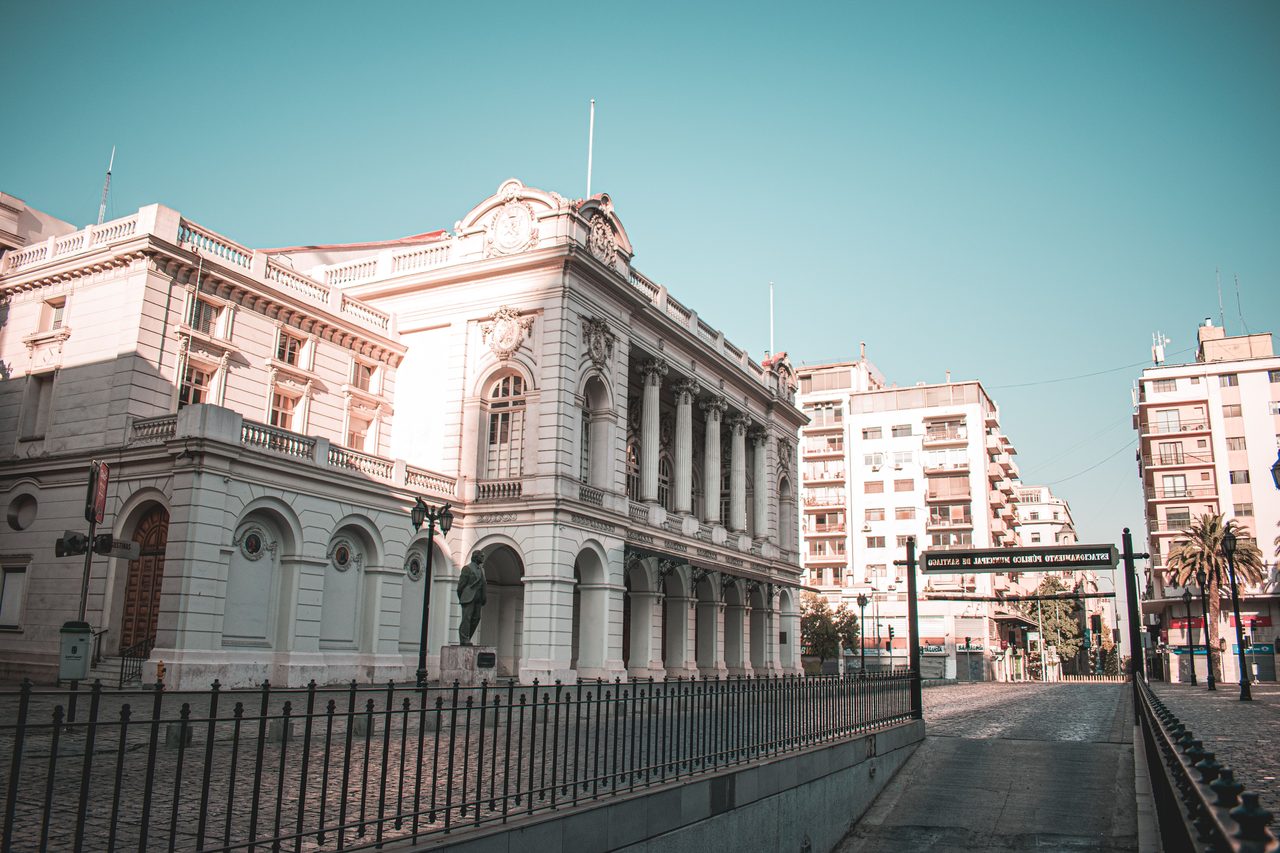
Metropolitana de Santiago · 21 Places · Best October-November and March-April
Metropolitana de Santiago
Metropolitana de Santiago is the central Chilean region built around the capital, Santiago, a city of about seven million set in a valley between the Andes and the Coastal Range. Beyond the capital it holds the Cajon del Maipo canyon, the pottery town of Pomaire, the Maipo Valley vineyards and the Andean ski centres of Farellones, La Parva, El Colorado and Valle Nevado.
Metropolitana de Santiago covers the Santiago basin and the mountains, valleys and farmland around it, all within roughly two hours of the capital. Santiago itself offers the Plaza de Armas, La Moneda palace, Cerro San Cristobal and Cerro Santa Lucia, the Mercado Central and the Bellavista and Lastarria neighbourhoods, linked by a clean, fast metro. To the southeast the Cajon del Maipo canyon offers hot springs, hiking and rafting, while the Maipo Valley south of the city holds Chile's most visited wineries. Farellones and the neighbouring ski centres operate roughly June to September, and Pomaire to the west is known for its clay pottery and hearty empanadas. The region works year-round: ski in winter, hike and wine-taste in spring and autumn.
The 21 destinations our editors recommend — from iconic landmarks to under-the-radar finds.
Cerro San Cristobal and Parque Metropolitano
The 880 m hill rising above Bellavista is Santiago's biggest green space. A funicular (running since 1925) climbs to the summit, where the 14 m Virgin Mary statue looks over the city, with a cable car continuing to the Pedro de Valdivia Norte side. Walking and cycling roads wind through the park, which also holds two public swimming pools and the Camino Real trail.
Cerro Santa Lucia
A rocky outcrop in the heart of downtown where Pedro de Valdivia founded Santiago in 1541, then called Huelen by the Mapuche and Picunche. In the 1870s it was landscaped into terraced gardens with stairways, fountains, the Neptune fountain, a chapel, and the Castillo Hidalgo fort. The summit viewpoint gives a 360-degree panorama of the city.
Plaza de Armas and Catedral Metropolitana
The historic centre of Santiago, laid out by Valdivia in 1541. The square is framed by the neoclassical cathedral (rebuilt in the late 1700s with Joaquin Toesca involved), the Correo Central post office, the Municipalidad, and the Museo Historico Nacional. Palm trees, shoe-shine stands, caricaturists and chess players fill the plaza.
Palacio de La Moneda and Centro Cultural La Moneda
The presidential palace, designed by Joaquin Toesca and finished in 1805 as the colonial mint, was bombed during the 1973 coup and later restored. Beneath the Plaza de la Ciudadania, the Centro Cultural Palacio La Moneda hosts major international exhibitions, a cinema, shops and a cafe. The palace interior can be seen only on advance-registered guided visits through the government's official site.
Museo Chileno de Arte Precolombino
Housed in the 1807 Real Aduana building, this museum displays about 3,000 pieces from Mesoamerica, the Andes, the Amazon and Chile, including Chinchorro mummies, Inca textiles and Moche ceramics. The collection is laid out chronologically across two floors around a covered courtyard. Considered one of the best museums in South America; website precolombino.cl.
Museo de la Memoria y los Derechos Humanos
Opened in January 2010, the museum documents human rights violations committed during the 1973-1990 military dictatorship through photographs, documents, personal belongings, video testimony and the original letters of the disappeared. Audio guides in English are available; the content is sombre and best visited with time to reflect. Website museodememoria.gob.cl.
Recommended itineraries
Pick a length, follow the route. Each itinerary balances headline sights with breathing room.
5-Day Metropolitana de Santiago Explorer
Day 1Arrive in Metropolitana de Santiago, explore city center
Day 2Visit top attractions and museums
Day 3Day trip to nearby highlights
Day 4Local markets and hidden gems
Day 5Final sightseeing, departure
7-Day Classic Metropolitana de Santiago
Days 1-2Metropolitana de Santiago city highlights
Days 3-4Regional exploration
Days 5-6Cultural immersion and local experiences
Day 7Return and departure
14-Day Ultimate Metropolitana de Santiago
Days 1-3Metropolitana de Santiago comprehensive city tour
Days 4-6Northern region exploration
Days 7-9Eastern highlights
Days 10-12Southern attractions
Days 13-14Return to Metropolitana de Santiago, departure
Where to stay in Metropolitana de Santiago
Three tiers, every traveller covered — from cost-conscious to flagship hotels.
Budget CLP 51,000 (~USD 55)
Hostels, budget hotels, and guesthouses offer affordable stays without sacrificing experience.
Mid-range CLP 130,000 (~USD 139)
Boutique hotels and well-located accommodations provide comfort and convenience at reasonable prices.
Luxury CLP 400,000+ (~USD 428+)
World-class resorts and premium hotels deliver unforgettable experiences.
The Ritz-Carlton, Santiago
El Golf, Las Condes · $$$$
Five-star tower in the El Golf financial district of Las Condes, with an indoor pool, spa and a well-known cocktail bar. A polished choice for business trips and for visitors who want El Golf metro station a few minutes away.
Luxury high-rise in eastern Las Condes with Andes views, a large spa and a pool deck. Quieter and more residential than El Golf; taxi or rideshare is the practical way to reach the centre.
Design-led hotel on Isidora Goyenechea, the main restaurant and nightlife strip of El Golf, with a lively lobby bar and rooftop pool. Best for travellers who want to be in the middle of the Las Condes dining scene.
Large pyramid-shaped five-star hotel on Avenida Kennedy near the Parque Arauco and Costanera Center area, with a big outdoor pool and tennis courts. Suits families and conference travellers.
Cafés, neighbourhood gems, and tasting menus worth the table reservation.
Boragó
Chilean - endemic ingredients tasting menu · $$$$
Chef Rodolfo Guzmán's Vitacura restaurant serves a single tasting menu built entirely from wild and endemic Chilean ingredients foraged from the Andes, the coast and the south. It is the highest-profile fine-dining address in the Santiago region and operates by advance reservation only.
Peumayén Ancestral Food
Chilean - Mapuche and ancestral · $$$
A Bellavista restaurant devoted to the foods of Chile's Indigenous peoples, with sharing platters that mix Mapuche, Rapa Nui and Andean preparations. It suits travellers who want to taste traditional ingredients such as quinoa, merquen, wild herbs and game.
Galindo
Chilean - traditional bistro · $$
A long-running Bellavista picada (casual local eatery) on the corner of Dardignac and Constitución, known for generous plates of home-style Chilean food such as pastel de choclo, lomo a lo pobre and cazuela. Tables spill onto the street in warm weather.
La Piojera
Chilean - traditional · $
A historic downtown bar-restaurant near the Mercado Central famous for the terremoto, a cocktail of pipeño wine, pineapple ice cream and grenadine, and for hearty plates like chorrillana and empanadas. Crowded and loud at lunch and after work.
Donde Augusto (Mercado Central)
Chilean - seafood · $$
One of the long-standing seafood restaurants inside Santiago's Mercado Central, serving congrio (conger eel) caldillo, machas a la parmesana, pastel de jaiba and daily fish. Staff at the market entrances will pitch visitors; the interior restaurants are the calmer option.
Fuente Alemana
Chilean - sandwiches · $
A counter-service institution beside Cerro Santa Lucía famous for the lomito, a slow-cooked pork sandwich with avocado, sauerkraut and mayonnaise. It is a quick, inexpensive lunch near Lastarria and the city centre.
Santiago is a basin city of about seven million people ringed by the Andes and the coastal range. The Metro (metro.cl) is the backbone for visitors: Line 1 runs east-west along the Alameda past Santa Lucia, Universidad de Chile and Baquedano, while lines 2, 3, 4, 5 and 6 reach Bellavista, Providencia and Las Condes. Buses and colectivos cover the foothills and the Cajon del Maipo, and intercity coaches from the city terminals reach Valparaiso, the Maipo wine valleys and the ski centres. Arturo Merino Benitez International Airport (SCL) is the single gateway, 15 km north-west of the centre. A car is only worth renting for wineries, the mountains and the coast.
Budget breakdown
Daily spend by tier in CLP, broken out by category.
Category
Budget
Mid-range
Luxury
Accommodation
CLP 20,000 (~USD 21)
CLP 70,000 (~USD 75)
CLP 250,000 (~USD 267)
Food (per day)
CLP 16,000 (~USD 17)
CLP 32,000 (~USD 34)
CLP 100,000 (~USD 107)
Transportation
CLP 6,000 (~USD 6)
CLP 10,000 (~USD 11)
CLP 25,000 (~USD 27)
Activities
CLP 9,000 (~USD 10)
CLP 18,000 (~USD 19)
CLP 25,000 (~USD 27)
Daily total
CLP 51,000 (~USD 55)
CLP 130,000 (~USD 139)
CLP 400,000+ (~USD 428+)
Best time to visit Metropolitana de Santiago
Weather through the year in Metropolitana de Santiago
Best timeShoulderWorth avoiding
Average daytime temperature in °C. Figures are for Metropolitana de Santiago.
Spring (October-November) and autumn (March-April) bring mild, clear days and good light on the Andes. Winter skiing runs roughly June to September; summer is hot and dry, with the grape harvest in March-April.
Santiago sits in a basin where winter inversions trap smog; clear days follow rain fronts.
Essential travel tips
Load a Bip! card at any Metro station and top up with cash at the ticket window
Tipping 10% is customary in restaurants and usually suggested on the bill (propina sugerida)
Shops and museums often close on Mondays; check hours before travelling
Winter pollution alerts restrict car use; the metro is the reliable option
Carry cash for markets, Pomaire and rural Cajon del Maipo, where card readers are rare
Dinner starts after 20:00 in most restaurants
Hidden gems
Off-the-beaten-path corners most travellers miss.
Barrio Yungay
A historic residential neighbourhood west of the centre with 19th-century facades, corner cafes and local street art
Santiago Centro
Barrio Italia
A low-rise neighbourhood of design shops, antique dealers and craft cafes on Calle Italia and Av. Italia
Providencia / Nunoa
Paseo Bulnes and Barrio Civico
A pedestrian promenade south of La Moneda with weekend art stalls and civic buildings
Santiago Centro
Safety information
INFO
Santiago is among the safer capitals in South America, but opportunistic theft is common: phone snatching on streets and the Metro, pickpocketing on Lines 1 and 5, and bag theft at the Plaza de Armas, Mercado Central, Cerro San Cristobal, and Bellavista nightlife strip
INFO
Chile sits on a major fault line. Learn the evacuation routes (look for 'Via de evacuacion' and 'Zona de seguridad' signs) and if shaking starts, drop, cover, and hold on, and move outdoors only once it stops; Chilean building codes are strict, and the phone emergency alert system (SAE) sends warnings to all phones
INFO
Winter air pollution (May-August) can trigger 'alerta' or 'preemergencia ambiental' days; check the official air quality index at sinca.mma.gob.cl and limit outdoor exercise on bad days
INFO
Do not use a phone or camera near Metro train doors or on street corners while walking; thieves on bikes and motor scooters grab devices in Providencia, Santiago Centro and Bellavista
INFO
Take Metro or official ride-hail apps (Uber, Cabify, DiDi) at night and avoid walking alone through the Parque Forestal, the Mapocho river banks, and the Estacion Central area after dark
INFO
Andes day trips (Cajon del Maipo, ski centres) involve altitude (2,500-3,300 m), strong UV, and sudden weather; go with a registered operator, carry water and sunscreen, and check road status at the Direccion de Vialidad before driving up the Camino a Farellones
INFO
Stray dogs are common but typically calm; avoid petting unfamiliar dogs and do not walk through parks at dusk if an aggressive pack is present
INFO
Public protests occur in Santiago, usually around Plaza Italia (also called Plaza de la Dignidad), the Alameda, and La Moneda on Fridays and political dates; avoid the area and leave if police water cannons or tear gas appear
Frequently asked questions
Do I need a visa to visit Metropolitana de Santiago?
Citizens of the United States, Canada, the United Kingdom, Australia, EU countries and many Latin American countries enter Chile visa-free for up to 90 days. Keep the tourist card issued on arrival until departure. Requirements vary by nationality, so check the Chilean consulate website.
How do I get from Santiago airport to the city centre?
Centropuerto and Turbus Aeropuerto buses run every 10-15 minutes from SCL to Pajaritos Metro station and downtown for about CLP 2,500-3,500 (~USD 3-4). Rideshare and official taxis cost CLP 15,000-25,000 (~USD 16-27) and take 30-45 minutes depending on traffic.
Is Santiago safe for tourists?
Santiago is generally safe, with petty theft the main concern around the Plaza de Armas, Mercado Central and busy Metro cars. Violent crime against visitors is rare. Emergency numbers are 133 (Carabineros), 131 (ambulance) and 132 (fire).
When is the best time to visit the Santiago region?
October-November and March-April offer mild weather and clear mountain views. Ski season runs about June to September at Valle Nevado, La Parva and El Colorado, while the grape harvest peaks in March-April.
How do I get to the Cajon del Maipo without a car?
Take Metro Line 4 to Plaza de Puente Alto, then a colectivo or bus to San Jose de Maipo, about 1.5 hours total for around CLP 3,000 (~USD 3). Many tour operators run day trips from central Santiago from CLP 45,000 (~USD 48).
Can I visit Maipo Valley wineries as a day trip?
Yes. Concha y Toro in Pirque is reachable by Metro Line 4 to Plaza de Puente Alto and a colectivo, while Santa Rita and Undurraga run tours with transfers. Book tastings in advance; tours cost about CLP 20,000-45,000 (~USD 21-48).
Explore Metropolitana de Santiago by city
The cities below have their own guides — hotels, attractions and where to eat, in depth.