Chongqing · 18 Places · Best March-May and September-November
Chongqing
Chongqing is a sprawling municipality in southwest China built on hills and cliffs at the confluence of the Yangtze and Jialing rivers. Often called a '3D city' for its stacked roads, sky bridges, and buildings that appear to grow directly out of cliffsides, Chongqing is famous for its spicy hotpot, dramatic river views, and a public transit network that runs through the middle of an apartment tower at Liziba Station. As one of China's four direct-administered municipalities, it functions as both a city and a province-level region covering a vast, mostly mountainous territory.
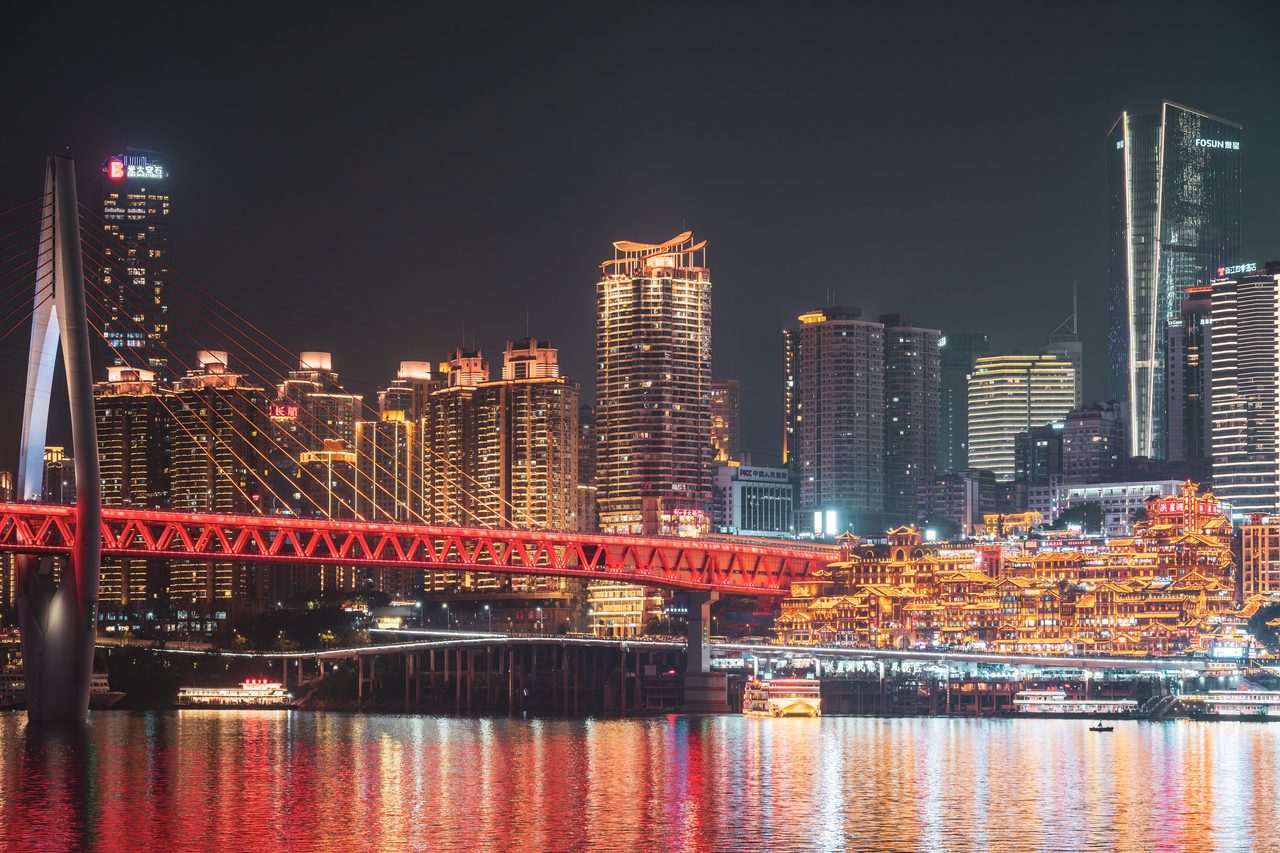
Chongqing municipality stretches along the Yangtze River from the Sichuan Basin into the Three Gorges region, making it one of the largest and most populous administrative areas in the world by land and headcount. The urban core sits on a hilly peninsula between the Yangtze and Jialing rivers, where skyscrapers, cliffside walkways, and multi-level roads create a famously vertical, maze-like cityscape. Visitors come for the neon-lit Hongya Cave stilt complex, the riverside old town of Ciqikou, cable cars and river cruises over the water, and a hotpot culture so central to local identity that entire streets are devoted to it. Beyond the city, the wider municipality holds UNESCO-listed Dazu Rock Carvings, karst landscapes, and departure points for Yangtze River and Three Gorges cruises.
Capital
Chongqing (Yuzhong District, urban core)
Largest city
Chongqing (urban core, centered on Yuzhong District)
Population
~32 million (municipality-wide); ~8-9 million in the core urban districts
The 18 destinations our editors recommend — from iconic landmarks to under-the-radar finds.
Hongya Cave (Hongyadong)
This is a multi-level structure built into a cliff face on the Jialing River, stacking eleven storeys of restaurants, shops and walkways in a stilted style adapted from traditional Ba-Yu river-town architecture. The design lets you enter at street level and exit several floors lower near the riverbank, or vice versa, depending on which of its multiple street entrances you use. At night the tiered facade is lit up, which is when it draws the largest crowds and photo lines.
Ciqikou Ancient Town
Ciqikou grew up as a Ming and Qing dynasty river port on the Jialing, shipping porcelain from nearby kilns (the name means 'porcelain port'), and its steep stone lanes and wooden shopfront buildings are what remain of that trade town. Today the lanes are packed with snack vendors and small shops rather than porcelain sellers, so it functions more as a food street than a craft market. Zhong's Courtyard and Baolun Temple are separately ticketed sites within the town that preserve residential and religious architecture from that era.
Chongqing China Three Gorges Museum
This state museum sits directly across the plaza from the Great Hall and centers its collection on the Three Gorges region, covering the dam project, the resettlement of residents whose towns were flooded, and the area's geology and folk culture. Additional galleries hold archaeological finds from the wider Chongqing region, including Ba-people bronzes. It's a large, air-conditioned indoor stop that works well as a break between outdoor sightseeing.
Eling Park
Eling Park sits on a hilltop in Yuzhong District and has functioned as a public garden since the early twentieth century, making it one of the older green spaces in the city center. Its main draw is elevation: paths and pavilions along the ridge give views over the surrounding built-up peninsula, in a city where flat open viewpoints are scarce. It's a quieter, more local alternative to the newer purpose-built viewing platforms elsewhere in Chongqing.
Liziba Monorail Station Viewing Platform
Liziba station is where Chongqing's Line 2 monorail runs directly through the middle floors of a residential apartment tower, a solution the city adopted because the terrain here left no other route through the building. A public viewing platform nearby lets people watch trains enter and exit the building without riding it. It has become one of the more photographed pieces of transit infrastructure in the city precisely because the arrangement is unusual rather than decorative.
Chongqing People's Great Hall (Renmin Auditorium)
Built in the early 1950s, this auditorium combines a circular roof modeled on Beijing's Temple of Heaven with a Western-style domed hall, a hybrid style chosen to represent the new municipal government's aspirations at the time. It remains an active venue for performances and official functions rather than a purely historic shell. The paid entry lets you see the domed interior and surrounding plaza up close, rather than only viewing the exterior from the street.
Recommended itineraries
Pick a length, follow the route. Each itinerary balances headline sights with breathing room.
5-Day Chongqing Explorer
Day 1Arrive in Chongqing, explore city center
Day 2Visit top attractions and museums
Day 3Day trip to nearby highlights
Day 4Local markets and hidden gems
Day 5Final sightseeing, departure
7-Day Classic Chongqing
Days 1-2Chongqing city highlights
Days 3-4Regional exploration
Days 5-6Cultural immersion and local experiences
Day 7Return and departure
14-Day Ultimate Chongqing
Days 1-3Chongqing comprehensive city tour
Days 4-6Northern region exploration
Days 7-9Eastern highlights
Days 10-12Southern attractions
Days 13-14Return to Chongqing, departure
Where to stay in Chongqing
Three tiers, every traveller covered — from cost-conscious to flagship hotels.
Budget ¥210 ($30)
Hostels, budget hotels, and guesthouses offer affordable stays without sacrificing experience.
Mid-range ¥620 ($87)
Boutique hotels and well-located accommodations provide comfort and convenience at reasonable prices.
Luxury ¥1,850+ ($260+)
World-class resorts and premium hotels deliver unforgettable experiences.
Cafés, neighbourhood gems, and tasting menus worth the table reservation.
Peijie Hotpot (Bayi Road)
Chongqing hotpot - old-style mala beef tallow · $$ (CNY 150-250 / USD 21-35 per person)
Liuyishou Hotpot (Jiefangbei)
Chongqing hotpot - national chain · $$ (CNY 120-200 / USD 17-28 per person)
Liuyishou is one of the largest hotpot chains to originate in Chongqing, and this branch sits right in Jiefangbei, the city's central pedestrian shopping street. The beef-tallow mala base follows the chain's standardized recipe, so the heat level and oiliness are consistent with other Liuyishou branches rather than a one-off house style. The room is a modern, multi-table restaurant built to handle the foot traffic of the pedestrian zone rather than an intimate setting.
Chongqing is built on steep hills at the confluence of the Yangtze and Jialing rivers, so its transport network was engineered around the terrain rather than a flat street grid. Chongqing Rail Transit - a 593 km, 12-line system blending straddle-beam monorail with conventional subway - is the fastest and most reliable way to move around, reaching the airport, both main rail stations, and most sightseeing districts. Taxis and DiDi ride-hailing fill in the gaps, river cableways and cruise ferries cross the two rivers, and walking involves stairs, sky bridges, and multi-level pedestrian decks rather than flat pavement. Renting a car is not recommended for visitors given the elevated, stacked road network and frequent fog.
Budget breakdown
Daily spend by tier in CNY, broken out by category.
Category
Budget
Mid-range
Luxury
Accommodation
¥95 ($13)
¥350 ($49)
¥1,150 ($162)
Food (per day)
¥65 ($9)
¥150 ($21)
¥400 ($56)
Transportation
¥25 ($4)
¥60 ($8)
¥150 ($21)
Activities
¥25 ($4)
¥60 ($8)
¥150 ($21)
Daily total
¥210 ($30)
¥620 ($87)
¥1,850+ ($260+)
Best time to visit Chongqing
Weather through the year in China
Best timeShoulderWorth avoiding
Average daytime temperature in °C. Figures are for China.
Essential travel tips
Book a Yangtze River night cruise from Chaotianmen dock to see the skyline and Hongya Cave illuminated from the water
Ride Metro Line 2 to Liziba Station for the famous photo of the monorail passing through the apartment building, best viewed from the designated platform on Jiaotong Road
Try authentic Chongqing hotpot at a local restaurant and ask for 'yuan yang guo' (split pot) if a milder broth alongside the spicy one is preferred
Use Didi (ride-hailing app) or the metro rather than hailing taxis on the street, since traffic and one-way systems make curbside pickups difficult
Visit Ciqikou Ancient Town in the early morning to avoid the heaviest tour-group crowds
Hidden gems
Off-the-beaten-path corners most travellers miss.
Shibati (Stone Steps) Historic Block
A steep, terraced old neighborhood of stone stairways and traditional buildings being redeveloped into a heritage/retail district, offering a quieter alternative to Hongya Cave's crowds
Yuzhong District
Huangjueping Graffiti Art Street
A university-district lane covered in large-scale murals and graffiti art created by students from the Sichuan Fine Arts Institute
Jiulongpo District
Laojun Cave (Laojundong)
A little-visited riverside cliff village near Ciqikou with Taoist temple ruins and sweeping views of the Jialing River, far less crowded than the main old town
Shapingba District
E'Ling Park at sunrise
The same panoramic hilltop park popular at sunset draws almost no visitors at sunrise, offering quiet views over the misty confluence of the Yangtze and Jialing rivers
Yuzhong District
Dazu Rock Carvings (Baodingshan)
A UNESCO World Heritage site of Tang and Song-dynasty Buddhist, Taoist, and Confucian rock carvings, roughly a 1.5-2 hour drive from downtown and far less crowded than closer-in sights
Dazu District, about 90 km (56 miles) from downtown Chongqing
Safety information
INFO
Chongqing has very low rates of violent crime against visitors; the main practical risks are pickpocketing in crowded tourist spots like Hongyadong and Ciqikou Ancient Town, and getting disoriented in the city's famously hilly, multi-level street layout
INFO
Extreme summer heat and humidity (June-August, one of China's 'Three Furnaces') make heatstroke and dehydration real risks; carry water and limit strenuous walking during midday hours
INFO
Winter and spring bring dense, persistent fog and low visibility across the city, which can delay river cruises, cable car operations, and flights - build flexibility into travel plans
INFO
The Yangtze River Cableway and glass-floor viewpoints have posted safety rules and queue systems; follow staff instructions, especially with children
INFO
Steep staircases, escalators between building levels (Chongqing's terrain means streets stack vertically), and slippery surfaces after rain are common minor hazards - wear sturdy, grippy shoes
INFO
Foreign registration: visitors staying in private accommodation rather than a hotel must register with the local police station (Public Security Bureau) within 24 hours, as required nationwide in China
INFO
Internet access is restricted under China's firewall; major foreign apps, search engines, and social media (Google, WhatsApp, Instagram) are blocked without a VPN, which affects staying in contact and navigation apps
Frequently asked questions
Do I need a visa to visit Chongqing?
Most foreign visitors need a Chinese visa arranged in advance through a Chinese embassy or consulate. Travelers continuing to a third country/region within 6 days may qualify for the 144-hour visa-free transit policy at Chongqing Jiangbei International Airport, and citizens of some countries qualify for China's broader unilateral visa-free entry. Rules vary by nationality and change periodically, so it is best to confirm current requirements with the nearest Chinese embassy or consulate before traveling.
What is the famous metro station that runs through a building in Chongqing?
Liziba Station on Chongqing Rail Transit Line 2 is famous for having the monorail pass directly through floors 6 to 8 of a 19-story residential apartment building in Yuzhong District. A designated public viewing platform on nearby Jiaotong Road lets visitors photograph the train passing through without needing a ticket.
Is Chongqing hotpot very spicy?
Yes, traditional Chongqing hotpot uses a beef-tallow broth loaded with chili peppers and numbing Sichuan peppercorns, and is generally considered spicier and oilier than hotpot elsewhere in China. Most restaurants offer a split pot (yuan yang guo) so a milder broth can be ordered alongside the spicy one.
What are the top attractions in Chongqing?
The top attractions in Chongqing include the illuminated stilt-house complex of Hongya Cave, the historic riverside streets of Ciqikou Ancient Town, the China Three Gorges Museum, panoramic Eling Park, the through-building Liziba monorail station, and, as a day trip, the UNESCO-listed Dazu Rock Carvings.
Explore Chongqing by city
The cities below have their own guides — hotels, attractions and where to eat, in depth.