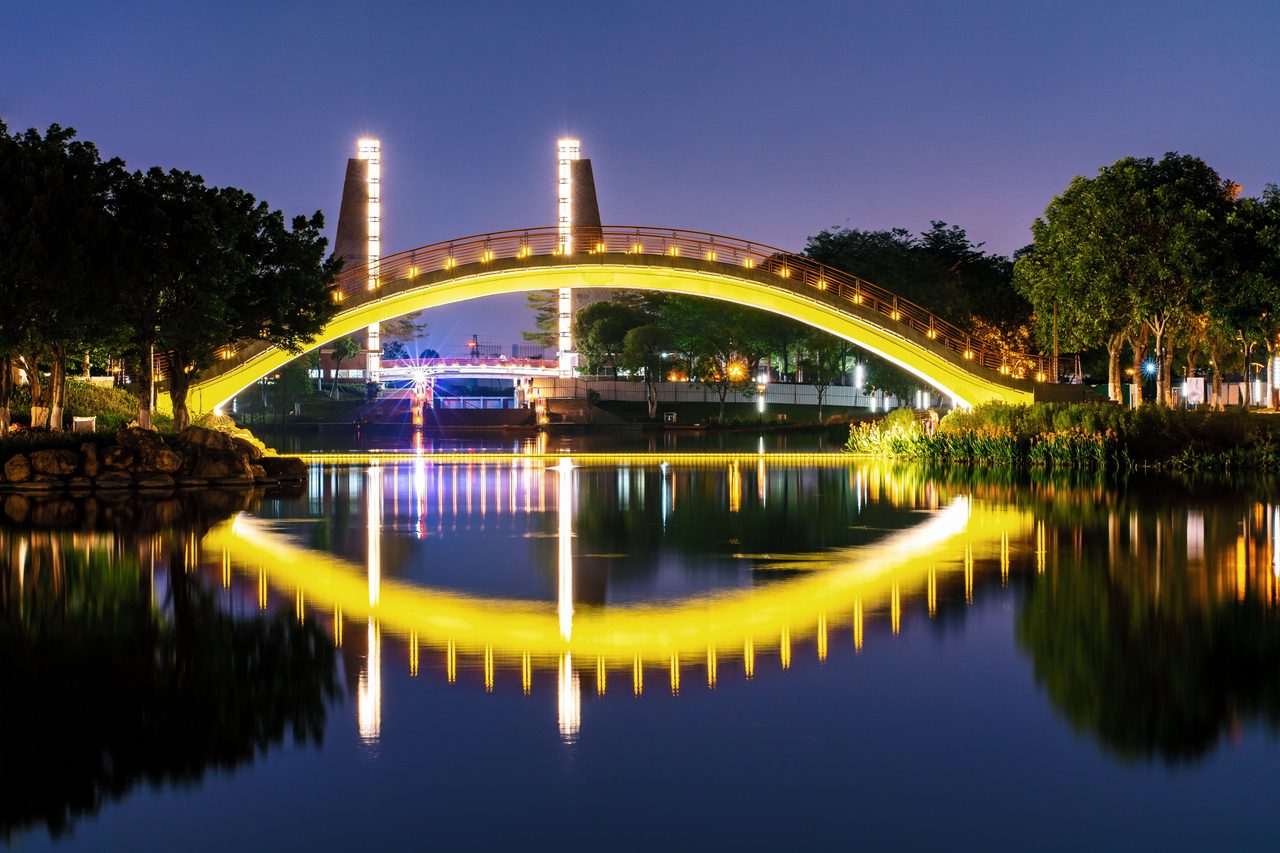
Foshan is a prefecture-level city in the Pearl River Delta, directly southwest of Guangzhou and linked to it by the Guangfo metro line. It is the birthplace of Cantonese martial arts and lion dance, home to the Ming-Qing Zumiao Ancestral Temple, the ceramics kilns of Shiwan, and Shunde, widely regarded as the cradle of Cantonese cuisine. Visitors fly into Guangzhou, Shenzhen or Hong Kong and reach Foshan by metro or intercity rail.
Foshan sits on the western side of the Pearl River Delta, adjoining Guangzhou to the northeast. It has five districts: Chancheng (the old centre, with Zumiao, Lingnan Tiandi and Shiwan), Nanhai (Xiqiao Mountain and Liang Garden area), Shunde (Qinghui Garden and the food scene), Sanshui and Gaoming. Foshan is known as the home of Wing Chun and Hung Gar kung fu (Yip Man and Wong Fei-hung both have Foshan connections), Cantonese opera, Shiwan ceramics, paper-cut art, and Foshan Shadow Play. The Guangfo line (Foshan Metro Line 1 with Guangzhou Metro through-running) links central Foshan to Guangzhou in about 30-40 minutes, so many visitors stay in either city and day-trip to the other.
Capital
Foshan
Largest city
Foshan
Population
About 9.7 million permanent residents (recent official estimates)
The 12 destinations our editors recommend — from iconic landmarks to under-the-radar finds.
Foshan Ancestral Temple (Zumiao)
Taoist temple complex dating to the Northern Song dynasty and now run as a folk museum, with the Beidi hall, a Wanfu stage and the Confucius Temple. The ticket also covers the Huang Feihong and Yip Man halls; lion dance and martial arts shows run on the front square most days except in rain.
Yip Man Memorial Hall
Museum honoring Foshan-born Wing Chun master Yip Man (Ip Man), teacher of Bruce Lee, opened in 2002 within the Ancestral Temple grounds. Exhibits cover his life and the Wing Chun lineage.
Huang Feihong Lion Dance Martial Arts Museum
Memorial hall to folk hero and martial artist Wong Fei Hung (Huang Feihong) and the Foshan lion dance tradition, with a daily martial arts and lion dance show on the adjoining square.
Foshan Confucius Temple (Wenmiao)
Confucian temple built in 1911 inside the Ancestral Temple grounds, a small hall used for scholarly ritual and now part of the museum tour.
Lingnan Tiandi
Restored old-town district (the former Donghua Lane) with 22 heritage buildings, grey-brick arcades, restaurants, cafes and shops next to the Ancestral Temple.
Nanfeng Ancient Kiln
Dragon kiln in continuous use for around 500 years, among the oldest working kilns in China, set in the Shiwan ceramic district with workshops and a ceramics museum.
Recommended itineraries
Pick a length, follow the route. Each itinerary balances headline sights with breathing room.
5-Day Foshan Explorer
Day 1Arrive in Foshan, explore city center
Day 2Visit top attractions and museums
Day 3Day trip to nearby highlights
Day 4Local markets and hidden gems
Day 5Final sightseeing, departure
7-Day Classic Foshan
Days 1-2Foshan city highlights
Days 3-4Regional exploration
Days 5-6Cultural immersion and local experiences
Day 7Return and departure
14-Day Ultimate Foshan
Days 1-3Foshan comprehensive city tour
Days 4-6Northern region exploration
Days 7-9Eastern highlights
Days 10-12Southern attractions
Days 13-14Return to Foshan, departure
Where to stay in Foshan
Three tiers, every traveller covered — from cost-conscious to flagship hotels.
Budget $35-50 (about 235-335 CNY)
Hostels, budget hotels, and guesthouses offer affordable stays without sacrificing experience.
Mid-range $80-130 (535-870 CNY)
Boutique hotels and well-located accommodations provide comfort and convenience at reasonable prices.
Luxury $230+ (1,540+ CNY)
World-class resorts and premium hotels deliver unforgettable experiences.
Cordis, Foshan, Lingnan Tiandi
Zumiao and Lingnan Tiandi · CNY 700-1500 (USD 104-224) per night
Upscale hotel inside the Lingnan Tiandi district, about an 8-minute walk from Zumiao Metro Station and the Ancestral Temple. Suits visitors focused on Foshan's historic core.
Five-star hotel described as walking distance from Guangfo Metro Station, Zumiao Temple and Lingnan Tiandi. Street address is not confirmed in the sources checked.
Cafés, neighbourhood gems, and tasting menus worth the table reservation.
Minxin Double-Skin Milk (民信老铺)
Shunde dessert - double-skin milk · $
A long-established Daliang dessert shop credited with popularising double-skin milk in Shunde. Branches include No. 119 Huagai Road, and a second listing gives No. 131 Daliang Street; confirm the branch on Dianping before visiting. Some listings note a small double-skin milk display museum.
Shisanyi Double-Skin Milk
Cantonese dessert - double-skin milk · $
A double-skin milk shop on Zumiao Road, close to Zumiao Temple, convenient for visitors staying in Chancheng.
Shunde Fishery Village (顺德渔村)
Shunde - river fish · $$
A Shunde fish restaurant listed with fish-head casserole and shrimp cake among its specialities. The address below is taken from a Shunde restaurant guide; check the branch on Dianping.
Shunde Fish Feast (顺德鱼宴), Daliang
Shunde - river fish · $$
A Daliang fish restaurant on Jinlong Road listed as open 10AM-9PM; its exact Chinese trading name is not confirmed, so verify on Dianping.
Fengcheng Fish Skin (凤城鱼皮)
Shunde - fish skin · $
A small restaurant reached through an alley off Jinbang Road in Daliang, known for crisp tossed fish skin.
Shunfeng Mountain Villa (顺峰山庄)
Shunde Cantonese banquet · $$$
A large Shunde restaurant near the Shunfeng Mountain tourist area, listed for roast goose, steamed fish, scallop rice and Peking duck.
Foshan is served mainly through Guangzhou Baiyun International Airport (CAN), about 30-60 km from central Foshan, with Shenzhen Bao'an (SZX) and Hong Kong (HKG) as longer alternatives. Foshan Shadi Airport (FUO) is a small dual-use airfield in Nanhai with limited commercial service. Most visitors arrive by rail at Foshan West or Foshan Railway Station, or by metro from Guangzhou. Inside the city, the Guangfo Line and Foshan Metro Lines 2 and 3 are supplemented by buses, taxis and DiDi.
Budget breakdown
Daily spend by tier in CNY, broken out by category.
Category
Budget
Mid-range
Luxury
Accommodation
$15-25 (100-170 CNY)
$40-70 (270-470 CNY)
$130+ (870+ CNY)
Food (per day)
$8-14 (55-95 CNY)
$18-30 (120-200 CNY)
$45-80 (300-535 CNY)
Transportation
$3-6 (20-40 CNY)
$8-15 (55-100 CNY)
$25-45 (170-300 CNY)
Activities
$3-8 (20-55 CNY)
$10-20 (65-135 CNY)
$30-70 (200-470 CNY)
Daily total
$35-50 (about 235-335 CNY)
$80-130 (535-870 CNY)
$230+ (1,540+ CNY)
Best time to visit Foshan
Weather through the year in Foshan
Best timeShoulderWorth avoiding
Average daytime temperature in °C.
October to December offers comfortable temperatures (17-29°C) and the lowest rainfall of the year, while March-April is pleasant but damp.
Typhoons make landfall in the Pearl River Delta two or three times most years from July to September, so keep travel plans flexible in summer.
Essential travel tips
Base yourself in Chancheng for Zumiao, Lingnan Tiandi and Shiwan, all reachable by metro Line 2 or Line 3; Shunde and Xiqiao need separate half-day trips
Combine Zumiao, Yip Man Ancestral Hall and Lingnan Tiandi in one morning, as they are within walking distance of each other
Carry a screenshot of each address in Chinese characters for taxi drivers
Guangzhou is 15-40 minutes away, so day trips either way are easy
Learn a few Mandarin phrases; Cantonese is the local language and English is limited outside international hotels
Hidden gems
Off-the-beaten-path corners most travellers miss.
Nanfeng Ancient Kiln
Working dragon kiln in Shiwan dating to the Ming dynasty, with pottery workshops and a ceramics museum
6 Gaomiao Road, Shiwan Town, Chancheng District
Liang Garden (Liangyuan)
Qing-dynasty Lingnan garden of a scholar family, with rockeries, ponds and calligraphy, less visited than the Zumiao area
Songfeng Road, Songfeng Community, Chancheng District (verify exact address before travelling)
Xiqiao Mountain
Volcanic mountain with lakes, temples and hiking trails, popular with locals at weekends
Xiqiao Town, Nanhai District
Safety information
INFO
Foshan is generally safe for visitors, with low violent-crime rates against foreigners; the practical risks are petty theft in crowded markets and tourist streets, overcharging, and internet and payment friction rather than personal danger
INFO
China's national visa policy: as of September 2026 citizens of the UK, Canada, Australia, New Zealand, most EU states and dozens of other countries can enter visa-free for up to 30 days under a policy extended to 31 December 2026; US citizens are not covered by that 30-day list but can use the 240-hour (10-day) visa-free transit rule when continuing to a third country, or apply for an L tourist visa. Check current rules with the Chinese embassy or consulate before booking
INFO
Foreign visitors must register with the local police within 24 hours of arrival; hotels do this automatically at check-in with a passport, but visitors staying in private homes or rentals must register at the local police station (paichusuo) themselves
INFO
Carry the original passport or a clear photo of it at all times, since hotels, trains, metro security checks and occasional police spot checks ask for ID
INFO
Mainland China filters the internet: Google, Gmail, WhatsApp, Instagram, Facebook and most Western news and social media are blocked without a VPN. VPN apps cannot be downloaded inside China, so install and test one before arriving. Roaming eSIMs that route traffic outside China bypass the filter
INFO
Foshan is a cashless city: Alipay and WeChat Pay dominate. Foreign Visa or Mastercard cards can be linked to both apps with a passport; keep some cash as backup, since cash-only travelers may be refused at small shops
INFO
Typhoon season runs from roughly June to early November, peaking July to September; Foshan issues signal warnings (rainstorm and typhoon color signals). Under a No. 8 typhoon signal, transport and schools are suspended, so stay indoors and away from rivers, canals and low-lying streets
INFO
Summer heat and humidity are strong (32-34°C highs); carry water, use sunscreen and avoid strenuous outdoor activity between 11 am and 3 pm, especially on Xiqiao Mountain trails
INFO
Air quality is usually acceptable but can worsen in October-January when winds bring pollution from the north; check the AQI on the China Environmental Monitoring or WeChat weather apps
INFO
Dengue transmitted by mosquitoes has occurred in Foshan and elsewhere in Guangdong from summer to autumn, so use repellent, wear long sleeves in the evening and avoid standing water
Frequently asked questions
Do I need a visa to visit Foshan?
Citizens of about 50 countries, including most of Europe, the UK, Canada, Australia and New Zealand, can currently visit mainland China visa-free for up to 30 days (policy extended to 31 December 2026). Nationals of about 55 countries may use the 240-hour visa-free transit rule when continuing to a third country. Rules change, so verify at en.nia.gov.cn or with a Chinese embassy before travelling.
Does Foshan have an airport?
Foshan has no major airport in regular international service. The nearest are Guangzhou Baiyun (CAN), Shenzhen Bao'an (SZX) and Hong Kong (HKG). From Guangzhou, metro and rail reach Foshan in about 30-60 minutes.
What currency is used in Foshan?
The Chinese Yuan (CNY, also called RMB). At 1 USD = 6.70 CNY, a 100 CNY meal costs about $15. Alipay and WeChat Pay are used for nearly everything; set them up with a foreign card before arrival and carry some cash as backup.
What are the top attractions in Foshan?
The top attractions are Zumiao Ancestral Temple, Qinghui Garden in Shunde, Nanfeng Ancient Kiln, Yip Man Ancestral Hall with Lingnan Tiandi, and Xiqiao Mountain. Plan them by area and use the Foshan Metro, trains and DiDi.