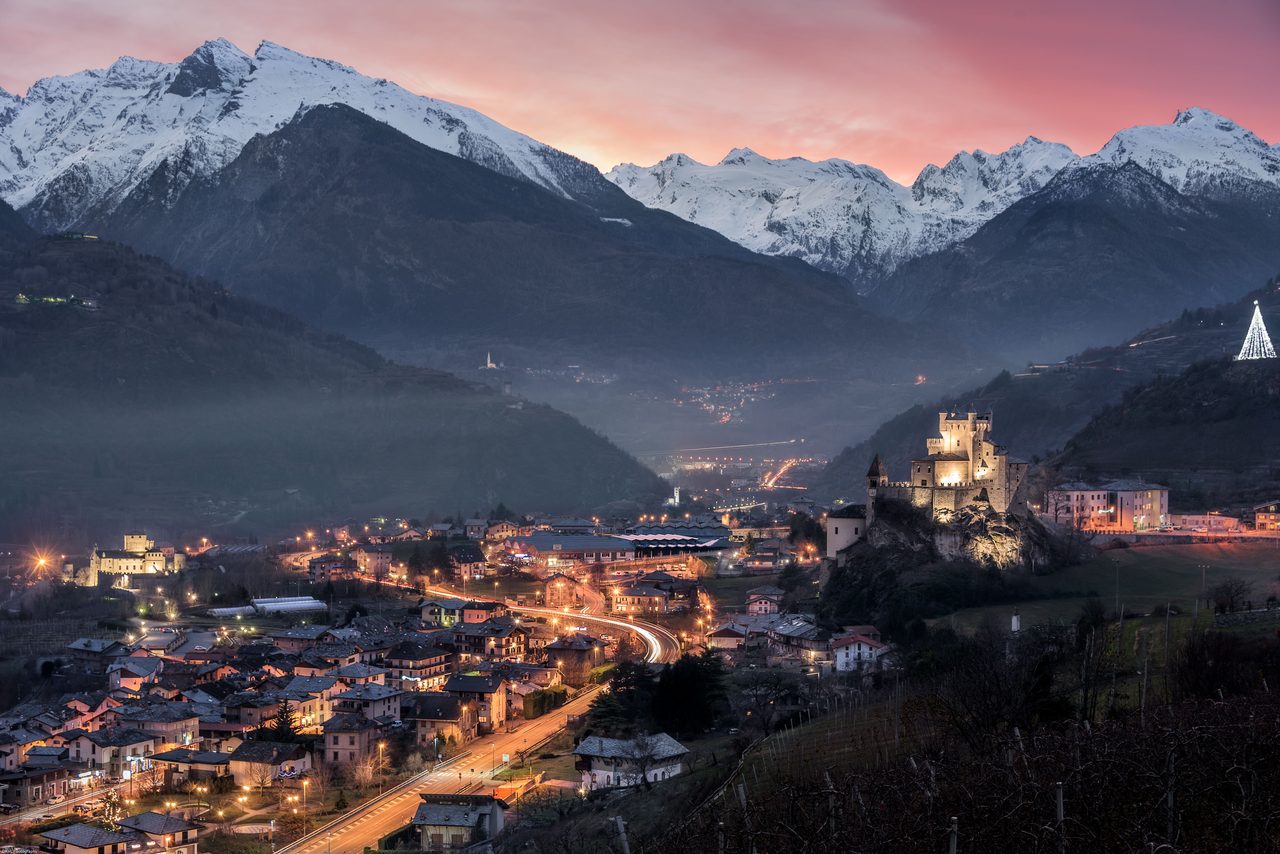
Aosta Valley (Valle d'Aosta) is Italy's smallest and least populated region, nestled in the far northwest corner of the country surrounded by the Alps. Bordered by France to the west and Switzerland to the north, the region is dominated by some of Europe's highest peaks — Mont Blanc (4,808 m), the Matterhorn (4,478 m), and Monte Rosa — and is home to Gran Paradiso National Park, over 70 medieval castles, and a bilingual Italian-French culture that reflects centuries of cross-border exchange. Its capital, Aosta, preserves remarkable Roman monuments alongside a vibrant contemporary food scene anchored by DOP cheeses, cured meats, and mountain wines.
Aosta Valley offers an extraordinary confluence of alpine adventure and Latin-alpine heritage. The valley's main artery, the Aosta Valley road (SS26), connects a string of medieval castles and Roman ruins between the Mont Blanc tunnel at Courmayeur and the Po plain entry at Pont-Saint-Martin. Skiers flock to Courmayeur, Cervinia (at the foot of the Matterhorn), Pila, La Thuile, and Champoluc for world-class slopes; summer hikers explore 120 trails inside Gran Paradiso National Park, where ibex and chamois roam freely. The regional cuisine — Fontina DOP fondue, carbonade beef stew, lardo di Arnad, and Valdostana wines — rewards those who seek out local trattorie over tourist menus.
The 22 destinations our editors recommend — from iconic landmarks to under-the-radar finds.
Castello di Fénis (Fenis Castle)
Fénis is the best-preserved of the Aosta Valley's medieval castles, built for the Challant family, viscounts of Aosta, mainly in the 14th century. Its defensive ring of walls and towers looks severe from outside, but the inner courtyard holds a famous fresco of Saint George slaying the dragon and a curved wooden staircase leading to the great hall. Unlike many valley castles that were later converted into residences, Fénis kept its original layered defensive plan largely intact.
Forte di Bard
This is a 19th-century Piedmontese fortress rebuilt after Napoleon's forces struggled to take the earlier stronghold guarding the Dora Baltea gorge in 1800. The complex now sprawls across three main structures on the rock spur above Bard village and houses the Museo delle Alpi, a museum on Alpine geography, culture, and mountaineering, plus temporary exhibitions. Getting up to the fort is part of the experience: a series of lifts and walkways carries visitors through the fortifications rather than a single straightforward entrance.
Gran Paradiso National Park
Italy's oldest national park, established in 1922 from a former royal hunting reserve of the House of Savoy, protects the massif around the 4,061m Gran Paradiso peak and is one of the more reliable places in the Alps to see ibex at close range, since the animals were the reason the reserve existed in the first place. The Cogne side of the park, reached via the Valnontey valley, has some of the gentler, more accessible trails, while other valleys demand more serious hiking. The Cogne visitor centre is a good starting point for trail information before heading up into Valnontey or Valsavarenche.
Breuil-Cervinia and Matterhorn Viewpoint
Breuil-Cervinia sits at the foot of the Matterhorn's Italian (south) face, a very different profile from the classic pyramid seen from Zermatt on the Swiss side. The resort is primarily a ski base with high-altitude, glacier-covered terrain, and the cable car system climbs in stages up to Plateau Rosà, from where the view extends across into Switzerland. Even without skiing, the lift ride itself is the main draw for the scale of the high-altitude terrain it opens up.
Courmayeur and Mont Blanc
Courmayeur is the Italian base for Mont Blanc, sitting opposite Chamonix on the French side of the massif, and functions as both a smart alpine resort town and the starting point for the Skyway Monte Bianco cable car. The Skyway climbs in two stages to Punta Helbronner at around 3,466m, with rotating cabins and a terrace that looks across the glaciers toward the summit and, on clear days, over to Chamonix. The town centre itself is a pedestrian core of stone buildings good for a pre- or post-lift wander, separate from the lift base station a short walk away.
Castello di Issogne
Issogne is a Challant-family castle built more as a Renaissance residence than a fortress, and it's best known for its courtyard fountain shaped like a pomegranate tree and the frescoed loggia around it depicting shops and daily trades of the period. Inside, furnished rooms give a sense of aristocratic domestic life in the valley in a way the more military-focused Fénis castle doesn't. It sits close to Fénis and the two are often visited on the same day given the short driving distance between them.
Recommended itineraries
Pick a length, follow the route. Each itinerary balances headline sights with breathing room.
5-Day Aosta Valley Explorer
Day 1Arrive in Aosta Valley, explore city center
Day 2Visit top attractions and museums
Day 3Day trip to nearby highlights
Day 4Local markets and hidden gems
Day 5Final sightseeing, departure
7-Day Classic Aosta Valley
Days 1-2Aosta Valley city highlights
Days 3-4Regional exploration
Days 5-6Cultural immersion and local experiences
Day 7Return and departure
14-Day Ultimate Aosta Valley
Days 1-3Aosta Valley comprehensive city tour
Days 4-6Northern region exploration
Days 7-9Eastern highlights
Days 10-12Southern attractions
Days 13-14Return to Aosta Valley, departure
Where to stay in Aosta Valley
Three tiers, every traveller covered — from cost-conscious to flagship hotels.
Budget €70
Hostels, budget hotels, and guesthouses offer affordable stays without sacrificing experience.
Mid-range €160
Boutique hotels and well-located accommodations provide comfort and convenience at reasonable prices.
Luxury €450+
World-class resorts and premium hotels deliver unforgettable experiences.
Aosta's longest-running fine-dining address, run for decades by the Fontana family in a former mill building near the Roman walls, with old stone and wood-beamed rooms that keep the feel of the original structure. The kitchen builds tasting menus around Valdostana ingredients pushed toward contemporary technique rather than rustic presentation.
Brasserie du Commerce
Valdostana / Italian · €15-35/person (~$16-38 USD)
Trattoria degli Artisti
Traditional Valdostana · €20-40/person (~$22-44 USD)
Ristorante La Clusaz
Valdostana · €18-38/person (~$20-41 USD)
Ristorante La Palud
Mountain Italian · €25-55/person (~$27-60 USD)
Cadran Solaire
Traditional Valdostana · €30-60/person (~$33-65 USD)
A long-established traditional restaurant on Courmayeur's main street, built around a wood-and-stone dining room typical of the valley's older trattorie rather than the newer ski-resort style venues nearby. The menu stays close to Valdostana staples - fontina-based dishes and game from the surrounding mountains - cooked in a straightforward, unfussy way.
Aosta Valley is accessible by road (A5 motorway from Turin, Mont Blanc Tunnel from France) and by train from Turin to Aosta. Within the valley, SVAP buses serve most villages; car rental is strongly recommended for castle-hopping and reaching trailheads.
Train
Trenitalia/SNCF runs services from Turin Porta Nuova to Aosta (~2 hours, changes at Chivasso). No rail service beyond Aosta into the valleys.
Cost: €10-18 (about $11-20 USD)
SVAP Regional Bus
SVAP buses connect Aosta to Courmayeur, Cervinia, Cogne, Champoluc, and most villages. Route timetables at savda.it.
Cost: €2.50-8 (about $3-9 USD)
Car Rental
Essential for castle circuits and trailhead access. Available at Turin airport and Aosta train station. Europcar, Hertz, and Avis have local offices.
Cost: €45-90/day (about $50-100 USD)
Cable Cars / Gondolas
Multiple cable cars connect valley floor to mountain stations. Aosta-Pila gondola, Courmayeur-Plan Chécrouit, Cervinia base stations.
Cost: €15-30 single / €30-55 return (about $16-60 USD)
Budget breakdown
Daily spend by tier in EUR, broken out by category.
Category
Budget
Mid-range
Luxury
Accommodation
€30
€90
€280
Food (per day)
€20
€45
€120
Transportation
€10
€15
€30
Activities
€10
€10
€20
Daily total
€70
€160
€450+
Best time to visit Aosta Valley
Weather through the year in Italy
Best timeShoulderWorth avoiding
Average daytime temperature in °C. Figures are for Italy.
June-September for hiking; December-March for skiing
Shoulder seasons (May, October) offer lower prices and fewer crowds but some mountain facilities are closed.
Essential travel tips
The Aosta Valley Guest Card (available at accommodation) offers free or discounted public transport and attraction entry
French is co-official — basic French phrases are appreciated by locals in mountain villages
Book Cervinia and Courmayeur accommodation at least 3 months ahead for Christmas/New Year and February school holidays
The A5 motorway tunnel tolls are high; budget approximately €50 for a Turin-Courmayeur return trip by car
Many restaurants close between 3 PM and 7 PM; plan lunch and dinner accordingly
Hidden gems
Off-the-beaten-path corners most travellers miss.
Safety information
INFO
Register with the local Alpine rescue (Soccorso Alpino, tel: 118) when undertaking difficult routes
INFO
Never hike alone on high-altitude trails above 2,500 m
INFO
Carry emergency gear (whistle, foil blanket, headlamp) on mountain excursions
INFO
Winter drivers must carry snow chains and have winter tyres from November 15 to April 15
INFO
Petty crime is rare but keep valuables secure in ski resort villages during peak season
Frequently asked questions
Is Aosta Valley safe to visit in 2026?
Aosta Valley is one of the safest regions in Italy and Europe. Crime rates are exceptionally low. The main risks for visitors are mountain-related: altitude sickness, sudden weather changes, avalanche danger in winter, and trail accidents. Standard alpine precautions apply to any excursion above 2,0
What is the best time to visit Aosta Valley?
The best time to visit Aosta Valley is June-September. Aosta Valley has a continental alpine climate with significant elevation variation. The valley floor (Aosta at 583 m) enjoys a drier, sheltered microclimate with warm summers (25-30°C) and cold winter
Do I need a visa to visit Aosta Valley?
Entry requirements follow Italy/Schengen rules. EU citizens need only a national ID card; non-EU visitors from many countries may stay visa-free for up to 90 days within the Schengen Area; others require a Schengen visa obtained through the Italian Embassy. Requirements vary by nationality, so check with your nearest embassy or the official immigration website before traveling.
What currency is used in Aosta Valley?
The currency in Aosta Valley is the Euro (EUR). ATMs are widely available in cities and tourist areas. Credit cards are accepted at most hotels and restaurants, but carry cash for markets and smaller establishments.
What language is spoken in Aosta Valley?
The main language(s) spoken in Aosta Valley: Italian, French, Franco-Provençal (Arpitan). In tourist areas, English is generally understood. Learning a few basic phrases in the local language is appreciated by locals.
What are the top attractions in Aosta Valley?
The top attractions in Aosta Valley include Castello di Fénis (Fenis Castle), Forte di Bard, Gran Paradiso National Park, Breuil-Cervinia and Matterhorn Viewpoint, and Courmayeur and Mont Blanc. Each offers a unique experience, from historic landmarks to natural wonders.