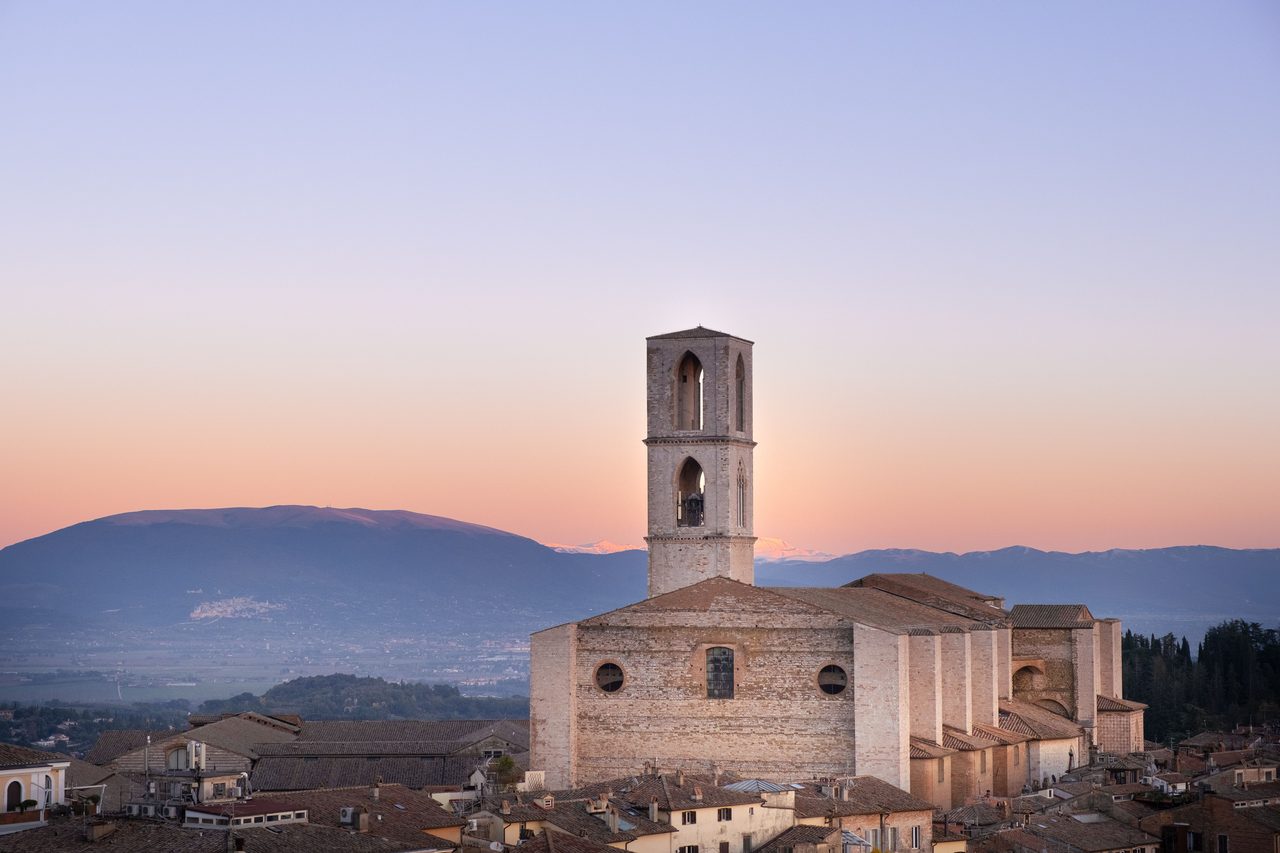
Umbria · 37 Places · Best April-June and September-October
Umbria
Umbria is a landlocked region in central Italy, the only one on the Italian peninsula with neither a coastline nor a border with another country. Known as the 'Green Heart of Italy', it is a land of rolling hills, oak forests, olive groves, and medieval hill towns. Umbria is famous for the Basilica of San Francesco in Assisi, the Gothic Duomo of Orvieto, the festivals of Spoleto and Perugia, and a hearty cuisine built around black truffles, cured pork from Norcia, lentils, and the powerful Sagrantino red wine of Montefalco.
Umbria sits in the heart of central Italy, between Tuscany, Lazio, and Le Marche, divided into the provinces of Perugia and Terni and crossed by the Tiber river. Often called the Green Heart of Italy, it pairs a wealth of art and history with unspoilt countryside: the UNESCO-listed Basilica of San Francesco and Giotto frescoes in Assisi, the cliff-top Gothic cathedral of Orvieto, the Roman theatre and Ponte delle Torri of Spoleto, the ceramic town of Deruta, and the ancient medieval streets of Gubbio, Todi, and Perugia. Natural highlights include Lake Trasimeno, the thundering Cascata delle Marmore near Terni, and the flowering plains of Castelluccio in the Sibillini mountains. Whether visitors come for spiritual heritage, hilltop villages, truffles and Sagrantino wine, or quiet walking and cycling, Umbria offers an authentic, slower-paced side of Italy.
The 37 destinations our editors recommend — from iconic landmarks to under-the-radar finds.
Basilica di San Francesco (Basilica of Saint Francis), Assisi
The mother church of the Franciscan order and burial place of Saint Francis, a two-level Gothic basilica begun in 1228 and inscribed as a UNESCO World Heritage Site in 2000. Its Upper Church holds the famous fresco cycle of the Life of Saint Francis attributed to Giotto, while the Lower Church and crypt contain works by Cimabue, Simone Martini and Pietro Lorenzetti.
Basilica di Santa Chiara (Basilica of Saint Clare), Assisi
A pink-and-white striped Gothic basilica built from 1257 to house the body of Saint Clare, founder of the Poor Clares and a follower of Saint Francis. It preserves the Byzantine Crucifix of San Damiano that, according to tradition, spoke to Francis, along with Clare's relics in the crypt.
Eremo delle Carceri (Hermitage), Assisi
A tranquil Franciscan hermitage tucked into a wooded gorge on the slopes of Monte Subasio above Assisi, where Saint Francis and his companions withdrew to pray. The site preserves tiny caves, an ancient ilex wood and a small church, surrounded by hiking trails.
Tempio di Minerva (Temple of Minerva), Assisi
A remarkably intact 1st-century-BC Roman temple fronting Assisi's main square, its six Corinthian columns and portico preserved when the building was converted into the church of Santa Maria sopra Minerva. It is one of the best-preserved Roman temple facades in Italy.
Rocca Maggiore, Assisi
A commanding medieval fortress crowning the hill above Assisi, rebuilt by Cardinal Albornoz in 1367 on earlier foundations. Visitors can walk its ramparts and towers for sweeping views over the basilica, the rooftops of the old town and the Spoleto valley.
Galleria Nazionale dell'Umbria (Palazzo dei Priori), Perugia
Umbria's foremost art gallery, housed on the upper floors of the Gothic Palazzo dei Priori on Corso Vannucci. Its collection spans the 13th to 19th centuries and holds the world's richest gathering of works by Perugino and Pinturicchio, alongside Piero della Francesca's Sant'Antonio polyptych and panels by Duccio and Fra Angelico.
Recommended itineraries
Pick a length, follow the route. Each itinerary balances headline sights with breathing room.
5-Day Umbria Explorer
Day 1Arrive in Umbria, explore city center
Day 2Visit top attractions and museums
Day 3Day trip to nearby highlights
Day 4Local markets and hidden gems
Day 5Final sightseeing, departure
7-Day Classic Umbria
Days 1-2Umbria city highlights
Days 3-4Regional exploration
Days 5-6Cultural immersion and local experiences
Day 7Return and departure
14-Day Ultimate Umbria
Days 1-3Umbria comprehensive city tour
Days 4-6Northern region exploration
Days 7-9Eastern highlights
Days 10-12Southern attractions
Days 13-14Return to Umbria, departure
Where to stay in Umbria
Three tiers, every traveller covered — from cost-conscious to flagship hotels.
Budget €60
Hostels, budget hotels, and guesthouses offer affordable stays without sacrificing experience.
Mid-range €150
Boutique hotels and well-located accommodations provide comfort and convenience at reasonable prices.
Luxury €420+
World-class resorts and premium hotels deliver unforgettable experiences.
Castello di Reschio
Lisciano Niccone, Niccone Valley · $$$$
An ultra-luxury hotel set within a meticulously restored medieval castle on a private 1,500-hectare estate near the Tuscan-Umbrian border, opened in 2021 by the Bolza family. The 36 individually designed suites are deliberately free of in-room televisions, complemented by the Bathhouse spa in vaulted former wine cellars.
A 5-star Relais & Chateaux resort set in a fortified 17th-century mansion on a hilltop estate overlooking the Nestore Valley near Perugia. The property combines a spa, outdoor pool, and gardens with refined dining at the Cedri restaurant across a 20-hectare estate.
A 5-star relais created from the restored 13th-century monastery of Saint Catherine in the heart of Assisi, with a spa built among preserved 1st-century Roman ruins. The 18 split-level rooms and suites surround the Roman Spa Museum, set in an ancient amphitheatre and temple complex.
A Relais & Chateaux hotel in a restored 16th-century Renaissance palazzo in the historic centre of Norcia, home to the Michelin-starred Ristorante Vespasia. The property offers a spa, library lounges with fireplaces, and curated experiences such as truffle hunting and cooking classes.
Cafés, neighbourhood gems, and tasting menus worth the table reservation.
L'Officina
Umbrian - contemporary · $$$
A Michelin Guide-listed restaurant just south of Perugia's centre that pairs Umbrian tradition with refined, contemporary cooking. The kitchen works black truffle, palomba and house-made pasta into seasonal tasting menus.
La Taverna
Umbrian traditional · $$$
An atmospheric brick-vaulted restaurant just off Perugia's main square, run by chef Claudio Brugalossi and among the city's most consistently recommended tables. The menu centres on truffle ravioli, meaty pappardelle and roast lamb.
Antica Trattoria San Lorenzo
Umbrian fine dining - truffle · $$$$
A small, elegant Michelin-starred restaurant beside Perugia's Duomo where chef Simone Ciccotti reinterprets Umbrian tradition. White truffle and refined pasta courses headline the menu.
La Bottega del Vino
Umbrian - wine-focused · $$$
A wine bar and restaurant near Perugia's Duomo with a panoramic terrace and an extensive Umbrian wine list. Salumi and cheese boards, strangozzi al tartufo and regional mains pair with the cellar.
Dal Mi' Cocco
Umbrian - fixed-menu home cooking · $$
A beloved budget historic trattoria on Corso Garibaldi famous for a generous fixed multi-course menu of Umbrian home cooking. Torta al testo, umbricelli and roast meats keep students and locals coming back.
Osteria a Priori
Umbrian - km-zero / slow food · $$$
A cosy osteria-enoteca on Via dei Priori championing zero-kilometre Umbrian ingredients with a strong regional wine list. The kitchen turns out pâté, ragù tagliatelle and wild boar with lentils.
Landlocked Umbria is best explored by a mix of train and car. Trenitalia and the regional Ferrovia Centrale Umbra (FCU) connect the main towns - Perugia, Assisi, Foligno, Spoleto, Terni and Orvieto - while Busitalia Umbria runs the regional and city bus network. Perugia's hilltop centre is reached from the Pian di Massiano car park by the automated Minimetrò people-mover and a series of escalators. A rental car is the most flexible option for the hill towns, Lake Trasimeno villages, and the remote Valnerina, Norcia and Castelluccio, which are poorly served by buses. Orvieto, on the Rome-Florence high-speed line, is the quickest rail link to the rest of Italy.
Budget breakdown
Daily spend by tier in EUR, broken out by category.
Category
Budget
Mid-range
Luxury
Accommodation
€28
€85
€260
Food (per day)
€18
€38
€100
Transportation
€8
€15
€35
Activities
€6
€12
€25
Daily total
€60
€150
€420+
Best time to visit Umbria
Weather through the year in Umbria
Best timeShoulderWorth avoiding
Average daytime temperature in °C. Figures are for Umbria.
Essential travel tips
Rent a car to reach the scattered hill towns, vineyards, and countryside agriturismi
Many town centres have limited-traffic zones (ZTL); park outside the walls and walk in
Check the scheduled water-release times before visiting the Cascata delle Marmore
Try strangozzi pasta with black truffle and a glass of Sagrantino di Montefalco at a local osteria
Hidden gems
Off-the-beaten-path corners most travellers miss.
The Rocca Maggiore ramparts above Assisi at sunset
over the Spoleto valley
Montefalco's belvedere, the 'balcony of Umbria'
over the patchwork Valle Umbra
The cliff-edge promenade and Torre del Moro in Orvieto
over the tufa plateau
The Tempietto del Clitunno near Campello
a tiny UNESCO Lombard temple beside the springs
Bevagna's Roman mosaic baths floor
quiet and often empty
Isola Maggiore on Lake Trasimeno
medieval lanes and lace workshops
Skip driving into Perugia's centro storico
park at Pian di Massiano and ride the Minimetro for 1.50 EUR
The Fonti del Clitunno springs
in still early light
The Eremo delle Carceri woods on Monte Subasio
over the Assisi plain
Montefalco's ringhiera dell'Umbria
over the vineyards
Orvieto's Duomo facade
glowing gold in the evening sun
Spoleto's Ponte delle Torri
spanning the gorge
Safety information
INFO
Umbria is one of the safest regions in Italy, with very low violent crime; the main risk is occasional petty theft and pickpocketing in crowded tourist spots such as Assisi's Basilica area, Perugia's Corso Vannucci, and during major events like Umbria Jazz and Eurochocolate
INFO
Always validate (stamp) regional train tickets in the green machines on the platform before boarding, and validate bus and Minimetrò tickets on board; failure to validate can mean a fine of €50 or more, and inspectors are common on the Perugia-Assisi-Foligno line
INFO
Several towns in the Valnerina were struck by the 2016 Norcia and Sibillini earthquakes; reconstruction continues, the rebuilt Basilica di San Benedetto in Norcia reopened in late 2025, but Castelluccio di Norcia is still partly being rebuilt, so respect construction zones and closure signs
INFO
The Piano Grande plateau and Castelluccio sit above 1,400 metres and the weather changes fast, with cold winds, fog, and sudden storms even in summer; carry layers, check road conditions, and note that car access to Castelluccio is restricted on the busy fioritura bloom weekends
INFO
Summer heat is intense in the inland valleys, with July and August highs around 31°C and little coastal breeze; carry water, wear a hat and high-factor sunscreen, and avoid strenuous midday walking
INFO
Trenitalia and local transport strikes (sciopero) happen periodically; check the carrier website for guaranteed service bands and confirm timetables before relying on trains or buses between towns
INFO
Hill-town streets are steep, cobbled, and uneven, and many are pedestrianised; wear sturdy shoes, take care on worn stone steps, and watch your footing after rain
INFO
Mosquitoes are common near Lake Trasimeno and river valleys in summer; bring repellent, as accommodation in older buildings may lack window screens
Frequently asked questions
Do I need a visa to visit Umbria?
Entry requirements follow Italy/Schengen rules. EU citizens need only a national ID card; non-EU visitors from many countries may stay visa-free for up to 90 days; others require a Schengen visa. Requirements vary by nationality, so check with your nearest embassy or the official immigration website before traveling.
What is the best way to get around Umbria?
Renting a car is the most flexible way to explore Umbria, as the region's hill towns, vineyards, and countryside stays are spread out and poorly served by public transport. Trains link the main centres of Perugia, Assisi, Spoleto, Orvieto, and Terni, while regional buses reach towns such as Gubbio, Todi, and Montefalco. Within Perugia, escalators and the MiniMetrò help navigate the steep historic centre.
What food is Umbria famous for?
Umbria is known for its black truffles, especially around Norcia and Spoleto, and for the prized cured pork and salumi of Norcia. Other specialities include strangozzi and umbricelli pasta, Castelluccio lentils, porchetta, and wild game. The region produces the powerful Sagrantino di Montefalco red and the crisp white wines of Orvieto.
What are the top attractions in Umbria?
The top attractions in Umbria include the Basilica of San Francesco in Assisi, the Gothic Duomo of Orvieto, the Cascata delle Marmore waterfall near Terni, Perugia's historic centre and Rocca Paolina, and Lake Trasimeno. The region is also dotted with medieval hill towns such as Spoleto, Gubbio, Todi, and Montefalco.