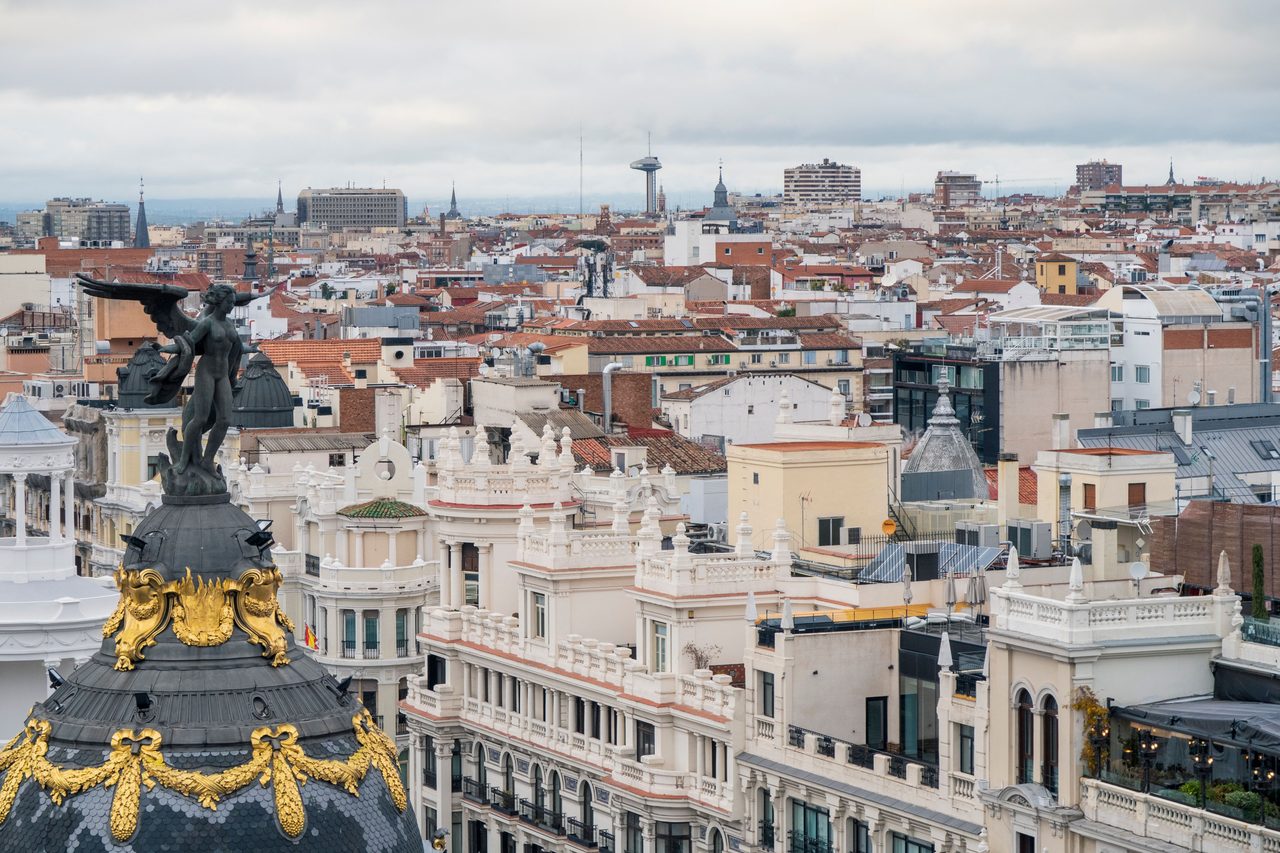
Madrid · 27 Places · Best April–June, September–October
Madrid
Madrid is Spain's vibrant capital and largest city, a metropolis of world-class art museums, grand boulevards, lively plazas, and an electric nightlife that never sleeps. As the Autonomous Community of Madrid, the region combines the cosmopolitan energy of the city with green sierra mountains, historic royal towns, and charming villages within easy reach.
Madrid sits at the geographic heart of the Iberian Peninsula at an elevation of 667 metres, making it the highest capital city in the European Union. The city is home to the famed 'Golden Triangle of Art' — the Prado, Reina Sofía, and Thyssen-Bornemisza museums — alongside the magnificent Royal Palace and countless plazas brimming with café culture. Beyond the city limits, the Sierra de Guadarrama mountain range offers skiing in winter and hiking in summer, while historic towns such as Alcalá de Henares and Aranjuez add layers of royal and literary heritage.
The 27 destinations our editors recommend — from iconic landmarks to under-the-radar finds.
Prado Museum (Museo del Prado)
One of the world's greatest art museums, housing over 8,000 paintings including masterpieces by Velázquez, Goya, El Greco, and Rubens. The collection spans from the 12th to the early 20th century and is considered the finest collection of European art anywhere on earth.
Royal Palace of Madrid (Palacio Real)
The official residence of the Spanish royal family and the largest functioning royal palace in Western Europe, with 3,418 lavishly decorated rooms. Highlights include the Royal Armoury, Throne Room, and the ceiling frescoes by Tiepolo.
Reina Sofía Museum (Museo Reina Sofía)
Spain's national museum of 20th-century art, most famous for housing Picasso's monumental anti-war painting Guernica. The museum also features major works by Salvador Dalí, Joan Miró, and Juan Gris in a converted 18th-century hospital building.
Retiro Park (Parque del Buen Retiro)
A stunning 125-hectare royal park that is the green lung of Madrid, featuring a rowing lake, the Crystal Palace, rose garden, outdoor sculptures, and street performers. Listed as a UNESCO World Heritage Site, it is the city's most beloved outdoor space.
Thyssen-Bornemisza Museum
The third pillar of Madrid's Golden Triangle of Art, showcasing a comprehensive sweep of Western art from the 13th to the late 20th century. The collection covers Impressionism, Expressionism, Cubism, and Pop Art with works by Monet, Renoir, Degas, and Hopper.
Puerta del Sol
Madrid's central square and official kilometre zero of Spain's radial road network, surrounded by historic buildings including the clock tower whose bells mark the Spanish New Year. The square is the pulsing heart of the city and a prime spot to watch city life.
Recommended itineraries
Pick a length, follow the route. Each itinerary balances headline sights with breathing room.
5-Day Madrid Explorer
Day 1Arrive in Madrid, explore city center
Day 2Visit top attractions and museums
Day 3Day trip to nearby highlights
Day 4Local markets and hidden gems
Day 5Final sightseeing, departure
7-Day Classic Madrid
Days 1-2Madrid city highlights
Days 3-4Regional exploration
Days 5-6Cultural immersion and local experiences
Day 7Return and departure
14-Day Ultimate Madrid
Days 1-3Madrid comprehensive city tour
Days 4-6Northern region exploration
Days 7-9Eastern highlights
Days 10-12Southern attractions
Days 13-14Return to Madrid, departure
Where to stay in Madrid
Three tiers, every traveller covered — from cost-conscious to flagship hotels.
Budget $55
Hostels, budget hotels, and guesthouses offer affordable stays without sacrificing experience.
Mid-range $130
Boutique hotels and well-located accommodations provide comfort and convenience at reasonable prices.
Luxury $350
World-class resorts and premium hotels deliver unforgettable experiences.
Mandarin Oriental Ritz, Madrid
Paseo del Prado · €400–€900/night (~$440–$990 USD)
Cafés, neighbourhood gems, and tasting menus worth the table reservation.
Sobrino de Botín
Traditional Castilian · €40–€60/person (~$44–$66 USD)
Operating since 1725 and recognized by Guinness World Records as the oldest restaurant in continuous operation, this is Castilian roasting at its most traditional. The kitchen still uses its original wood-fired oven to cook whole suckling pig and lamb, and the multi-level dining rooms with tiled walls and wooden beams feel unchanged by time.
Chef Dabiz Muñoz's three-Michelin-star restaurant treats dinner as a theatrical, multi-hour tasting menu that fuses Spanish technique with Asian flavors and playful, often provocative presentation. The dining room is small, dark, and design-forward, built around the idea that each course is a performance piece rather than a plate of food.
Casa Lucio
Castilian · €35–€55/person (~$38.50–$60.50 USD)
A Cava Baja institution since the 1970s, known for straightforward Castilian grilling and stewing rather than flourish. It's famous for having hosted Spanish royalty and celebrities, and the dining rooms keep a plain, old-Madrid tavern look with wood tables and tiled floors.
La Bola Taberna
Castilian · €25–€45/person (~$27.50–$49.50 USD)
A 19th-century tavern near Plaza de España that has built its entire reputation on one dish, cooked the old way: individual clay pots of cocido madrileño simmered slowly over coals. The narrow dining rooms, with their dark wood and old tiling, look much as they would have generations ago.
Madrid has one of Europe's most efficient and comprehensive public transport networks, centred on a modern 13-line metro system that connects the city and its airport. The EMT bus network fills any metro gaps, while Cercanías suburban trains link the capital to towns across the Community of Madrid. The city centre is flat and very walkable.
Metro
13 lines and 302 stations covering the entire city including Barajas airport (Line 8). Runs 06:00–01:30 daily; 24-hour service on Fridays and Saturdays. Single ticket €1.50–€2 (zone-based); 10-trip Tarjeta Multi card €12.20 (Zones A)
Cost: €1.50–€3
EMT City Bus
Extensive EMT network of over 200 bus lines covering areas not served by metro; night buses (Búho) run 23:30–06:00. Same ticket as metro can be used
Cost: €1.50 single
Cercanías (Suburban Rail)
RENFE commuter rail network (10 lines) connecting Madrid city with satellite towns including Alcalá de Henares, Aranjuez, El Escorial, and Alcobendas. Integrated ticketing with metro in Zone A; very punctual
Cost: €1.70–€7
BiciMAD Electric Bikes
Public electric bike-sharing scheme with 260 stations and 2,600 electric bikes across the city. Excellent for flat central Madrid and the Madrid Río cycle path. App required; €2/hour or annual subscription
Cost: €2/hour
Taxi
White Mercedes taxis are plentiful and legally required to use taximeters. Flagfall €2.40, then €1.05–€1.20/km. Legal taxis are safe; avoid unofficial 'pirate taxis' especially at airports
Cost: €8–€20 city fare
Uber / Cabify / FreeNow
All three ride-hailing apps operate in Madrid; Cabify is the most widely used local option. Prices comparable to taxis; useful for advance booking and cashless payment
Cost: €8–€25
Intercity Bus (ALSA / Avanza)
Long-distance buses from Estación Sur de Autobuses (Méndez Álvaro) and Moncloa interchange to destinations across Spain. Often cheaper than train but slower
Cost: €5–€40 depending on destination
Budget breakdown
Daily spend by tier in EUR, broken out by category.
Category
Budget
Mid-range
Luxury
Accommodation
$20
$80
$200
Food (per day)
$15
$35
$100
Transportation
$5
$10
$30
Activities
$15
$25
$60
Daily total
$55
$130
$350
Best time to visit Madrid
Weather through the year in Spain
Best timeShoulderWorth avoiding
Average daytime temperature in °C. Figures are for Spain.
Essential travel tips
Lunch is the main meal — look for the 'Menú del Día' (set lunch €10–€15)
Dinner is rarely before 9 PM in Madrid; kitchens stay open late
Buy a 10-trip metro card (Tarjeta Multi) for the best value
Many museums offer free entry on Sunday afternoons
Madrid is very walkable between Prado, Retiro, and Sol
Hidden gems
Off-the-beaten-path corners most travellers miss.
Mirador del Cerro del Tío Pío (Parque de las Siete Tetas, Vallecas
locals' secret)
Faro de Moncloa observation deck (€3, almost always empty)
Terraza del Círculo de Bellas Artes (€4, spectacular 360-degree views)
Bodega de la Ardosa (1892 taberna, Malasaña)
La Venencia (1929 sherry bar, Huertas)
El Capricho Park (18th-century garden, weekends only)
Tabacalera Cultural Centre (free contemporary art, Lavapiés weekends)
Skip: overpriced restaurants on Plaza Mayor terrace. Do instead: Casa Revuelta (3 min walk) for €7 bacalao
Skip: Hop-on hop-off tourist bus. Do instead: Free Sandeman's walking tour from Sol at 10:00
Skip: Hard Rock Café on Gran Vía. Do instead: Yakitoro by Chicote (Spanish-Japanese tapas)
Royal Palace from Jardines de Sabatini (08:00
09:00)
Templo de Debod area at dawn
Retiro Park before 09:00
completely empty and magical
Templo de Debod
the classic Madrid sunset
Azotea del Círculo de Bellas Artes
€4 rooftop access
Mirador del Cerro del Tío Pío
locals only, spectacular
Safety information
INFO
Keep bags in front of you in crowded tourist areas
INFO
Use only licensed taxis or reputable apps (Uber, Cabify, FreeNow)
INFO
Be wary of the 'rose scam' and shell games near major monuments
INFO
Store passports and valuables in your hotel safe
INFO
Emergency number 112 works across Spain
Frequently asked questions
Is Madrid safe to visit in 2026?
Madrid is one of Western Europe's safer capital cities with a low rate of violent crime against tourists. The main risks are petty theft and opportunistic pickpocketing in crowded tourist areas, which are easily mitigated with basic awareness. Emergency services: police at 091 (national police) or 112 (all emergencies), medical at 061 (medical emergencies) or 112 (all emergencies).
What is the best time to visit Madrid?
The best time to visit Madrid is April–June, September–October. Madrid has a semi-arid continental climate (Köppen BSk) characterised by hot, dry summers and cold winters, with very low rainfall year-round. The city sits at 667 metres altitude at the geographic he
Do I need a visa to visit Madrid?
Entry requirements follow Spain/EU Schengen rules. EU citizens enter freely; most Western nationals receive 90-day visa-free access. A European Travel Information and Authorisation System (ETIAS) is expected to be required for non-EU visa-exempt visitors. Requirements vary by nationality, so check with your nearest embassy or the official immigration website before traveling.
What currency is used in Madrid?
The currency in Madrid is the Euro (EUR). ATMs are widely available in cities and tourist areas. Credit cards are accepted at most hotels and restaurants, but carry cash for markets and smaller establishments.
What language is spoken in Madrid?
The main language(s) spoken in Madrid: Spanish (Castilian). In tourist areas, English is generally understood. Learning a few basic phrases in the local language is appreciated by locals.
What are the top attractions in Madrid?
The top attractions in Madrid include Prado Museum (Museo del Prado), Royal Palace of Madrid (Palacio Real), Reina Sofía Museum (Museo Reina Sofía), Retiro Park (Parque del Buen Retiro), and Thyssen-Bornemisza Museum. Each offers a unique experience, from historic landmarks to natural wonders.
Explore Madrid by city
The cities below have their own guides — hotels, attractions and where to eat, in depth.