
Open Travel Guide
Grand Est

Grand Est · 25 Places · Best May–June and September–October

Grand Est

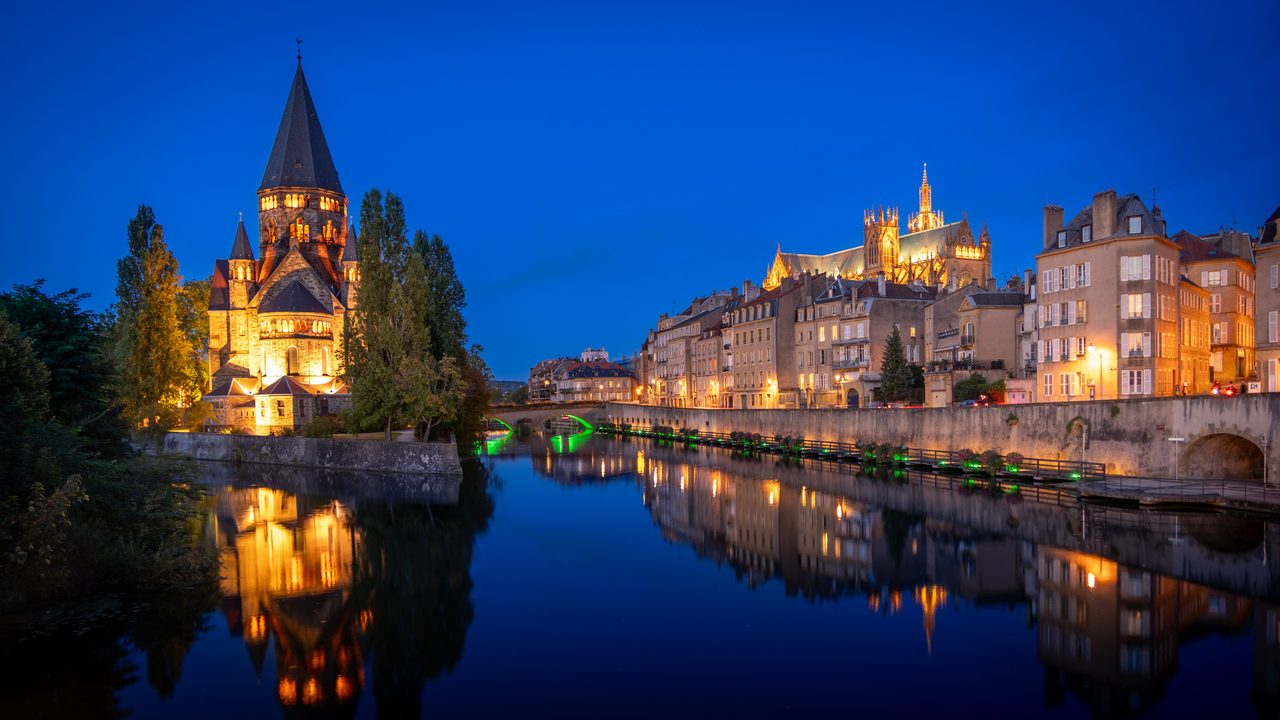
Grand Est is a vast northeastern French region created in 2016 from the historic provinces of Alsace, Champagne-Ardenne, and Lorraine. Bordered by Germany, Luxembourg, Switzerland, and Belgium, it is a crossroads of European culture, language, and cuisine. Strasbourg, the regional capital, hosts the European Parliament and flaunts one of Europe's finest Gothic cathedrals. Reims preserves the coronation church of French kings and the prestige champagne cellars of the world-famous Champagne region. In between, Colmar's half-timbered lanes, the vine-draped Alsace Wine Route, the Vosges mountain forests, and the solemn WWI battlefields of Verdun create an unrivalled diversity of experiences within a single region.

Capital
Strasbourg
Currency
Euro
Language
French
Time zone
Europe/Paris (CET/CEST, UTC+1/+2)
Best time
May–June and September–October
Places
25 curated
On this page

About Grand Est

Grand Est spans from the Rhine valley vineyards and Alsatian villages in the east across the plateau of Lorraine and the chalk plains of Champagne in the west. Strasbourg — home to the European Parliament — is a cultural and gastronomic capital. Reims anchors the world-famous Champagne wine district. Nancy is renowned for the jewel-like Place Stanislas. The Vosges mountains offer skiing, hiking, and spa resorts. Verdun's battlefield memorials stand as a permanent reminder of WWI's devastation. Medieval hilltop castles, preserved wine-route villages, a dense network of bike paths, and three distinct regional cuisines make Grand Est one of France's most rewarding long-stay destinations.

Capital
Strasbourg
Largest city
Strasbourg
Population
5.56 million
Languages
French, Alsatian dialect, Lorrain dialect
Currency
Euro
Time zone
Europe/Paris (CET/CEST, UTC+1/+2)

Explore Grand Est by topic

Jump straight to the experience you're planning.

Best places to visit in Grand Est

The 25 destinations our editors recommend — from iconic landmarks to under-the-radar finds.

Strasbourg Cathedral (Notre-Dame de Strasbourg)

Built mostly between the 12th and 15th centuries, the cathedral's single spire made it the tallest building in the world for over two centuries after its completion in 1439 (the second tower was never added). The pink Vosges sandstone facade is covered in tiers of statuary, and inside, the 16th-century astronomical clock draws a crowd each day for its mechanical procession of the Apostles.

Petite France District

This former tanners', millers' and fishermen's quarter sits where the River Ill splits into four channels on the edge of Strasbourg's old town. The half-timbered houses, many with steep roofs pierced by drying lofts once used for hides, line narrow canals and small footbridges, and the area is the most photographed part of the city for that reason.

Reims Cathedral (Notre-Dame de Reims)

This is the cathedral where French kings were crowned for centuries, from Clovis's baptism site tradition through Charles VII's coronation with Joan of Arc present in 1429. Heavily shelled in the First World War, it was restored over subsequent decades, and its west facade still carries an unusually dense program of Gothic statuary, including the well-known smiling angel.

Taittinger Champagne Cellars

Taittinger's cellars in Reims are dug through former Roman chalk quarries and the crypt of the ruined Abbey of Saint-Nicaise, giving the tour a genuinely different setting from a standard production facility. Guides walk visitors through the chalk galleries where bottles age on their lees before the tour ends with a seated tasting.

Colmar Old Town & Petite Venise

Colmar's old town escaped the wartime destruction that hit Strasbourg and Reims, so its half-timbered Alsatian houses, many dating to the 15th–17th centuries, survive largely intact along streets like the rue des Marchands. Petite Venise, the old tanners' and fishermen's district along the Lauch river, is the most-photographed corner, with houses built right to the water's edge.

Haut-Kœnigsbourg Castle

Perched above the Alsace plain at over 700 metres, this medieval fortress was ruined by the 17th century and then rebuilt from 1900 to 1908 on the orders of Kaiser Wilhelm II, who wanted a showpiece of German imperial history in newly annexed Alsace. The result is one of the most complete-looking medieval castles in France, though the interiors and much of the fortification reflect early-20th-century restoration choices as much as the Middle Ages.

Recommended itineraries

Pick a length, follow the route. Each itinerary balances headline sights with breathing room.

5-Day Grand Est Explorer

  • Day 1Arrive in Grand Est, explore city center
  • Day 2Visit top attractions and museums
  • Day 3Day trip to nearby highlights
  • Day 4Local markets and hidden gems
  • Day 5Final sightseeing, departure

7-Day Classic Grand Est

  • Days 1-2Grand Est city highlights
  • Days 3-4Regional exploration
  • Days 5-6Cultural immersion and local experiences
  • Day 7Return and departure

14-Day Ultimate Grand Est

  • Days 1-3Grand Est comprehensive city tour
  • Days 4-6Northern region exploration
  • Days 7-9Eastern highlights
  • Days 10-12Southern attractions
  • Days 13-14Return to Grand Est, departure

Where to stay in Grand Est

Three tiers, every traveller covered — from cost-conscious to flagship hotels.

Budget €60

Hostels, budget hotels, and guesthouses offer affordable stays without sacrificing experience.

Mid-range €150

Boutique hotels and well-located accommodations provide comfort and convenience at reasonable prices.

Luxury €380

World-class resorts and premium hotels deliver unforgettable experiences.

Where to eat in Grand Est

Cafés, neighbourhood gems, and tasting menus worth the table reservation.

Auberge de l'Ill

Alsatian haute cuisine · €€€€€ — menus €130–€250 (~$143–$275) per person

Run by the Haeberlin family for generations, this restaurant sits directly on the banks of the Ill river near Colmar, with willows and a garden visible from the dining room. The cooking is classic French haute cuisine built on Alsatian ingredients, refined rather than rustic, and the kitchen has carried Michelin recognition since the 1960s. The dining room is formal, with river views and service built around set tasting menus rather than casual à la carte ordering.

L'Assiette Champenoise

French haute cuisine · €€€€€ — menus €165–€300 (~$182–$330) per person

Chef Arnaud Lallement's restaurant occupies a 19th-century manor set in its own park just outside Reims, pairing formal French haute cuisine with a Champagne list drawn from the surrounding vineyards. The cooking is precise and ingredient-driven, built around tasting menus rather than an à la carte format, and the multi-starred kitchen has made this a destination beyond the city itself. The dining room matches the setting - manor-house formal, not a casual bistro.

Au Crocodile

Contemporary Alsatian · €€€€ — menus €85–€160 (~$93–$176) per person

One of Strasbourg's historic dining rooms, named for a stuffed crocodile brought back from Napoleon's Egyptian campaign by a local general and displayed inside. The kitchen serves contemporary Alsatian cooking that moves beyond the standard choucroute-and-flammekueche repertoire, reworking foie gras and Rhine fish in lighter, more composed plates. The room keeps a formal, old-Strasbourg character rather than a winstub feel.

Buerehiesel

Modern Alsatian · €€€€ — menus €80–€150 (~$88–$165) per person

Housed in a genuine 18th-century Alsatian farmhouse relocated into the Parc de l'Orangerie, its half-timbered structure sets it apart from Strasbourg's city-center dining rooms. The cooking is modern Alsatian, built on regional ingredients like Rhine fish and foie gras but plated with a lighter, more contemporary hand than a traditional winstub. Service is formal, in keeping with its Michelin pedigree.

Le Tire-Bouchon (Winstub)

Traditional Alsatian · €€ — mains €14–€22 (~$15–$24)

Winstub Zum Strissel

Traditional Alsatian · €€ — mains €13–€20 (~$14–$22)

Book a food tour in Grand Est We may earn a commission from bookings made through this link.

Getting around Grand Est

Grand Est has excellent rail infrastructure as France's gateway to Germany, Luxembourg, and Switzerland. The TGV LGV Est line (Paris Gare de l'Est to Strasbourg in 1h45) is the backbone of long-distance travel. TER regional trains connect all major towns. A car is strongly recommended for exploring the Alsace Wine Route, Vosges roads, and Champagne vineyard routes.

Budget breakdown

Daily spend by tier in EUR, broken out by category.

Category Budget Mid-range Luxury
Accommodation €30 €90 €250
Food (per day) €18 €40 €100
Transportation €8 €12 €20
Activities €4 €18 €40
Daily total €60 €150 €380

Best time to visit Grand Est

Weather through the year in France

5° JAN 6° FEB 10° MAR 14° APR 18° MAY 22° JUN 25° JUL 25° AUG 21° SEP 15° OCT 10° NOV 6° DEC

Best time Shoulder Worth avoiding

Average daytime temperature in °C. Figures are for France.

Essential travel tips

  • Buy a Strasbourg Pass (€18.50 / ~$20) for free museum entry and tram access
  • Book champagne cellar tours in Reims at least a week ahead in high season
  • Rent a bicycle in Strasbourg — the flat city and Rhine paths are superb for cycling
  • Tarte flambée evenings (winstubs) typically start at 18:00; no reservation needed at traditional spots

Hidden gems

Off-the-beaten-path corners most travellers miss.

Eguisheim

Concentric medieval village ringed by three ruined towers — voted France's Favourite Village; dramatically uncrowded compared to Riquewihr

Haut-Rhin, near Colmar

Kaysersberg

Albert Schweitzer's birthplace — fortified medieval bridge over the Weiss river, Renaissance fountain, and excellent winstubs with local Riesling

Haut-Rhin, Alsace Wine Route

Wissembourg

Northernmost Alsatian town, pressed against the German border, with a grand 14th-century abbey church and preserved medieval lanes almost entirely free of tourist crowds

Bas-Rhin

Rouffach

Underrated wine village with twin Romanesque towers and the prestigious Théâtre de Haute Alsace; grand cru Clos Saint-Landelin wines available direct from producers

Haut-Rhin, Wine Route

Safety information

INFO

Keep bags and cameras close in Strasbourg Christmas market crowds — pickpocketing increases when it is densely crowded

INFO

Do not walk on unpaved ground at Verdun battlefield sites — unexploded ordnance still exists; stay on marked trails

INFO

In the Vosges mountains, register hiking plans with the refuge or hotel reception and check bison-futé.gouv.fr for road conditions

INFO

Keep a photocopy of passport/ID separate from the original

INFO

Emergency: dial 112 from any phone — English-speaking operators are available

INFO

In Strasbourg's Elsau neighbourhood at night, exercise standard big-city caution

Frequently asked questions

Is Grand Est safe to visit in 2026?

Grand Est is one of France's safer regions for tourists. Violent crime is rare. Petty theft occurs at Strasbourg Christmas markets and in busy pedestrian areas. Road safety requires care on mountain passes in winter. Verdun battlefields have safety notices about unexploded ordnance — stay on marked paths.

What is the best time to visit Grand Est?

May to June and September to October are the most rewarding months. Vineyards are lush in spring and golden in autumn harvest season. December is spectacular for Christmas markets but very crowded. July and August are warm and busy; July is peak season. Winter skiing in the Vosges runs January to March.

Do I need a visa to visit Grand Est?

France is part of the Schengen Area. EU/EEA citizens enter with a national ID card. US, Canadian, Australian, and UK citizens can stay up to 90 days without a visa. Other nationalities should check requirements at france-visas.gouv.fr before travelling.

What currency is used in Grand Est?

The Euro (EUR) is the currency. ATMs (DAB/distributeur) are widely available in cities and larger towns. Credit cards are accepted nearly everywhere, but carry some cash for village markets, rural winstubs, and smaller cafés.

How do I get from Paris to Strasbourg?

TGV trains run Paris Gare de l'Est to Strasbourg in about 1 hour 45 minutes. Tickets cost €25–€80 depending on booking lead time. Book via sncf-connect.com. Reims is only 45 minutes from Paris by TGV.

What are the top attractions in Grand Est?

Top attractions include Strasbourg Cathedral, the Alsace Wine Route, Colmar old town, Reims Cathedral, champagne cellar tours in Reims and Épernay, Haut-Kœnigsbourg Castle, Place Stanislas in Nancy, and the Verdun WWI battlefield memorials.