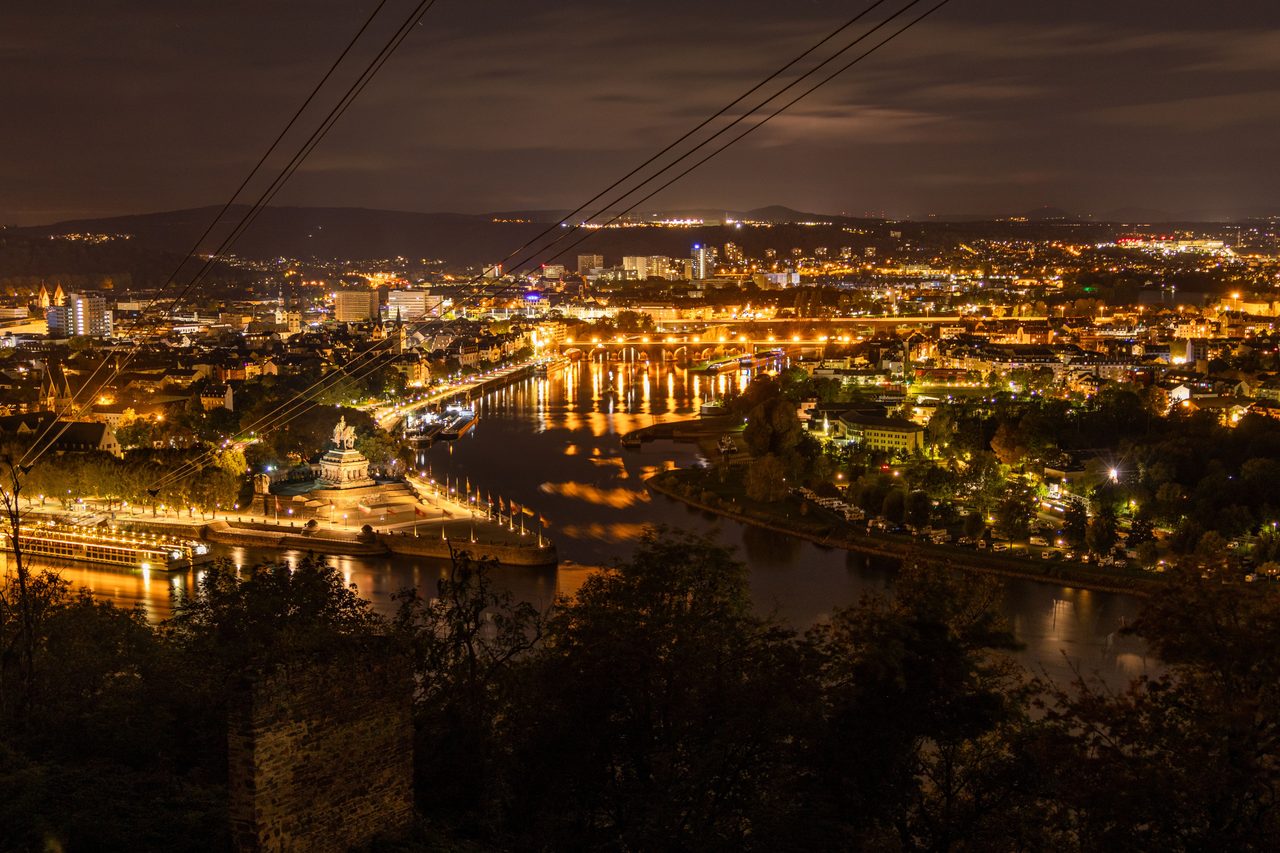
Rhineland-Palatinate · 24 Places · Best May-June and September-October
Rhineland-Palatinate
Rhineland-Palatinate is a state in western Germany defined by the Rhine, Moselle, and Nahe rivers, rolling vineyard hills, and dense forests. It is home to the Rhine Gorge and the legendary Loreley rock, Germany's oldest city Trier with its Roman Porta Nigra, the romantic hilltop castle Burg Eltz, and the Romanesque Speyer Cathedral, a UNESCO World Heritage Site. The state is also Germany's wine heartland, crossed by the historic Deutsche Weinstrasse (German Wine Route) through the Palatinate Forest.
Rhineland-Palatinate stretches from the Rhine Gorge in the north, past the Moselle Valley's terraced vineyards, down through the Palatinate Forest and Deutsche Weinstrasse to the French border in the south. The state contains the Upper Middle Rhine Valley, a UNESCO World Heritage cultural landscape of castles, terraced vineyards, and the Loreley rock, along with Germany's oldest city, Trier, founded by the Romans and home to the Porta Nigra and an amphitheatre. Elsewhere, the fairy-tale silhouette of Burg Eltz rises from its forest, the Romanesque cathedrals of Speyer and Worms recall the medieval Holy Roman Empire, and the Palatinate wine country produces some of Germany's best Riesling. Mainz, the capital on the Rhine, combines a working state government with a lively student population, Gutenberg heritage, and a well-preserved old town.
The 24 destinations our editors recommend — from iconic landmarks to under-the-radar finds.
Porta Nigra
The best-preserved Roman city gate north of the Alps, built around 170 AD from massive dark sandstone blocks to guard the northern entrance to Augusta Treverorum, the Roman forerunner of Trier. Part of the UNESCO-listed Roman Monuments, Cathedral of St. Peter and Church of Our Lady in Trier, the gate can be climbed for views over the old town.
Trier Cathedral (Hohe Domkirche St. Peter)
Germany's oldest cathedral, with a core dating to a 4th-century Roman audience hall converted into a church under Emperor Constantine. The Romanesque-Gothic building forms part of the UNESCO-listed Roman Monuments of Trier and stands beside the Liebfrauenkirche, one of Germany's earliest Gothic churches, with a shared cloister connecting the two.
Kaiserthermen (Imperial Roman Baths)
The ruins of one of the largest Roman bath complexes outside Rome, begun around 300 AD under Constantine as a monumental imperial bathhouse for Augusta Treverorum. Visitors can descend into the surviving service tunnels and underfloor heating chambers beneath the towering brick walls. The site is part of the UNESCO-listed Roman Monuments of Trier.
Trier Amphitheater
A Roman amphitheater built around 100 AD into the slope of the Petrisberg hill, once seating up to 20,000 spectators for gladiatorial games. Underground chambers beneath the arena floor, used to hold animals and equipment, are open to visitors. It is part of the UNESCO-listed Roman Monuments of Trier.
Burg Eltz
A medieval castle owned by the same family for more than 800 years, rising on a rock spur above the Elzbach valley between the Moselle and Rhine. Unlike most Rhineland castles, Burg Eltz was never destroyed and preserves an authentic medieval interior, including the armory and treasury, viewable on a guided tour.
Marksburg
The only hilltop castle on the Middle Rhine never destroyed or rebuilt, standing 150 meters above the town of Braubach. Its intact medieval fortifications, kitchen, and knights' hall make it a benchmark for the region's original castle architecture, and it is part of the UNESCO-listed Upper Middle Rhine Valley.
Recommended itineraries
Pick a length, follow the route. Each itinerary balances headline sights with breathing room.
5-Day Rhineland-Palatinate Explorer
Day 1Arrive in Rhineland-Palatinate, explore city center
Day 2Visit top attractions and museums
Day 3Day trip to nearby highlights
Day 4Local markets and hidden gems
Day 5Final sightseeing, departure
7-Day Classic Rhineland-Palatinate
Days 1-2Rhineland-Palatinate city highlights
Days 3-4Regional exploration
Days 5-6Cultural immersion and local experiences
Day 7Return and departure
14-Day Ultimate Rhineland-Palatinate
Days 1-3Rhineland-Palatinate comprehensive city tour
Days 4-6Northern region exploration
Days 7-9Eastern highlights
Days 10-12Southern attractions
Days 13-14Return to Rhineland-Palatinate, departure
Where to stay in Rhineland-Palatinate
Three tiers, every traveller covered — from cost-conscious to flagship hotels.
Budget €60 ($70)
Hostels, budget hotels, and guesthouses offer affordable stays without sacrificing experience.
Mid-range €145 ($168)
Boutique hotels and well-located accommodations provide comfort and convenience at reasonable prices.
Luxury €400+ ($464+)
World-class resorts and premium hotels deliver unforgettable experiences.
Hyatt Regency Mainz
Mainz - Rhine riverfront · $$$
Hyatt Regency Mainz sits directly on the Rhine promenade near the old town, offering a five-star base with river-view rooms, a rooftop restaurant, and easy walking access to Mainz Cathedral and the Gutenberg Museum.
A 4.5-star spa hotel beside Bad Ems's Kurpark and the Lahn river, Häcker's Grand Hotel offers thermal spa facilities, an indoor pool, and 106 rooms within a historic spa-town setting once favored by European royalty.
Set in a restored 19th-century wine estate on the Moselle riverbank in Mülheim, Weinromantikhotel Richtershof pairs a full-service spa with tastings from its own vineyard, drawing travelers focused on the region's steep-slope Riesling country.
Moselschlösschen Spa & Resort occupies a riverside setting in Traben-Trarbach, with an extensive wellness area, indoor pool, sauna landscape, and yoga classes overlooking the Moselle and its terraced vineyards.
A one-Michelin-star restaurant inside the Favorite Parkhotel overlooking Mainz's Stadtpark, serving a creative blend of Mediterranean and French technique with regional, seasonal produce in a refined, contemporary dining room.
Geberts Weinstuben
Rheinhessen regional · $$
A family-run wine tavern on Frauenlobstrasse near the Rhine, in the same family's hands since 1887 and recognized with a Michelin Bib Gourmand for honest regional cooking paired with an extensive Rheinhessen wine list.
Weinstube Rote Kopf
Mainz - Rhenish tavern classics · $
A cozy wine tavern tucked into an alley in Mainz's Altstadt, pouring around 50 wines by the glass alongside Spundekäs, Handkäs and other Rhenish tavern classics in a wood-paneled, convivial room.
Steins Traube
Farm-to-table classic, Michelin-starred · $$$$
A one-Michelin-star restaurant on Poststrasse that grew from an early-20th-century village tavern into a sophisticated, farm-to-table dining room run by the Stein family, sourcing closely from regional producers.
Wirtshaus Zur Glocke
Trier - traditional German · $$
A Trier institution in continuous operation since 1803, serving hearty traditional German dishes in a historic dining room near the Hauptmarkt, popular with locals for its long-standing recipes and unpretentious atmosphere.
Beckers Weinhaus
Trier - contemporary country house cuisine · $$$
A wood-panelled Weinhaus with a vaulted cellar in the Olewig wine village on Trier's edge, serving contemporary country-house cooking paired with the estate's own Moselle Rieslings.
Rhineland-Palatinate is a landlocked state threaded by the Rhine and Moselle rivers, and getting around means combining Deutsche Bahn regional trains along the river valleys with a rental car for the vineyard villages and forest hill country that the railways bypass. Mainz, Koblenz, Trier, Kaiserslautern and Ludwigshafen are the main rail hubs, while Frankfurt-Hahn Airport, though named for Frankfurt, sits within the state's own Hunsrück district. Seasonal KD Line river cruises along the Rhine Gorge and the Moselle add a scenic, unhurried alternative to the train for towns like Bacharach, St. Goar, Boppard and Cochem.
Budget breakdown
Daily spend by tier in EUR, broken out by category.
Category
Budget
Mid-range
Luxury
Accommodation
€28 ($32)
€80 ($93)
€250 ($290)
Food (per day)
€16 ($19)
€38 ($44)
€100 ($116)
Transportation
€10 ($12)
€15 ($17)
€30 ($35)
Activities
€6 ($7)
€12 ($14)
€20 ($23)
Daily total
€60 ($70)
€145 ($168)
€400+ ($464+)
Best time to visit Rhineland-Palatinate
Weather through the year in Rhineland-Palatinate
Best timeShoulderWorth avoiding
Average daytime temperature in °C. Figures are for Rhineland-Palatinate.
Spring brings blossoming vineyards and mild hiking weather along the Rhine and Moselle; autumn brings the wine harvest, the Wurstmarkt in Bad Durkheim, and colorful vineyard foliage. Winter is quiet and cold but Mainz and Trier host atmospheric Christmas markets.
Essential travel tips
Combine a Rhine Gorge river cruise with a stop in Boppard or St. Goar to see the Loreley up close
Book Burg Eltz guided tours in advance in summer, as visitor numbers are capped
Regional Deutsche Bahn day tickets can be shared by up to five people for group savings
Try Saumagen and Riesling wine at a Palatinate Forest winery restaurant
Hidden gems
Off-the-beaten-path corners most travellers miss.
Idar-Oberstein
Germany's gemstone capital, with gemstone mines, workshops, and the striking Felsenkirche church built into a cliff face
Birkenfeld district
Bad Durkheim
Home to the world's largest wine barrel and the Wurstmarkt, one of the largest wine festivals in the world
Bad Durkheim district, Palatinate
Hambach Castle
A hilltop castle above the vineyards known as the cradle of German democracy, site of the 1832 Hambach Festival
Neustadt an der Weinstrasse, Palatinate
Safety information
INFO
Rhineland-Palatinate is a very safe region; the main risk is petty theft and pickpocketing around crowded tourist spots such as Trier's Porta Nigra and Hauptmarkt, Rhine river cruise docks, and Mainz's Christmas markets
INFO
Steep vineyard paths and forest trails along the Rhine Gorge, Moselle Valley, and Palatinate Forest can be slippery after rain; wear sturdy footwear and take care on the terraced hillside footpaths above wine villages
INFO
Always validate regional Deutsche Bahn tickets before boarding where required (older paper tickets), and keep a Deutschlandticket or valid ticket ready for spot checks; travelling without a valid ticket brings an on-the-spot fine
INFO
Deutsche Bahn strikes (Streik) occur periodically; check bahn.de or the DB Navigator app for service disruptions before travelling between Mainz, Trier, and Koblenz
INFO
The Rhine and Moselle rivers have real currents and boat traffic; swim only in designated river-bathing areas, avoid swimming near locks, and never dive into unknown water near the Rhine Gorge
INFO
Summer crowds peak from June to September along the Rhine Gorge castle route, the Deutsche Weinstrasse, and during the Bad Durkheim Wurstmarkt; keep bags zipped and secure in packed regional trains and festival crowds
INFO
Sun exposure is significant on open vineyard terraces and via ferrata routes in the Palatinate Forest; carry water, wear sunscreen and a hat, and avoid strenuous hikes during the hottest midday hours in July and August
INFO
Wasps are common at outdoor wine festivals and beer gardens in late summer; keep sweet drinks and food covered and stay calm around them
Frequently asked questions
Do I need a visa to visit Rhineland-Palatinate?
Entry requirements follow Germany/Schengen rules. EU citizens need only a national ID card; non-EU visitors from many countries may stay visa-free for up to 90 days; others require a Schengen visa. Requirements vary by nationality, so check with the nearest embassy or the official immigration website before traveling.
What is the best way to see the Rhine Gorge?
The Rhine Gorge is best explored by a combination of Deutsche Bahn regional trains, which stop at towns like Boppard, St. Goar, and Bacharach, and seasonal KD river cruises that pass beneath the Loreley rock and the gorge's hilltop castles. Many travellers combine a train ride one way with a river cruise the other for the best views.
What food is Rhineland-Palatinate famous for?
Rhineland-Palatinate is best known for Saumagen, a stuffed pork stomach specialty from the Palatinate, alongside Riesling and other wines from the Rhine, Moselle, and Deutsche Weinstrasse regions. Other local dishes include Spundekas, a spiced curd cheese spread, and hearty regional stews served in Weinstuben (wine taverns).
What are the top attractions in Rhineland-Palatinate?
The top attractions in Rhineland-Palatinate include the Rhine Gorge and Loreley rock, the Roman Porta Nigra in Trier, the fairy-tale castle Burg Eltz, the UNESCO-listed Speyer Cathedral, and the Deutsche Weinstrasse wine route through the Palatinate Forest.