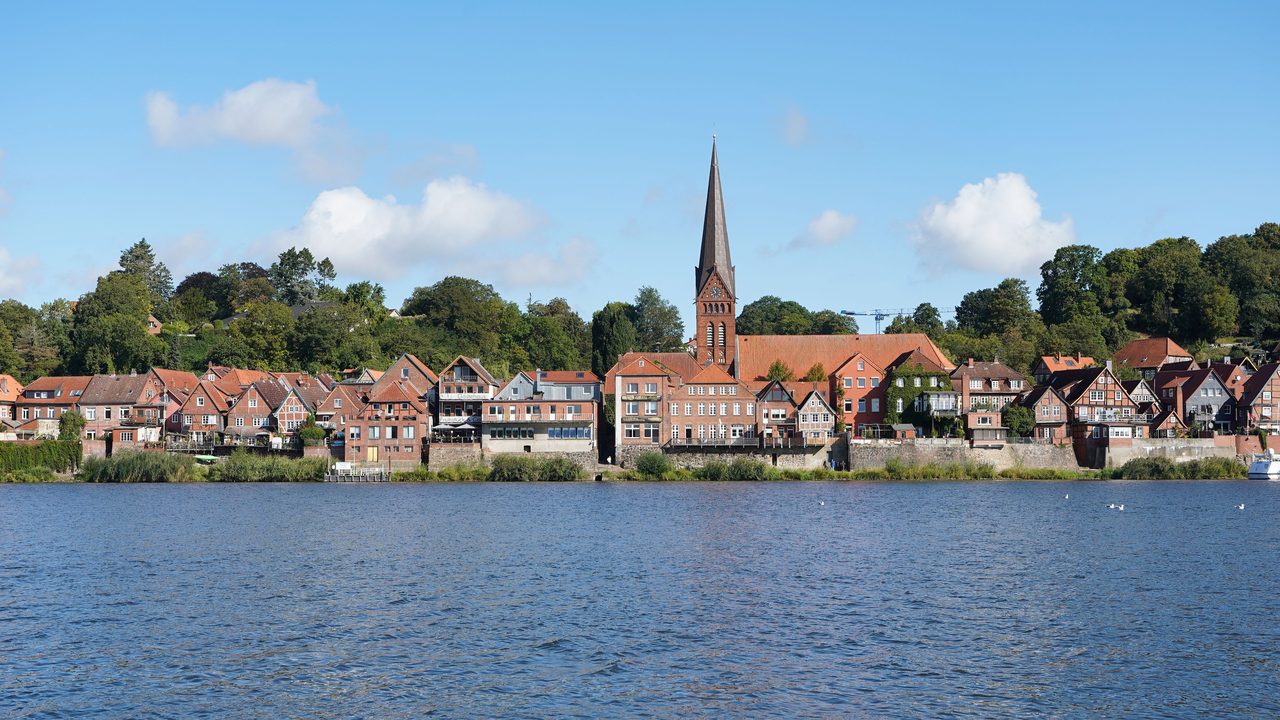
Schleswig-Holstein · 26 Places · Best May-June and September
Schleswig-Holstein
Schleswig-Holstein is Germany's northernmost federal state, a narrow peninsula wedged between the North Sea and the Baltic Sea, bordering Denmark. It combines windswept Wadden Sea islands like Sylt and Amrum, the historic Hanseatic port of Lubeck, the sailing capital Kiel, and the tranquil lake district of Holstein Switzerland. The state is defined by water on nearly every side, a mix of German, Danish, and North Frisian culture, and a laid-back maritime pace of life.
Schleswig-Holstein sits on the narrow neck of the Jutland peninsula, with the North Sea to the west and the Baltic Sea to the east, separated by the Kiel Canal (Nord-Ostsee-Kanal), one of the world's busiest artificial waterways. The North Frisian Islands, including Sylt, Fohr, and Amrum, rise from the UNESCO-listed Wadden Sea on the west coast, while the Baltic side offers sandy resort towns such as Timmendorfer Strand and Travemunde. Inland, the Holstein Switzerland region around Ploen and Eutin is dotted with glacial lakes and beech forests. The UNESCO World Heritage Old Town of Lubeck, the former Viking trading post of Haithabu near Schleswig, and Gottorf Castle add centuries of maritime and royal history, while Kiel's annual Kiel Week is the world's largest sailing event.
Capital
Kiel
Largest city
Kiel
Population
~2.96 million
Languages
German, Danish (regional minority language), North Frisian (regional minority language), Low German (Plattdeutsch)
The 26 destinations our editors recommend — from iconic landmarks to under-the-radar finds.
Holstentor
This twin-towered brick gate, completed in 1478, was one of the original fortified entrances to Lubeck and is the city's most recognizable symbol, appearing on the German 2-euro commemorative coin. The towers lean slightly inward, a result of the marshy ground they were built on settling unevenly over the centuries. Inside, the Lubeck city history museum occupies the gate's rooms and covers the city's Hanseatic League trading power.
European Hansemuseum
Opened in 2015 on a hill above the Trave that once held a Dominican monastery, this is the largest museum in Europe devoted to the Hanseatic League, the medieval merchant network that made Lubeck its unofficial capital. Reconstructed rooms, a counting house, and a merchant's warehouse trace how the League controlled trade routes across the Baltic and North Seas for roughly 300 years. The exhibits lean heavily on the Lubeck-specific angle, since the city's own archives and excavated artifacts supply much of the material.
Buddenbrookhaus
This townhouse belonged to Thomas Mann's grandparents and inspired the setting of his 1901 novel Buddenbrooks, the multi-generational saga of a declining Lubeck merchant family that won him the Nobel Prize in Literature. The museum blends the Mann family's own history with the fictional Buddenbrooks, using period rooms to illustrate scenes from the book alongside biographical material on Thomas and his brother Heinrich, also a novelist. It works best for visitors who have read or plan to read the novel, since much of the display assumes familiarity with its characters and plot.
Marienkirche (St. Mary's Church Lubeck)
Built mainly in the 13th and 14th centuries, this brick Gothic church served as the model for dozens of churches across the Baltic region and held the title of world's tallest brick vault until Allied bombing in 1942 destroyed the roof and brought the original bells crashing down. The shattered bells were left embedded in the stone floor of the south tower chapel as a permanent war memorial rather than being removed. The nave was rebuilt after the war and now holds a large astronomical clock, a modern replacement for one destroyed in the same raid.
Lubeck Old Town (Altstadt UNESCO Site)
The historic core sits on an island formed by the Trave river and the Elbe-Lubeck Canal, its street layout and brick Gothic architecture largely intact from Lubeck's peak as head of the Hanseatic League in the 14th and 15th centuries. UNESCO listed it as a World Heritage Site in 1987 specifically for this concentration of merchant houses, churches, and gabled facades built from the local red brick tradition. Allied bombing in 1942 destroyed roughly a fifth of the old town, and postwar rebuilding mixed reconstruction with some plainer infill, so the surviving medieval fabric is genuine but not wall-to-wall.
Museum Ship Passat
The Passat is a four-masted steel barque built in 1911 in Hamburg, one of the surviving 'Flying P-Liners' that carried nitrate and grain around Cape Horn under sail during the early 20th century. Permanently moored at Priwall since 1960, it now functions as a youth hostel as well as a museum, so visitors can walk the deck and below-deck crew quarters of a working commercial sailing ship from the last era before engines took over. The scale of the rigging is the main draw, since photographs of tall ships rarely convey how large the masts and yards actually are up close.
Recommended itineraries
Pick a length, follow the route. Each itinerary balances headline sights with breathing room.
5-Day Schleswig-Holstein Explorer
Day 1Arrive in Schleswig-Holstein, explore city center
Day 2Visit top attractions and museums
Day 3Day trip to nearby highlights
Day 4Local markets and hidden gems
Day 5Final sightseeing, departure
7-Day Classic Schleswig-Holstein
Days 1-2Schleswig-Holstein city highlights
Days 3-4Regional exploration
Days 5-6Cultural immersion and local experiences
Day 7Return and departure
14-Day Ultimate Schleswig-Holstein
Days 1-3Schleswig-Holstein comprehensive city tour
Days 4-6Northern region exploration
Days 7-9Eastern highlights
Days 10-12Southern attractions
Days 13-14Return to Schleswig-Holstein, departure
Where to stay in Schleswig-Holstein
Three tiers, every traveller covered — from cost-conscious to flagship hotels.
Budget €70
Hostels, budget hotels, and guesthouses offer affordable stays without sacrificing experience.
Mid-range €170
Boutique hotels and well-located accommodations provide comfort and convenience at reasonable prices.
Luxury €420+
World-class resorts and premium hotels deliver unforgettable experiences.
Radisson Blu Senator Hotel, Lubeck
Lubeck, on the Trave river opposite the Old Town · $$$
Cafés, neighbourhood gems, and tasting menus worth the table reservation.
Schiffergesellschaft
North German - maritime · $$
This is the former guild hall of Lübeck's sea captains, dating to 1535, and it still operates as a restaurant rather than a museum piece. The dining rooms are lined with dark carved wood, model ships hang from the ceiling beams, and guests sit at long communal tables shared with other parties. The kitchen sticks to the same North German staples the guild would have recognized, served in generous, unfussy portions.
Zum Alten Zolln
North German · $
A small, unpretentious dining room near the old town's western edge, built around a menu of straightforward North German cooking rather than any culinary reinvention. Portions run large and the pace is casual, with the kind of paper place mats and plain wooden furniture typical of a neighborhood institution rather than a destination restaurant.
Schabbelhaus
North German · $$$
Housed in a restored 16th-century merchant's house on Mengstrasse, this restaurant trades on Lübeck's patrician-era architecture as much as its food - think stucco ceilings, oil paintings and a formal dining room rather than a tavern feel. The menu takes classic North German dishes and plates them with more refinement and higher prices than the average Labskaus stop.
Cafe Niederegger Stammhaus
German - confectionery · $
The flagship café of Lübeck's marzipan maker, sitting directly across the Markt from the Rathaus. It's a proper sit-down confectionery café - marble-topped tables, cake counters, and a marzipan museum upstairs - built around pastries and coffee rather than savory meals.
Restaurant Wullenwever
Classic - Mediterranean accents · $$$$
A fine-dining restaurant set inside a restored 16th-century merchant house on Beckergrube, with vaulted rooms and a formal, quiet dining atmosphere. The kitchen works in a classic French-influenced register with Mediterranean touches, built entirely around multi-course tasting menus rather than an a la carte selection of small plates.
Schleswig-Holstein stretches between the North Sea and the Baltic Sea at the base of the Jutland peninsula, and getting around blends fast regional trains, an extensive rural bus network, and ferries to its North Frisian islands. Deutsche Bahn regional trains link Hamburg with Luebeck, Kiel, Flensburg, Husum, and Niebuell, while NAH.SH coordinates ticketing and bus connections into the countryside. Sylt is reached from the mainland by the Autozug/Sylt Shuttle car train from Niebuell (no public road links the island) or by passenger ferry to the smaller islands of Foehr and Amrum from Dagebuell. Kiel is a major ferry hub with overnight services to Oslo and Gothenburg. A rental car is the most flexible way to explore Holstein Switzerland's lakes and the rural coastline, though it is unnecessary in compact old towns like Luebeck and Flensburg.
Budget breakdown
Daily spend by tier in EUR, broken out by category.
Category
Budget
Mid-range
Luxury
Accommodation
€32
€95
€260
Food (per day)
€20
€42
€100
Transportation
€10
€16
€35
Activities
€8
€17
€25
Daily total
€70
€170
€420+
Best time to visit Schleswig-Holstein
Weather through the year in Schleswig-Holstein
Best timeShoulderWorth avoiding
Average daytime temperature in °C. Figures are for Schleswig-Holstein.
May-June and September for mild weather and fewer crowds
Essential travel tips
Buy a Schleswig-Holstein-Ticket for unlimited regional train and bus travel across the state in a single day
Book Sylt accommodation and the car train months ahead for July and August travel
Try Labskaus and fresh Kieler Sprotten (smoked sprats) at a harbourside fish stand
Pack layers and rain gear regardless of season, since coastal weather shifts quickly
Hidden gems
Off-the-beaten-path corners most travellers miss.
Petrikirche tower elevator platform over Luebeck's seven spires
Ploen Castle's Schlossberg terrace over the Grosser Ploener See
Rotes Kliff beacon platform above Kampen at golden hour
Hafen Moeltenort fishing harbor across the Kiel Fjord
from the city center
Friedrichstadt's Mittelburggraben canal loop
away from the main market square
Ellenbogen peninsula dunes
at the far northern tip of Sylt
Skip the crowded main Westerland beach in July and August
walk or cycle north toward Kampen's quieter dune sections instead
List harbor looking toward the Ellenbogen peninsula
Husum's Fischmarkt before the day boats return
Sansibar's dune terrace in Rantum, Sylt
Ploen Castle gardens over the Grosser Ploener See
Friedrichstadt's canal bridges lit by the low evening sun
Safety information
INFO
Schleswig-Holstein is a very safe region with low violent crime; the main risk is petty theft and pickpocketing in busy areas of Lubeck's old town, Kiel's ferry terminal, and Sylt's summer resorts
INFO
Strong tidal currents and quicksand-like mudflats affect the Wadden Sea (Wattenmeer); only walk out onto the mudflats (Wattwandern) with a certified local guide, since the tide returns quickly and fog can disorient walkers
INFO
Jellyfish and occasional strong rip currents occur along North Sea beaches such as Sankt Peter-Ording and Sylt; heed the colored flag system (green/yellow/red) at supervised beaches and swim only where lifeguards (DLRG) are present
INFO
Bicycle traffic is heavy in Kiel, Lubeck, and the flat coastal towns; look both ways for cyclists before crossing marked bike lanes, which are physically separated from the pavement
INFO
Weather on the North Sea coast changes quickly, with fog, wind, and sudden storms; check tide tables and forecasts before mudflat walks, cycling on exposed dikes, or sailing on the Kiel or Flensburg Fjords
INFO
Summer crowds peak during Kiel Week (late June) and on Sylt in July-August; pickpockets can work crowded ferry queues and festival areas, so keep bags zipped and worn across the body
INFO
Sun exposure is stronger than expected on open beaches and dikes due to reflection off water and sand; use sunscreen and a hat even on overcast days
INFO
Ticks (Zecken) are present in inland forests and the Holstein Switzerland lake district; check skin after hikes, as tick-borne encephalitis (TBE) risk exists in parts of northern Germany, though it is lower than in southern Germany
Frequently asked questions
Do I need a visa to visit Schleswig-Holstein?
Entry requirements follow Germany/Schengen rules. EU citizens need only a national ID card; non-EU visitors from many countries, including the US, Canada, and Australia, may stay visa-free for up to 90 days within a 180-day period; other nationalities require a Schengen visa arranged in advance. Requirements vary by nationality, so check with the nearest embassy or official immigration website before traveling.
What is the best way to reach Sylt and the North Frisian Islands?
Sylt is reached by the Sylt Shuttle car train from Niebull, which crosses the Hindenburgdamm causeway, or by direct regional trains from Hamburg and Kiel. Fohr and Amrum are reached by passenger ferry from Dagebull. Booking the car train or ferry in advance is recommended for July and August travel.
What food is Schleswig-Holstein known for?
Schleswig-Holstein is known for fresh North Sea and Baltic seafood, including Kieler Sprotten (smoked sprats), Labskaus (a corned beef, potato, and beetroot dish), and Fischbroetchen (fish sandwiches) sold at harbourside stands. Lubeck is also famous for its marzipan, produced by confectioners such as Niederegger since the 19th century.
Is it safe to walk on the Wadden Sea mudflats?
Independent mudflat walks are not recommended. Incoming tides on the Wadden Sea move quickly across the flat terrain and can cut off or strand walkers, and some areas contain soft, quicksand-like mud. Guided Wattwanderung tours with certified local guides who know the tide schedules and safe routes are the standard way to experience the tidal flats.
What are the top attractions in Schleswig-Holstein?
The top attractions in Schleswig-Holstein include Lubeck's UNESCO-listed Old Town, the island of Sylt, Gottorf Castle and the nearby Haithabu Viking museum in Schleswig, and Kiel Fjord, home to the annual Kiel Week sailing festival. Holstein Switzerland's lake district around Ploen and Eutin is a quieter inland alternative.