Thuringia (Thüringen) is a landlocked state at the geographic heart of Germany, often called the country's "Green Heart" for its dense forests and rolling hills. Home to Erfurt, Weimar, Jena, Gera, and Eisenach, Thuringia punches far above its size in cultural weight: it is the birthplace of the Reformation's Bible translation at Wartburg Castle, the cradle of German Classicism through Goethe and Schiller in Weimar, and the founding ground of the Bauhaus movement. Dense forests, half-timbered old towns, and a compact, affordable travel footprint make it one of central Germany's most rewarding regions to explore.
Thuringia is Germany's centermost federal state, a compact landscape of forested hills, medieval old towns, and outsized cultural history. Erfurt, the capital, retains one of Germany's best-preserved medieval city centers, anchored by the Krämerbrücke bridge lined with shops. Weimar, a short train ride away, was the intellectual heart of German Classicism, home to Goethe and Schiller, and later the founding city of the Bauhaus design movement. Eisenach's Wartburg Castle, where Martin Luther translated the New Testament into German, has been a UNESCO World Heritage Site since 1999. The Thuringian Forest (Thüringer Wald) offers extensive hiking and, in winter, cross-country skiing around Oberhof, while Jena blends historic optics industry heritage (Zeiss) with a lively university-town atmosphere. The state also carries heavier history at the Buchenwald Memorial near Weimar, a former Nazi concentration camp preserved as a site of remembrance.
The 24 destinations our editors recommend — from iconic landmarks to under-the-radar finds.
Wartburg Castle
This medieval hilltop castle above Eisenach is where Martin Luther, hiding under the alias 'Junker Jörg' after being outlawed by the Diet of Worms, translated the New Testament into German in just eleven weeks in 1521-22. The complex also hosted the medieval Sängerkrieg (Minstrels' Contest) that inspired Wagner's opera Tannhäuser, and its Romanesque great hall and Luther's preserved study room are the core of a visit. It is a UNESCO World Heritage Site, and the climb up from the town adds to the sense of arrival.
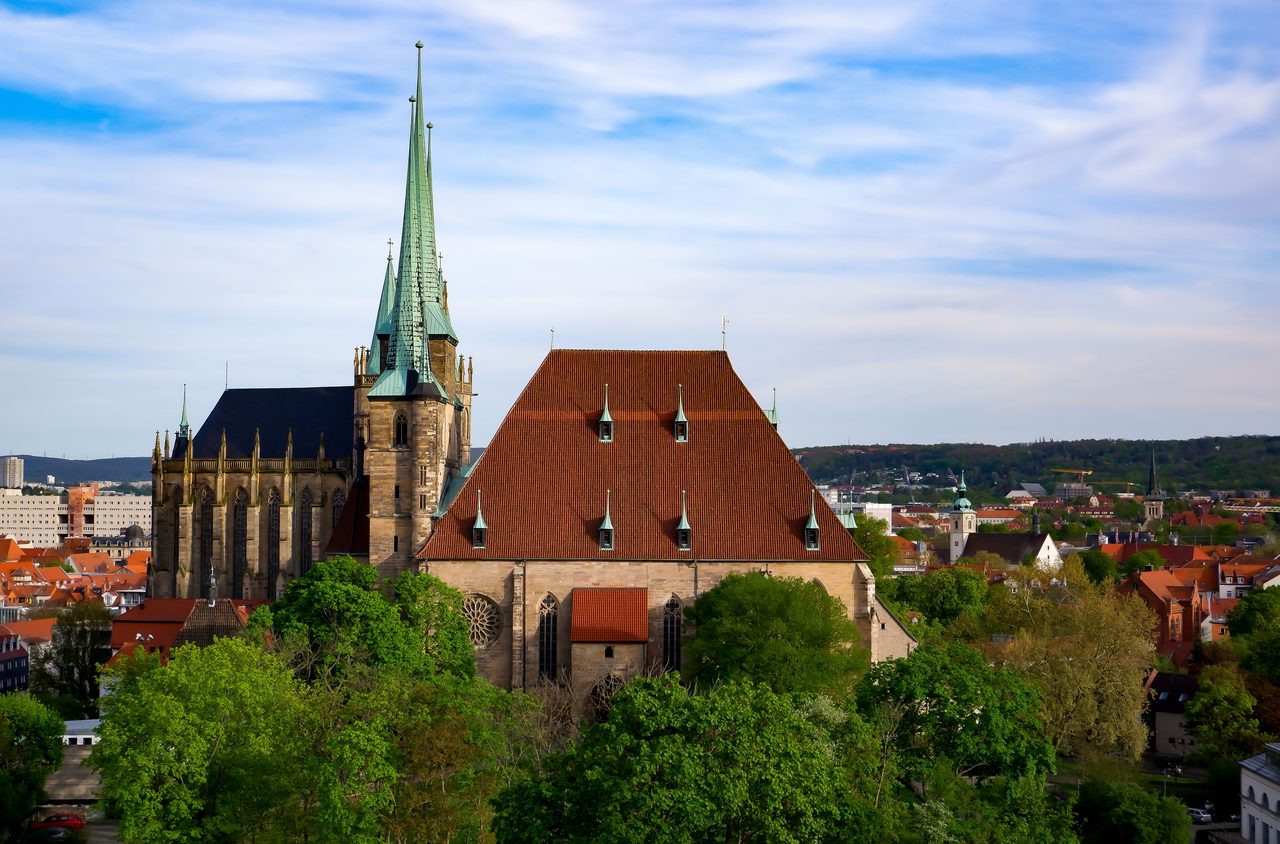
Erfurt Cathedral (Erfurter Dom)
Erfurt Cathedral rises above the city on the Domberg, reached by the wide Domstufen staircase that connects it to the market square below. Its Gloriosa bell, cast in 1497, is one of the largest free-swinging medieval bells still in use in the world and is rung only on major occasions. Inside, look for the medieval stained glass in the choir and the cathedral's Gothic vaulting, which replaced an earlier Romanesque structure on the same site.
Krämerbrücke
The Krämerbrücke, or Merchants' Bridge, is a medieval stone bridge over the Gera river's Breitstrom channel that is lined on both sides with half-timbered houses and small shops, making it easy to cross without realizing you're on a bridge at all. It dates to the 14th century in its stone form and is the longest inhabited bridge in Europe still built up entirely with buildings. Craft workshops, galleries, and small studios now occupy many of the houses.
Goethe House and National Museum
This Baroque townhouse on the Frauenplan was Goethe's home for around 50 years, from 1782 until his death in 1832, and its rooms are arranged largely as he used them, including his study and the room where he died. The adjoining National Museum wing adds exhibitions on his scientific work, his collections, and his role at the Weimar court. Seeing the house itself, rather than a reconstruction, is what distinguishes it from other Goethe-themed sites.
Bauhaus Museum Weimar
Weimar was the founding city of the Bauhaus school in 1919, and this museum, opened in 2019 for the school's centenary, holds the world's oldest Bauhaus collection, built from works the school itself donated to the city before it moved to Dessau. The displays trace the Weimar years specifically, including work by founding masters like Walter Gropius and predecessor Henry van de Velde, rather than the later, more widely known Dessau period. The building itself is a deliberately plain concrete cube, a design choice meant to let the collection carry the visit.
Duchess Anna Amalia Library
The library's Rococo Hall, an oval, galleried room lined with books up to the ceiling, was assembled under Duchess Anna Amalia in the 18th century and used by Goethe himself in his role overseeing the ducal collections. A 2004 fire destroyed roughly 50,000 books and damaged tens of thousands more before the hall was restored and reopened; some fire-damaged volumes are still on display as part of that history. It's a working research library as well as a historic space, which is why access to the Rococo Hall is limited.
Recommended itineraries
Pick a length, follow the route. Each itinerary balances headline sights with breathing room.
5-Day Thuringia Explorer
Day 1Arrive in Thuringia, explore city center
Day 2Visit top attractions and museums
Day 3Day trip to nearby highlights
Day 4Local markets and hidden gems
Day 5Final sightseeing, departure
7-Day Classic Thuringia
Days 1-2Thuringia city highlights
Days 3-4Regional exploration
Days 5-6Cultural immersion and local experiences
Day 7Return and departure
14-Day Ultimate Thuringia
Days 1-3Thuringia comprehensive city tour
Days 4-6Northern region exploration
Days 7-9Eastern highlights
Days 10-12Southern attractions
Days 13-14Return to Thuringia, departure
Where to stay in Thuringia
Three tiers, every traveller covered — from cost-conscious to flagship hotels.
Budget €50-70 ($58-81)
Hostels, budget hotels, and guesthouses offer affordable stays without sacrificing experience.
Mid-range €100-150 ($116-174)
Boutique hotels and well-located accommodations provide comfort and convenience at reasonable prices.
Luxury €250+ ($290+)
World-class resorts and premium hotels deliver unforgettable experiences.
Thuringia is compact and well served by Deutsche Bahn regional and ICE rail, with Erfurt Hauptbahnhof as the main hub on the Berlin-Munich high-speed line; most towns are reachable within an hour by train or regional bus
Deutsche Bahn ICE
High-speed rail through Erfurt Hauptbahnhof, connecting Berlin, Munich, Frankfurt, and Leipzig
Cost: €30-80 ($35-93) depending on route and advance booking
Thüringen-Ticket
Day ticket for unlimited regional train travel across Thuringia (up to 5 people)
Cost: €26 single ($30), €31 weekend group of 5 ($36)
Deutschlandticket
Monthly ticket valid for all local/regional public transport across Germany, including Thuringia's trams and buses
Cost: €49/month ($57/month)
Erfurt EVAG tram and bus
City tram and bus network in Erfurt, including the line to Erfurt-Weimar Airport
Cost: €2.20 single ($2.55), €5.90 day ticket ($6.84)
Intercity Bus (FlixBus)
Affordable intercity buses linking Thuringian cities with Berlin, Frankfurt, and beyond
Cost: €5-20 ($6-23)
Rental Car
Useful for reaching Thuringian Forest villages and castles off the rail network
Cost: €35-70/day ($41-81/day)
Erfurt-Weimar Airport
Thuringia's only commercial airport; limited scheduled flights (Berlin, Munich) plus seasonal charter routes to the Mediterranean
Cost: Varies by carrier and season
Budget breakdown
Daily spend by tier in EUR, broken out by category.
Category
Budget
Mid-range
Luxury
Accommodation
€20-35 ($23-41)
€60-100 ($70-116)
€150-350 ($174-406)
Food (per day)
€12-20 ($14-23)
€30-45 ($35-52)
€60-100 ($70-116)
Transportation
€5-8 ($6-9)
€10-15 ($12-17)
€25-45 ($29-52)
Activities
€8-12 ($9-14)
€15-25 ($17-29)
€40-80 ($46-93)
Daily total
€50-70 ($58-81)
€100-150 ($116-174)
€250+ ($290+)
Best time to visit Thuringia
Weather through the year in Germany
Best timeShoulderWorth avoiding
Average daytime temperature in °C. Figures are for Germany.
Essential travel tips
Buy the Thüringen-Ticket for cheap regional train travel across the state — one ticket covers up to five people on weekends
Book Wartburg Castle guided tours online in advance during summer and around Reformation Day (October 31)
Erfurt's Christmas market (late November-December) draws large crowds — arrive early or on weekdays
Tap water is safe and good quality throughout Thuringia
Sunday closures are widespread for shops — plan grocery runs for weekdays or Saturday mornings
The Rennsteig long-distance trail (170 km) is the classic way to experience the Thuringian Forest
Many museums offer combination tickets covering Weimar's UNESCO Classical Weimar sites
Cash is still commonly used in small-town restaurants and market stalls; carry some euros
Hidden gems
Off-the-beaten-path corners most travellers miss.
Drei Gleichen
trio of medieval hilltop castle ruins (Mühlburg, Gleichen, Wachsenburg) between Erfurt and Gotha, largely overlooked by tourists
Barbarossa Cave
show cave near the Kyffhäuser Monument descending 70 meters through anhydrite tunnels and crystal-clear underground lakes
Schmalkalden Old Town
exceptionally well-preserved half-timbered town where the Schmalkaldic League was founded in 1531
Veste Heldburg
the 'Fairy-Tale Castle of the Franconian Coburgers,' a lesser-visited fortress on the Thuringian-Bavarian border
Rennsteig Trail
170km ridge-line long-distance path through the Thuringian Forest, far quieter than Bavaria's Alpine trails
Mühlhausen Old Town
walled medieval town with intact ramparts where Thomas Müntzer preached during the German Peasants' War
Safety information
INFO
Current advisory levels for Germany (including Thuringia) — As of September 2026, the US State Department rates Germany at Level 2, 'Exercise Increased Caution', due to a general European terrorism threat affecting public spaces, transport hubs, and events. The UK FCDO advises normal precautions for Germany with awareness of the same background terrorism risk. Neither advisory singles out Thuringia, and both reflect country-wide guidance rather than an elevated regional risk.
INFO
Rennsteig and Thuringian Forest winter conditions — The Rennsteig ridge trail and other Thuringian Forest paths can be icy, snow-covered, or poorly marked in winter (November-March). Fog and rapidly falling temperatures at higher elevations (Großer Beerberg, 982m, and Schneekopf) catch unprepared hikers off guard.
INFO
Erfurt Christmas Market crowd and pickpocket awareness — The Erfurt Christmas Market (Erfurter Weihnachtsmarkt), held on the Domplatz beneath the cathedral, draws large crowds from late November through 24 December. Crowded market conditions create opportunities for pickpocketing, and heightened security measures (bollards, bag checks at some entries) are standard following country-wide precautions at German Christmas markets.
INFO
Petty theft in Erfurt and Weimar — Erfurt and Weimar are low-crime cities by international standards, but opportunistic bag and phone theft occurs occasionally around train stations and busy pedestrian zones such as Erfurt's Krämerbrücke and Weimar's Marktplatz during peak tourist periods.
INFO
Rural roads and Autobahn driving — Thuringia's A4 and A71 Autobahns carry fast-moving traffic with no general speed limit on many stretches, while rural roads through the Thuringian Forest have sharp curves, narrow lanes, and seasonal ice.
INFO
Tick awareness in forests and meadows — The Thuringian Forest and Hainich National Park have a tick population in wooded and meadow areas, particularly from April to October. Parts of Thuringia are classified as risk areas for both Lyme disease and TBE (tick-borne encephalitis).
INFO
Common tourist scams in Thuringia — Thuringia has very few scams targeting tourists compared to major western German cities or southern Europe, but standard precautions still apply in busy tourist areas such as the Wartburg, Weimar's Goethe and Schiller sites, and Erfurt's old town.
INFO
Cold weather and altitude health considerations — Thuringia has cold, often snowy winters, particularly in the Thuringian Forest around Oberhof and the Rennsteig, where temperatures can be several degrees colder than in Erfurt.
INFO
Important laws for visitors to Thuringia — Thuringia follows the same national legal framework as the rest of Germany, with some points that visitors may not expect.
Frequently asked questions
Do I need a visa to visit Thuringia?
EU/Schengen Area. No visa required for EU citizens. Many nationalities can visit for 90 days visa-free under Schengen rules. Non-Schengen nationals should check requirements. Requirements vary by nationality, so check with the nearest embassy or the official immigration website before traveling.
What currency is used in Thuringia?
The currency in Thuringia is the Euro (EUR). ATMs are widely available in cities and tourist areas. Credit cards are accepted at most hotels and restaurants, but cash is useful for markets, small-town restaurants, and rural establishments.
What language is spoken in Thuringia?
The main language(s) spoken in Thuringia: German, Thuringian dialect. In tourist areas such as Weimar and Erfurt, English is generally understood. Learning a few basic phrases in German is appreciated by locals.
What are the top attractions in Thuringia?
The top attractions in Thuringia include Wartburg Castle, Erfurt Cathedral and the Krämerbrücke, Classical Weimar's Goethe and Schiller houses, the Bauhaus Museum Weimar, and the Buchenwald Memorial. Each offers a distinct look at Germany's religious, cultural, and modern history.