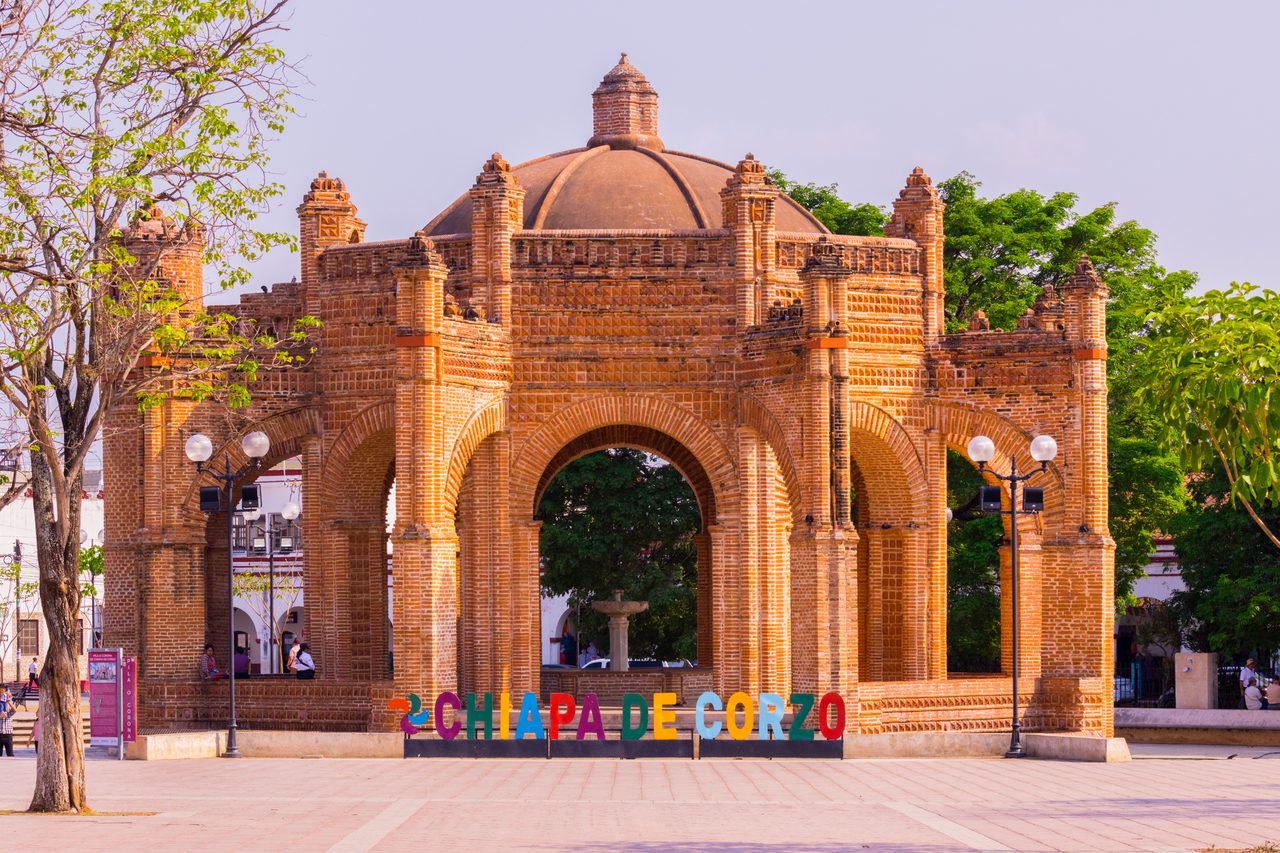
Chiapas is Mexico's southernmost state, a highland-and-jungle frontier on the Guatemalan border where colonial San Cristóbal de las Casas sits at 2,200 metres above sea level, the Maya city of Palenque rises out of rainforest, and the Grijalva River cuts the thousand-metre walls of the Sumidero Canyon. It is the most indigenous state in the country: Tzotzil, Tzeltal, Ch'ol, Tojolabal and Zoque communities keep their languages, markets and ceremonies as living practice rather than performance. Waterfalls at Agua Azul, Misol-Ha and El Chiflón, the turquoise lakes of Montebello, the coffee fincas of the Soconusco and the empty Pacific beaches at Puerto Arista round out a state that rewards slow, careful travel.
Chiapas covers 73,311 km² between the Pacific coast and the Guatemalan border, holding roughly 5.5 million people across five distinct landscapes: the hot Central Depression around Tuxtla Gutiérrez, the cool pine-forested Altos highlands around San Cristóbal de las Casas, the Lacandon rainforest of the east, the northern jungle escarpment where Palenque and the waterfalls sit, and the humid Soconusco coffee coast running down to Tapachula. Palenque is a UNESCO World Heritage Site, as is the Sumidero Canyon's neighbouring colonial town of Chiapa de Corzo through its Parachicos dance tradition, inscribed on the UNESCO intangible heritage list. The state is home to twelve recognised indigenous peoples, and Tzotzil and Tzeltal are each spoken by well over half a million people. Visitors come for the archaeology at Palenque, Yaxchilán and Bonampak, for the highland Tzotzil villages of San Juan Chamula and Zinacantán, for the waterfalls and lakes, and for the coffee. The state also carries a Level 3 United States travel advisory, which makes route planning, daylight driving and highway awareness genuinely important rather than boilerplate.
Capital
Tuxtla Gutiérrez
Largest city
Tuxtla Gutiérrez
Population
~5.5 million
Languages
Spanish, Tzotzil, Tzeltal, Ch'ol, Tojolabal, Zoque, Mam
The 27 destinations our editors recommend — from iconic landmarks to under-the-radar finds.
Palenque Archaeological Zone and Museo de Sitio Alberto Ruz L'Huillier
Palenque is the most refined Maya city of the Classic period and was inscribed on the UNESCO World Heritage List in 1987 together with its surrounding national park. The Templo de las Inscripciones covers the tomb of K'inich Janaab' Pakal, discovered by Alberto Ruz L'Huillier in 1952, and the Palacio, the Grupo de las Cruces and the jungle-wrapped Templo del Conde stand among some 1,500 recorded structures, of which fewer than 10 percent have been cleared. Entry involves two separate payments, the INAH archaeological ticket and a CONANP national park fee collected at the road barrier. The site museum on the access road holds the carved panels, stucco heads and a replica of Pakal's sarcophagus lid.
Yaxchilan Archaeological Zone
Yaxchilan spreads along a horseshoe bend of the Usumacinta River on the Guatemalan border and can be reached only by boat. Its rulers Itzamnaaj B'alam II and Bird Jaguar IV left the finest carved lintels in the Maya world, several still in place above the doorways of Structure 23, showing bloodletting rites and captive-taking in crisp relief. Visitors enter through the dark vaulted passages of the Labyrinth into the Gran Plaza, and Structure 33 stands above it with its roof comb intact. Howler monkeys, spider monkeys and toucans are near-constant company.
Bonampak Archaeological Zone
Bonampak is a small site with one overwhelming asset: the three painted rooms of Structure 1, the most complete Maya murals to survive anywhere. Painted around 790 AD in Maya blue, ochre and red, they show a royal procession with trumpets and drums, a battle and the arraignment of captives, and the bloodletting rites that followed. Rediscovered in 1946 with the help of Lacandon guides, the paintings are entered a few visitors at a time for a limited period to protect them. The Great Plaza in front carries Stela 1, one of the tallest in the Maya area.
Tonina Archaeological Zone
Tonina rises as a seven-terrace acropolis carved into a hillside above the Ocosingo valley, reaching about 75 m and making it one of the tallest structures the Maya built. Its rulers captured and held the Palenque king K'an Joy Chitam II in 711 AD, and the site carries the latest known Long Count date, 909 AD, on Monument 101. The great stucco frieze known as the Mural of the Four Eras, with its skeletal death lord carrying a severed head, is the outstanding survival, and the on-site museum holds the sculpture recovered from the terraces.
Chinkultic Archaeological Zone
Chinkultic occupies a limestone ridge above the Montebello lakes, and the climb to the Acropolis ends at a temple platform standing directly over a deep blue cenote into which offerings were thrown. The site preserves a ball court, carved stelae dated between 591 and 897 AD, and a marker disc showing a ballplayer that is now in the National Museum of Anthropology. The circuit is short but steep, and the summit view stretches across pine forest to the lake country and the Guatemalan border ranges.
Sumidero Canyon Boat Trip
The Grijalva River runs between vertical walls up to 1,000 m high through the Canon del Sumidero, and the standard two-hour lancha trip covers about 35 km from the Chiapa de Corzo jetty to the Chicoasen dam wall. Boats pass the hanging Cueva de Colores, the moss-draped Arbol de Navidad waterfall and stretches of shoreline where crocodiles bask and spider monkeys move through the gallery forest. The canyon appears on the coat of arms of Chiapas, and its fare includes the protected-area access right.
Recommended itineraries
Pick a length, follow the route. Each itinerary balances headline sights with breathing room.
5-Day Chiapas Explorer
Day 1Arrive in Chiapas, explore city center
Day 2Visit top attractions and museums
Day 3Day trip to nearby highlights
Day 4Local markets and hidden gems
Day 5Final sightseeing, departure
7-Day Classic Chiapas
Days 1-2Chiapas city highlights
Days 3-4Regional exploration
Days 5-6Cultural immersion and local experiences
Day 7Return and departure
14-Day Ultimate Chiapas
Days 1-3Chiapas comprehensive city tour
Days 4-6Northern region exploration
Days 7-9Eastern highlights
Days 10-12Southern attractions
Days 13-14Return to Chiapas, departure
Where to stay in Chiapas
Three tiers, every traveller covered — from cost-conscious to flagship hotels.
Budget MXN 830 (~USD 49)
Hostels, budget hotels, and guesthouses offer affordable stays without sacrificing experience.
Mid-range MXN 2,700 (~USD 159)
Boutique hotels and well-located accommodations provide comfort and convenience at reasonable prices.
Luxury MXN 7,500+ (~USD 441+)
World-class resorts and premium hotels deliver unforgettable experiences.
Hotel Bo
Barrio de Mexicanos, San Cristobal de las Casas · MXN 3,400-8,500 (~USD 200-500) per night
A contemporary design hotel in Barrio Mexicanos where local stone, adobe, and Chiapaneco textiles are handled in a stripped-back modern idiom, with a spa, a fitness room, and the well-regarded LUM restaurant on site. It is the most expensive address in San Cristobal and a ten-minute walk from the cathedral.
Centro Historico, San Cristobal de las Casas · MXN 2,600-4,600 (~USD 153-271) per night
A colonial house on Avenida 16 de Septiembre rebuilt as a boutique hotel with a full spa, a heated indoor pool, and rooms arranged around interior patios two blocks from the Zocalo. Wood, wool blankets, and open fireplaces suit the cold highland nights better than most hotels in town.
Beside the cathedral, San Cristobal de las Casas · MXN 1,100-1,900 (~USD 65-112) per night
Two joined colonial mansions beside the cathedral hold 78 rooms around arcaded courtyards planted with geraniums, one block from the Zocalo and the Andador Guadalupano. Rooms are traditional rather than fashionable, many have fireplaces, and the location is among the most central in San Cristobal.
Centro Historico, San Cristobal de las Casas · MXN 950-1,600 (~USD 56-94) per night
An 18th-century house on Maria Adelina Flores converted into a quiet hotel of about 40 rooms set around two planted patios and a colonnaded walkway. It is three blocks east of the Zocalo, keeps its original beams and tiled floors, and represents some of the steadiest value in the centro.
Chef Marta Zepeda's kitchen is the benchmark for modern Chiapaneco cooking, treating highland ingredients such as chipilin, hoja santa, comiteco spirit, and Chiapas cacao with tasting-menu seriousness.
Restaurante LUM at Hotel Bo
Refined regional · MXN 600-1,300 (~USD 35-76)
The glass-and-stone dining room of Hotel Bo, open to non-guests, serving refined regional cooking built on Chiapas coffee, cacao, and highland vegetables.
Belil Sabores de Chiapas
Traditional Chiapaneco · MXN 250-450 (~USD 15-26)
A small dining room dedicated to preserving traditional Chiapaneco family recipes, favored by residents as much as visitors for honest, unfussy regional plates.
500 Noches
Contemporary Mexican · MXN 250-500 (~USD 15-29)
A candlelit courtyard restaurant along Real de Guadalupe serving contemporary Mexican plates with a strong cocktail and mezcal list, popular for dinner among longer-staying visitors.
Amor Negro
Cafe and bakery · MXN 80-200 (~USD 5-12)
A bakery-cafe known for scratch-made sourdough bread and single-origin Chiapas coffee, a popular breakfast stop before heading out to the highland villages.
La Lupe
Mexican and international · MXN 100-250 (~USD 6-15)
A long-running, reliably busy corner restaurant a block from the cathedral, serving Mexican comfort food across an all-day menu popular with travelers on Real de Guadalupe.
Chiapas is mountainous and the map lies about travel time: the 190 km between San Cristóbal de las Casas and Palenque takes five to six hours by road, and the 400 km from Tuxtla Gutiérrez to Tapachula takes six to seven. Ángel Albino Corzo International (TGZ), 35 km from Tuxtla Gutiérrez in the municipality of Chiapa de Corzo, is the state's main gateway and handled about 1.7 million passengers in 2025; Tapachula (TAP) serves the Soconusco coast and Palenque (PQM) has a single Mexicana route to Felipe Ángeles. San Cristóbal de las Casas has no airport of its own and is reached by a 75-90 minute run up Highway 190D from TGZ. OCC and ADO coaches are the backbone of intercity travel, colectivo vans handle villages and ruins, and the Tren Maya ends its run at Palenque, where a short walk connects to the Tren Interoceánico Line FA station at Pakal Ná. Road blockades by teachers' unions and community groups are a genuine planning factor on Highways 199 and 190 and can add one to four hours, or close a road for a day.
Budget breakdown
Daily spend by tier in MXN, broken out by category.
Category
Budget
Mid-range
Luxury
Accommodation
MXN 350 (~USD 21)
MXN 1,400 (~USD 82)
MXN 4,500 (~USD 265)
Food (per day)
MXN 250 (~USD 15)
MXN 650 (~USD 38)
MXN 1,600 (~USD 94)
Transportation
MXN 130 (~USD 8)
MXN 350 (~USD 21)
MXN 800 (~USD 47)
Activities
MXN 100 (~USD 6)
MXN 300 (~USD 18)
MXN 600 (~USD 35)
Daily total
MXN 830 (~USD 49)
MXN 2,700 (~USD 159)
MXN 7,500+ (~USD 441+)
Best time to visit Chiapas
Weather through the year in Mexico
Best timeShoulderWorth avoiding
Average daytime temperature in °C. Figures are for Mexico.
Late November through April, the dry season across all five climate zones
There is no single ideal month for every zone at once: San Cristóbal is coldest exactly when Palenque and the coast are most pleasant, from December to February, so packing for both extremes is unavoidable on a state-wide itinerary.
Essential travel tips
San Cristóbal de las Casas works best as the base for the highlands, with Palenque as a second base for the jungle sites; trying to see Palenque as a day trip from San Cristóbal means eleven hours on the road for two hours at the ruins
Bring a fleece and a rain shell regardless of season: San Cristóbal nights fall to single digits from November to February while Palenque stays humid and hot the same week
Boat trips into the Sumidero Canyon leave from four docks; the Chiapa de Corzo embarcadero is the most convenient by colectivo from Tuxtla, and boats depart when they fill rather than on a timetable
Amber sold in San Cristóbal is genuine Simojovel amber at reputable shops around Santo Domingo, but plastic imitations circulate on the street; real amber floats in salt water and warms quickly in the hand
The Yaxchilán and Bonampak trip is a full 14-hour day from Palenque, and the Usumacinta boat to Yaxchilán costs roughly MXN 900 (~USD 53) per launch for up to seven passengers, so joining other travellers at the Frontera Corozal dock splits the price
Order a pox (pronounced posh), the Tzotzil corn-and-sugarcane spirit, at a San Cristóbal poxería, and try sopa de pan, cochito horneado, tamales de chipilín and a chocolate caliente ground with Chiapas cacao
Coffee in Chiapas is exceptional and cheap; a cup of single-origin from a Soconusco or Jaltenango finca runs MXN 40-60 (~USD 2-4) in San Cristóbal cafés
Hidden gems
Off-the-beaten-path corners most travellers miss.
Cascada El Aguacero
A 40 m waterfall that bursts straight out of the canyon wall of the Rio La Venta in the Selva El Ocote reserve, reached by a stairway of roughly 750 steps down from the ecotourism centre, with a long river beach of white boulders at the bottom
Ocozocoautla de Espinosa Municipality
Sima de las Cotorras
A near-perfect sinkhole 160 m across and 140 m deep in the El Ocote reserve, where several hundred green parakeets spiral out at dawn and return at dusk, and rock paintings of red figures survive on the shaft wall reached by rappel
Ocozocoautla de Espinosa Municipality
Tenam Puente Archaeological Zone
A terraced Maya hill city near Comitan with three ball courts and a stepped acropolis that survived into the tenth century after most lowland cities had collapsed, looking out over the Comitan valley and rarely holding more than a dozen visitors
Comitan de Dominguez Municipality
Laguna Miramar
The largest lake in the Lacandon rainforest, a clear expanse of water ringed by uncut jungle inside the Montes Azules biosphere reserve, reached from the Tzeltal community of Emiliano Zapata after a boat ride and a forest walk, with rock paintings and a cave on the far shore
Ocosingo Municipality
Grutas de Rancho Nuevo
A lit cave system 10 km south of San Cristobal on the Panamerican highway, with about 750 m of walkway threading past stalactites and flowstone columns inside a pine forest recreation area that also offers horse riding
San Cristobal de las Casas Municipality
Cascadas Las Nubes
A wide series of rapids and turquoise chutes where the Rio Santo Domingo drops through the jungle near the Guatemalan border, with a suspension bridge and a viewing platform above the main fall, run as an ecotourism centre by the Ejido Causas Verdes
Maravilla Tenejapa Municipality
Safety information
INFO
Avoid the Frontera Comalapa, Chicomuselo and Motozintla area near the Guatemalan border entirely, and do not use Highway 190 south of Comitán toward Ciudad Cuauhtémoc without checking current conditions with a hotel or tour operator first
INFO
Cross into Guatemala at Ciudad Hidalgo or Talismán near Tapachula rather than Ciudad Cuauhtémoc, where practical
INFO
Do not drive Chiapas highways after dark: fog on the Tuxtla-San Cristóbal climb, unlit topes, livestock and landslide debris on Highway 199 are common, and it is harder to assess a blockade or checkpoint at night
INFO
Check the state road situation on the morning of travel before setting out for Agua Azul, Ocosingo or Palenque; San Cristóbal hotel reception desks and shuttle operators track active bloqueos and cancel departures when a road is closed
INFO
Order taxis through a hotel reception, a taxi rank (sitio), or the Uber and DiDi apps in Tuxtla Gutiérrez and Tapachula rather than hailing an unmarked car on the street
INFO
Allow at least one full day to acclimatise in San Cristóbal de las Casas at 2,200 metres before any strenuous activity, drink extra water, and go easy on alcohol and pox the first night
INFO
Use insect repellent containing DEET or picaridin from dusk onward in Palenque, Yaxchilán, Bonampak and the Lacandon jungle, where dengue circulates year-round and Zika and chikungunya are also present
INFO
Do not drink tap water anywhere in the state; buy purified bottled water, which is sold in every OXXO and corner shop, and avoid ice from informal roadside stalls
INFO
Carry cash in small denominations for community entrance fees at Chamula, Zinacantán, Bonampak, Montebello and the waterfalls, none of which take cards, and withdraw at bank-branch ATMs in San Cristóbal, Comitán or Palenque town rather than standalone machines
INFO
Swim only where local families swim at Agua Azul and other river sites: currents are strong and drowning deaths occur most years at the unroped upper cascades
INFO
Never photograph inside the church of San Juan Bautista in San Juan Chamula, or photograph ceremonies, checkpoints or individuals in highland or Zapatista communities without asking; fines, camera confiscation and detention by community authorities are enforced
INFO
Register a rough itinerary with someone before heading into the Lacandon jungle toward Yaxchilán, Bonampak or Lacanjá Chansayab, where mobile signal disappears for hours at a time
INFO
Keep photocopies of a passport and visa stamp separate from the originals, and store valuables in a hotel safe rather than carrying them on colectivo journeys
Frequently asked questions
Is Chiapas safe for tourists in 2026?
The United States Department of State rates Chiapas Level 3, Reconsider Travel, because of crime and armed-group conflict, but the advisory places no restriction on United States government employees travelling within the state and names Palenque, San Cristóbal de las Casas and Tuxtla Gutiérrez as tourist areas they may visit. The serious risk is concentrated in the Guatemalan border belt around Frontera Comalapa, Chicomuselo and Motozintla, and on Highway 190 south of Comitán, which independent travellers should avoid. The main tourist corridor of Tuxtla, Chiapa de Corzo, San Cristóbal, the highland villages, Comitán, Montebello and Palenque is travelled daily by large numbers of visitors without incident. Sensible precautions are avoiding night driving, checking for road blockades on Highway 199 before setting out, and ordering taxis through hotels or the ride-hailing apps rather than hailing on the street.
Do travellers need a visa to visit Chiapas?
Entry requirements follow Mexico rules. Citizens of the United States, Canada, the United Kingdom, the European Union, Australia, and many other countries enter visa-free as tourists for up to 180 days, with the permitted stay recorded on arrival by immigration officers. Nationals of countries outside the visa-waiver list must apply at a Mexican consulate in advance, though holders of a valid US, Canadian, Japanese, UK, or Schengen visa are usually exempt. Travellers arriving overland from Guatemala must complete formalities at the border post and confirm the entry record before continuing. Requirements vary by nationality, so check with the nearest Mexican embassy or the official immigration website before travelling.
How do travellers get from San Cristóbal de las Casas to Palenque?
The two common options are the OCC or ADO coach and a tourist shuttle van. Buses leave the San Cristóbal terminal on Avenida Insurgentes at the Pan-American Highway several times a day, including overnight departures, taking roughly eight hours by the safer lowland route via Villahermosa or five to six hours on the direct mountain road, for about MXN 380-560 (~USD 22-33). Shuttle vans sold by agencies on Real de Guadalupe take the direct Highway 199 route in five to six hours with stops at Agua Azul and Misol-Ha for about MXN 450-700 (~USD 26-41). Road blockades occasionally close Highway 199 between Ocosingo and Palenque, so conditions are worth confirming on the morning of travel.
How much does it cost to visit Palenque?
Palenque requires two separate cash-only payments at the entrance. The Palenque National Park fee is about MXN 110 (~USD 6) for Mexican nationals and roughly MXN 217 (~USD 13) for foreign visitors, collected at the gate on the road up from town, and the INAH archaeological zone fee is about MXN 95 (~USD 6) on top of that, which also covers the site museum. Cards are not accepted at either booth, so pesos should be withdrawn in Palenque town first. The site is open daily 8AM to 5PM with last entry at 4:30PM, and arriving at opening time gives cooler air, jungle mist and far fewer people.
What food is Chiapas famous for?
Chiapas cooking is highland and distinct from Yucatecan or central Mexican food. Signature dishes include sopa de pan, a Coleto bread-and-broth soup served at Christmas and beyond, cochito horneado (oven-roasted pork in adobo), tamales de chipilín and the large tamal de bola, chanfaina, and butifarra sausage. The state grows some of Mexico's best arabica coffee in the Soconusco and around Jaltenango, and its cacao goes into a chocolate caliente ground with cinnamon. Local drinks include pox, a Tzotzil corn and sugarcane spirit, the sweet cinnamon-tinted tascalate, and pozol, a cold maize and cacao drink sold everywhere in the lowlands.
How many days are needed for Chiapas?
A minimum of seven days does the state justice. Two or three nights in San Cristóbal de las Casas cover the town, San Juan Chamula and Zinacantán, and the Sumidero Canyon by boat from Chiapa de Corzo. Two nights in Palenque allow an early start at the ruins plus a day for Yaxchilán and Bonampak, which is a fourteen-hour round trip. Adding Comitán as a base for El Chiflón and Lagos de Montebello needs two more nights. Ten to twelve days lets a traveller include the Lacandon jungle at Lacanjá Chansayab or the Soconusco coffee route and the Pacific beaches at Puerto Arista without rushing the mountain roads.
Can visitors take photographs in San Juan Chamula?
Photography and video are strictly prohibited inside the church of San Juan Bautista, without exception, and enforcement is serious: cameras have been confiscated, fines levied, and visitors detained by community authorities. A ticket costing about MXN 25-35 (~USD 1-2) is bought at the tourist office beside the churchyard before entering. Photographing the church exterior and the market square is generally accepted, but individual people, especially children and anyone engaged in ritual, should never be photographed without permission. The same restraint applies in Zinacantán and other highland Tzotzil communities.