Oaxaca is one of Mexico's most culturally rich states, home to 16 recognized indigenous groups, the archaeological capitals of Monte Albán and Mitla, and a coastline stretching from the surf town of Puerto Escondido to the calm resort bays of Huatulco. Oaxaca de Juárez, the colonial capital, is celebrated for mole, mezcal, and some of the finest regional cooking in the country.
Oaxaca state spans two dramatically different worlds: the highland Central Valleys around Oaxaca de Juárez, with their Zapotec and Mixtec archaeological sites, artisan weaving and pottery villages, and a UNESCO-listed historic center, and the Pacific coast, where the surf town of Puerto Escondido, the laid-back villages of Zipolite and Mazunte, and the resort bays of Huatulco offer everything from world-class waves to sheltered swimming coves. Sixteen officially recognized indigenous groups call the state home, giving it more linguistic and cultural diversity than anywhere else in Mexico, and its food and mezcal culture are considered among the country's finest.
The 24 destinations our editors recommend — from iconic landmarks to under-the-radar finds.
Monte Albán
Monte Albán is the hilltop capital the Zapotecs carved out of a leveled mountaintop overlooking the Oaxaca valley, occupied for over a thousand years before the Mixtecs later reused parts of it for elite burials. The core is a vast plaza ringed by platforms, ballcourts, and the observatory-like Building J, set at an angle that doesn't match the rest of the site. Walking the site means covering real distance across open, high-altitude ground with little shade.
Mitla
Mitla was a Zapotec and later Mixtec religious center known for geometric mosaic stonework unlike anything else in Mesoamerica, made from thousands of individually cut stone pieces fitted together without mortar into repeating step-fret patterns. Unlike Monte Albán's scale, Mitla is compact and dense, with several separate architectural groups spread through the modern town that grew up around the ruins. The Group of the Columns is the best-preserved section open to visitors.
Hierve el Agua
Hierve el Agua is a set of mineral-rich springs that have deposited calcium carbonate over centuries, creating rock formations that look like frozen waterfalls spilling over the edge of a cliff. The name means "the water boils," referring to the bubbling appearance of the spring water, not its temperature. There are small natural and constructed pools to swim in at the clifftop, with views down into the valley below.
Zócalo de Oaxaca
The Zócalo is Oaxaca city's main plaza, framed by the cathedral, government palace, and arcaded portales lined with cafés, and it functions as the social center of the historic center rather than just a monument to look at. Vendors, shoeshine stands, marching bands, and occasional political demonstrations all pass through depending on the day. It's the natural starting point for exploring the surrounding grid of colonial streets.
Templo de Santo Domingo de Guzmán
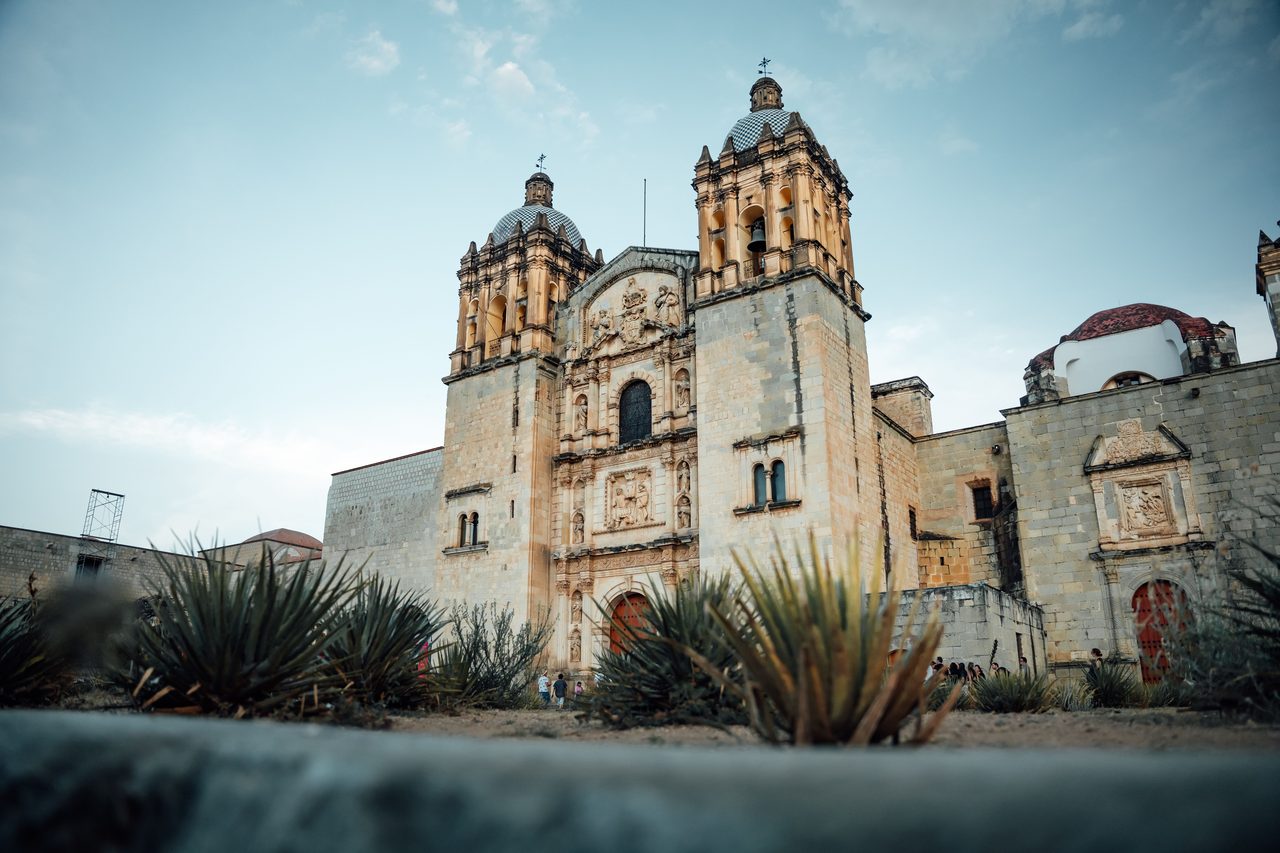
Santo Domingo is a former Dominican monastery church whose exterior's heavy, fortress-like stone walls give no hint of the gilded interior inside, where the Rosary Chapel and a genealogical tree of the Guzmán family cover the ceiling in relief and gold leaf. Built over more than two centuries starting in the late 1500s, it's the most elaborately decorated colonial church in the city. The attached former monastery now houses the Museo de las Culturas de Oaxaca and its botanical garden.
Museo Textil de Oaxaca
This museum is dedicated to the textile traditions of Oaxaca and Mexico more broadly, showing woven and embroidered pieces from indigenous communities across the state alongside rotating exhibitions on specific techniques, dyes, or regions. It occupies a restored colonial building a few blocks from the Zócalo. The collection is smaller and more focused than the Museo de las Culturas, making it a manageable visit rather than a sprawling one.
Recommended itineraries
Pick a length, follow the route. Each itinerary balances headline sights with breathing room.
5-Day Oaxaca Explorer
Day 1Arrive in Oaxaca, explore city center
Day 2Visit top attractions and museums
Day 3Day trip to nearby highlights
Day 4Local markets and hidden gems
Day 5Final sightseeing, departure
7-Day Classic Oaxaca
Days 1-2Oaxaca city highlights
Days 3-4Regional exploration
Days 5-6Cultural immersion and local experiences
Day 7Return and departure
14-Day Ultimate Oaxaca
Days 1-3Oaxaca comprehensive city tour
Days 4-6Northern region exploration
Days 7-9Eastern highlights
Days 10-12Southern attractions
Days 13-14Return to Oaxaca, departure
Where to stay in Oaxaca
Three tiers, every traveller covered — from cost-conscious to flagship hotels.
Budget $38
Hostels, budget hotels, and guesthouses offer affordable stays without sacrificing experience.
Mid-range $100
Boutique hotels and well-located accommodations provide comfort and convenience at reasonable prices.
Luxury $320
World-class resorts and premium hotels deliver unforgettable experiences.
Hotel Casa Antonieta
Centro Historico, Oaxaca de Juárez · $$$ (2,000-3,600 MXN / $100-180 USD per night)
Chef Alejandro Ruiz's flagship dining room sits on a terrace facing the Santo Domingo church, with a menu built around Oaxaca's mole tradition and market ingredients like chiles de agua and quesillo. The plating is refined rather than rustic, running tasting-menu options alongside a la carte classics. The room is open-air, with the best seats looking straight out at the church facade.
Part of the same family behind the Los Danzantes mezcal label and its sister restaurant in Coyoacán, this spot on the Alcalá pedestrian street serves contemporary Mexican cooking with Oaxacan touches in a plant-filled courtyard. The kitchen pairs dishes such as escamoles and mezcal-cured fish with the house's own mezcal line. Seating runs from the interior patio up to a balcony level overlooking the street.
Criollo
contemporary Mexican tasting menu · $$$ (tasting menu approx. 2200-2800 MXN / $112-143 USD per person)
Chef Luis Arellano's tasting-menu restaurant, tucked behind a courtyard on Madero, built its name on a "mountains to sea" menu that moves through Oaxaca's highland and coastal ingredients across many small courses. The cooking is technique-driven rather than a straight rendition of classic Oaxacan plates. On Sundays the terrace shifts to a slower brunch format.
Chef Rodolfo Castellanos, a judge on MasterChef México, runs this Hidalgo-street dining room around reworked Oaxacan staples — mole negro turned into a tamal, ribs marinated in chintextle. It's set in a converted house with a small interior patio, more polished than the market stalls its ingredients come from, and the tasting menu shifts with the season.
Almú Cocina de Humo
wood-fire Oaxacan (cocina de humo) · $$$ (approx. 700-1200 MXN / $36-61 USD per person)
Levadura de Olla
traditional Sierra Sur Oaxacan · $$$ (tasting menu approx. 1400-1900 MXN / $71-97 USD per person)
Chef Thalía Barrios cooks the food of her native Sierra Sur here, centered on heirloom corn masa and ingredients from that part of Oaxaca rather than the more commonly served Valles Centrales repertoire. The dining room is small and set up for a tasting-menu format rather than a la carte ordering — it's part of a newer wave of Oaxacan kitchens that's pushed past the standard mole-and-tlayuda lineup.
Oaxaca state is served by three airports: Xoxocotlán International Airport (OAX) near Oaxaca city, Puerto Escondido International Airport (PXM) on the coast, and Bahías de Huatulco International Airport (HUX) near Huatulco. A new toll superhighway (Autopista Barranca Larga-Ventanilla) now links Oaxaca city to the coast in about 3-4 hours, a major improvement over the older winding mountain routes through the Sierra Sur. Colectivos (shared vans and taxis) are the backbone of local transport both in Oaxaca city's surrounding valleys and along the coast between Puerto Escondido, Zipolite, Mazunte, and Pochutla. Uber operates in Oaxaca city but has inconsistent or no coverage on the coast, where colectivos and moto-taxis dominate.
Colectivo (Shared Van/Taxi)
Shared vans and sedans running fixed routes, the primary way locals and budget travelers move around Oaxaca city's valley towns and the entire coastal corridor (Pochutla-Puerto Escondido-Zipolite-Mazunte-San Agustinillo). Flag one down anywhere along the route.
Cost: 15-60 MXN ($0.80-3 USD) depending on distance
Uber
Available in Oaxaca city and reliable for airport transfers and getting around town. Coverage on the coast (Puerto Escondido, Huatulco) is thin or absent; locals mostly rely on taxis and colectivos there.
Older conventional buses cover Oaxaca city and the surrounding valley (Etla, Tlacolula, Zaachila routes), used heavily by residents commuting to work and market days. Exact change appreciated.
Cost: 8-10 MXN ($0.40-0.50 USD)
Taxi (Licensed)
Sitio taxis (radio taxi stands) are common in Oaxaca city and coastal towns. Fares are not metered in most towns — agree on price before departure.
Cost: 40-100 MXN ($2-5 USD) typical short city ride
Moto-taxi
Three-wheeled motorbike taxis common in Puerto Escondido, Mazunte, and smaller coastal towns for short hops between beaches and town centers.
Cost: 20-40 MXN ($1-2 USD) per short ride
Intercity Bus (ADO/OCC/AU)
ADO (first-class), OCC and AU (economy, same parent company) connect Oaxaca city to Puerto Escondido, Huatulco, Mexico City, and the Isthmus of Tehuantepec. Buses have air conditioning, reclining seats, and on-board bathrooms on ADO first-class services.
Cost: 350-750 MXN ($18-38 USD) depending on route and class
Budget breakdown
Daily spend by tier in USD, broken out by category.
Category
Budget
Mid-range
Luxury
Accommodation
$12
$50
$190
Food (per day)
$10
$25
$75
Transportation
$7
$12
$30
Activities
$9
$13
$25
Daily total
$38
$100
$320
Best time to visit Oaxaca
Weather through the year in Oaxaca
Best timeShoulderWorth avoiding
Average daytime temperature in °C. Figures are for Oaxaca.
Essential travel tips
Try tlayudas and mole negro — Oaxaca's signature dishes
Combine the Central Valleys (Oaxaca de Juárez, Monte Albán, Mitla, Hierve el Agua) with a few coastal days in Puerto Escondido or Huatulco
Book Guelaguetza and Día de los Muertos accommodation months ahead
Carry small-denomination cash for community-run sites and rural villages
Hidden gems
Off-the-beaten-path corners most travellers miss.
Cascadas de Apoala
Waterfalls in a Mixteca Alta canyon village reached by a scenic hike, far less visited than Hierve el Agua
Santa María Apoala, Sierra Norte
San Agustín Etla Textile and Art Center
A restored former textile factory turned contemporary art and papermaking center outside Oaxaca de Juárez
San Agustín Etla
Jalatlaco Neighborhood
A colorful, mural-lined colonial barrio just east of Oaxaca de Juárez's center
Jalatlaco, Oaxaca de Juárez
Pueblos Mancomunados
A network of Sierra Norte cloud-forest villages with community-run hiking trails and cabins
Sierra Norte
Safety information
INFO
Stay within well-visited tourist zones: Oaxaca city's historic center (Centro), Jalatlaco, and the surrounding valley towns; on the coast, Puerto Escondido's Zicatela and Carrizalillo, Zipolite, Mazunte, and Huatulco's Santa Cruz and La Crucecita
INFO
Use Uber in Oaxaca city rather than hailing unlicensed taxis; on the coast, use hotel-arranged taxis or well-established colectivo routes
INFO
Avoid overnight travel on rural highways in Oaxaca state, particularly the Isthmus of Tehuantepec region and remote stretches of the Sierra Sur
INFO
Exercise added caution in and around the Isthmus of Tehuantepec (Juchitán, Salina Cruz area), where localized crime and occasional civil unrest have been reported
INFO
Keep valuables low-key — leave passports, extra cash, and jewelry in a hotel safe when out sightseeing or at the beach
INFO
Use ATMs inside bank branches or shopping centers during daylight hours rather than standalone street machines
INFO
Book accommodation through reputable platforms with verified reviews, particularly for beach towns where informal listings are common
INFO
Drink only bottled or purified water — tap water is not potable anywhere in Oaxaca state
INFO
Stay hydrated and use strong sunscreen; UV exposure is intense both at Oaxaca city's elevation and on the tropical coast
INFO
Keep digital and physical copies of your passport, travel insurance policy, and emergency contacts stored separately from the originals
INFO
Register with your home country's embassy or consulate before traveling — US citizens can use the STEP program at step.state.gov
INFO
Watch for common tourist scams: distraction theft in the Central de Abastos and Mercado Benito Juárez, informal 'guides' at Monte Albán, and overpriced mezcal tastings
INFO
Respect strong rip currents at Puerto Escondido's Zicatela Beach and Zipolite ('Playa de la Muerte'/Beach of Death) — both have serious drowning risks and limited lifeguard coverage
INFO
Do not swim at Zicatela or Zipolite beyond the shallows unless experienced with heavy surf; ask locally about current conditions before entering the water
INFO
Do not purchase or use illegal drugs — despite Oaxaca's relaxed beach-town reputation, drug enforcement and occasional cartel activity carry real legal and safety risk
INFO
Purchase comprehensive travel insurance covering medical evacuation, particularly given the distance between coastal towns and major hospitals
Frequently asked questions
Is Oaxaca safe to visit in 2026?
Oaxaca's major tourist areas — Oaxaca de Juárez's historic center, Puerto Escondido, Zipolite, Mazunte, and Huatulco — are generally safe and welcoming for tourists. The US State Department rates Oaxaca at Level 2 (Exercise Increased Caution), the same as Mexico's national average, with no restrictions on the main tourist destinations. Exercise normal precautions: avoid overnight travel on rural highways and watch for common scams like taxi overcharging and unofficial site guides.
What is the best time to visit Oaxaca?
The best time to visit Oaxaca is October to April, when dry, clear conditions prevail in both the highland Central Valleys and the tropical Pacific coast. Late October through early November also coincides with Día de los Muertos, one of the most culturally significant times to visit. Avoid June to September, when rainy-season storms and elevated tropical storm risk on the coast are most common.
Do I need a visa to visit Oaxaca?
Entry requirements follow Mexico rules. Most nationalities including US, Canada, EU, UK, and Australia do not require a visa for tourist stays up to 180 days. A valid passport and completed FMM tourist form are required. Requirements vary by nationality, so travelers should check with their nearest embassy before traveling.
What currency is used in Oaxaca?
The currency in Oaxaca is the Mexican Peso (MXN). ATMs are widely available in Oaxaca de Juárez, Puerto Escondido, and Huatulco, but scarcer in small coastal towns like Mazunte. Credit cards are accepted at most hotels and mid-range restaurants, but cash is essential at markets, colectivos, and community-run sites like Hierve el Agua.
What language is spoken in Oaxaca?
Spanish is the main language spoken in Oaxaca, alongside 16 officially recognized indigenous languages including Zapotec, Mixtec, Mazatec, Mixe, and Chinantec. In tourist areas English is generally understood, but a few basic Spanish phrases are appreciated by locals and vendors.
What are the top attractions in Oaxaca?
The top attractions in Oaxaca include Monte Albán, the Templo de Santo Domingo de Guzmán, Hierve el Agua's petrified waterfalls, Mitla's geometric stone mosaics, the Zócalo de Oaxaca, and Puerto Escondido's Playa Zicatela surf beach. Each offers a distinct experience, from ancient Zapotec archaeology to Pacific coast surf culture.