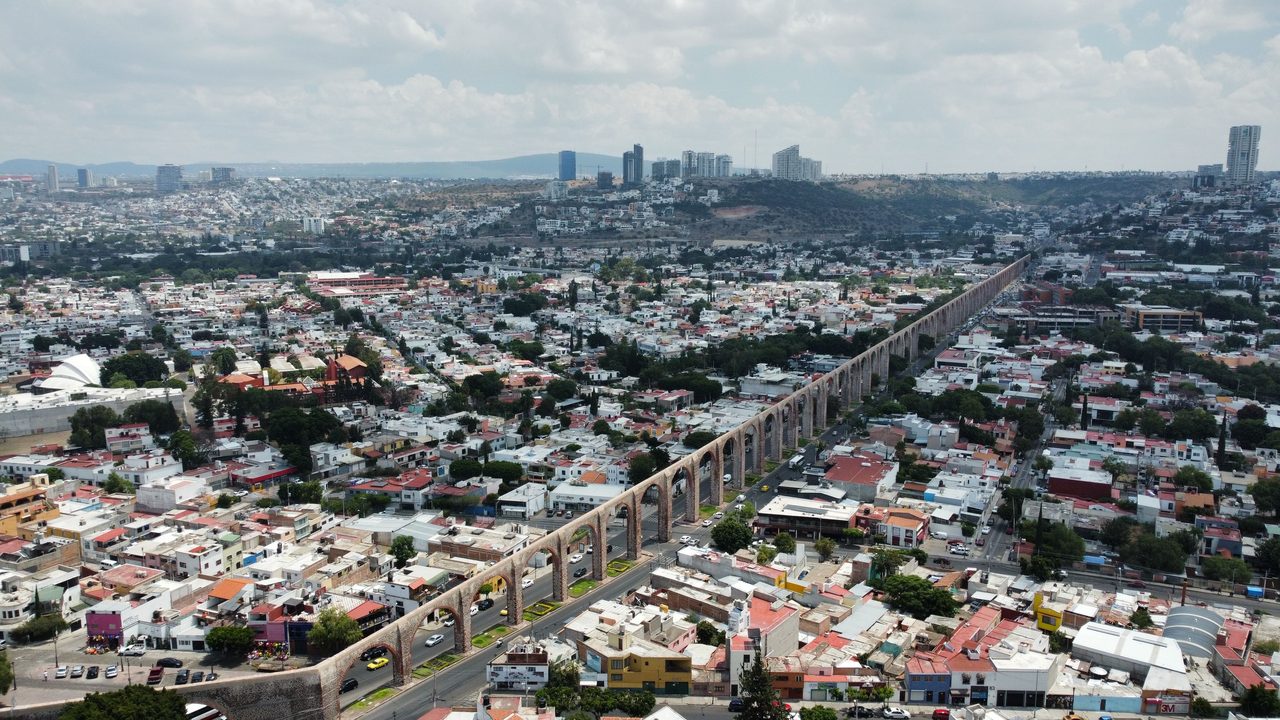
Querétaro is a landlocked state in central Mexico, known for the baroque Historic Monuments Zone of its capital, Santiago de Querétaro, a UNESCO World Heritage Site since 1996. Beyond the capital, the state holds the Sierra Gorda Biosphere Reserve, the Franciscan missions of Jalpan de Serra, the Pueblo Mágico of Tequisquiapan, and the towering monolith of Peña de Bernal. Querétaro is also Mexico's second-largest wine-producing region, with vineyards and cheese producers strung along the Ruta del Vino y Queso.
Querétaro sits on Mexico's central plateau, bordered by Guanajuato, San Luis Potosí, Hidalgo, and México State, roughly three hours by road or bus from Mexico City. The state splits into two distinct zones: the fertile Bajío valleys around the capital, and the rugged Sierra Gorda mountains in the north, a UNESCO biosphere reserve dotted with 18th-century Franciscan missions. Santiago de Querétaro's historic center is one of Mexico's best-preserved colonial cities, its narrow streets, plazas, and 74-arch aqueduct earning UNESCO recognition. East of the capital, the wine and cheese country around Tequisquiapan and Ezequiel Montes produces the bulk of Mexico's domestic wine, while the nearby Pueblo Mágico of San Sebastián Bernal sits beneath one of the world's tallest monoliths, the Peña de Bernal. The state combines colonial architecture, high-desert scenery, and an increasingly recognized wine industry within easy reach of central Mexico's main tourist circuit.
The 25 destinations our editors recommend — from iconic landmarks to under-the-radar finds.
Acueducto de Querétaro (Los Arcos)
This 18th-century aqueduct carried water into the city center via a line of stone arches, and long stretches of it still stand along what is now Calzada de los Arcos. It was funded by the Marqués del Villar del Águila after a Capuchin nun reportedly asked him to secure a reliable water supply for the city's convents. The arches are tallest near the Bosques del Acueducto end, where you can walk beneath them at street level.
Peña de Bernal
This monolith rises above the pueblo mágico of San Sebastián Bernal and is one of the tallest rock formations of its kind, drawing climbers to its lower faces and hikers to a trail that goes partway up to a small chapel. The town at its base is built around the rock, with the plaza and church framed by it in almost every view. Climbing to the summit requires technical gear and a guide; most visitors walk only the marked path to the cross or chapel partway up.
Teatro de la República
This theater is where the Mexican Constitution of 1917 was signed, and its plain, dignified interior still carries that history more than any lavish decoration would. It was also the site of the court-martial that condemned Emperor Maximilian I in 1867. The building continues to host cultural events, so its use as a working theater and civic monument overlap.
Cerro de las Campanas y Museo
This hill on the edge of the city center is where Emperor Maximilian I was executed by firing squad in 1867, ending the Second Mexican Empire, and a chapel and monument now mark the spot. A small museum on the grounds covers the events of the French Intervention and the fall of the empire. The hilltop also gives a wide view over Santiago de Querétaro, since the site sits above the surrounding streets.
Templo de Santa Rosa de Viterbo
This 18th-century baroque church is best known for its exterior flying buttresses shaped like ships' prows, an unusual design detail for a colonial church in this region. Inside, the churrigueresque altarpieces and choir screen show the same period's ornate style. It functioned alongside a convent and school, and the layout of the building still reflects that combined religious and educational purpose.
Templo y Ex Convento de San Francisco / Museo Regional de Querétaro
This former Franciscan convent now houses the Museo Regional de Querétaro, with exhibits on the region's pre-Hispanic, colonial, and independence-era history, including material tied to the conspiracy that preceded the 1810 War of Independence. The attached church remains active, so the complex mixes a working parish with a state-run museum inside the old convent cloisters. The cloister itself, with its arcaded courtyard, is worth as much attention as the exhibit cases.
Recommended itineraries
Pick a length, follow the route. Each itinerary balances headline sights with breathing room.
5-Day Querétaro Explorer
Day 1Arrive in Querétaro, explore city center
Day 2Visit top attractions and museums
Day 3Day trip to nearby highlights
Day 4Local markets and hidden gems
Day 5Final sightseeing, departure
7-Day Classic Querétaro
Days 1-2Querétaro city highlights
Days 3-4Regional exploration
Days 5-6Cultural immersion and local experiences
Day 7Return and departure
14-Day Ultimate Querétaro
Days 1-3Querétaro comprehensive city tour
Days 4-6Northern region exploration
Days 7-9Eastern highlights
Days 10-12Southern attractions
Days 13-14Return to Querétaro, departure
Where to stay in Querétaro
Three tiers, every traveller covered — from cost-conscious to flagship hotels.
Budget MX$800 (~$46)
Hostels, budget hotels, and guesthouses offer affordable stays without sacrificing experience.
Mid-range MX$2,200 (~$128)
Boutique hotels and well-located accommodations provide comfort and convenience at reasonable prices.
Luxury MX$6,500+ (~$377+)
World-class resorts and premium hotels deliver unforgettable experiences.
Casa de la Marquesa
Centro Histórico, Santiago de Querétaro · $$$$ (MXN 4,500-9,000 / USD 245-490)
Cafés, neighbourhood gems, and tasting menus worth the table reservation.
Restaurante 1810
Queretano traditional Mexican · $$
A sit-down restaurant in the historic center built around Querétaro's own regional cooking rather than generic Mexican standards. Dishes lean toward the state's signature preparations, served in a dining room that plays up the colonial-era setting of the surrounding streets.
La Vieja Varsovia
Artisan bakery and wood-fired pizza · $$
Josecho
Queretano traditional Mexican · $$$
Bisquets Obregon (Centro)
Mexican bakery-cafe breakfast · $
El Meson de Chucho el Roto
Queretano traditional Mexican · $$
A traditional restaurant near Plaza de Armas serving Querétaro's classic regional dishes to a mix of visitors and locals passing through the historic center. The menu centers on the state's heavier, slow-cooked plates rather than light antojitos.
Santiago de Querétaro's UNESCO-listed historic center is compact and pedestrian-friendly, so most sightseeing within the city is done on foot. The Qrobús network covers the wider metro area for locals and budget travelers, while Uber, DiDi, and sitio taxis handle most short point-to-point trips. For day trips to Bernal, Tequisquiapan, San Miguel de Allende, the wine route, and the Sierra Gorda missions, intercity buses from the Central Camionera are frequent and inexpensive, though a rental car offers far more flexibility for the more remote Sierra Gorda towns and the smaller wine country stops.
Budget breakdown
Daily spend by tier in MXN, broken out by category.
Category
Budget
Mid-range
Luxury
Accommodation
MX$400 (~$23)
MX$1,300 (~$75)
MX$4,200 (~$244)
Food (per day)
MX$250 (~$14)
MX$550 (~$32)
MX$1,500 (~$87)
Transportation
MX$100 (~$6)
MX$200 (~$12)
MX$500 (~$29)
Activities
MX$50 (~$3)
MX$150 (~$9)
MX$300 (~$17)
Daily total
MX$800 (~$46)
MX$2,200 (~$128)
MX$6,500+ (~$377+)
Best time to visit Querétaro
Weather through the year in Querétaro
Best timeShoulderWorth avoiding
Average daytime temperature in °C. Figures are for Querétaro.
Essential travel tips
Base in the historic center to walk to the Plaza de Armas, the aqueduct, and most colonial landmarks
Visit Peña de Bernal on a weekday morning to avoid the weekend crowds that fill San Sebastián Bernal's plaza
Book a car or a driver in advance for the Sierra Gorda missions, since public transport to Jalpan de Serra is limited
Try gorditas, enchiladas queretanas, and local Bajío-style barbacoa at a market fonda in the Mercado Escobedo
Hidden gems
Off-the-beaten-path corners most travellers miss.
Sierra Gorda Franciscan Missions
Five 18th-century missions with elaborately carved facades around Jalpan de Serra, founded by Junípero Serra before his California missions, and jointly UNESCO-listed
Jalpan de Serra, Sierra Gorda
Cascada El Chuveje
A roughly 25-meter waterfall reached via a forested trail in the Sierra Gorda Biosphere Reserve, with swimming pools below
Pinal de Amoles, Sierra Gorda
San Joaquín
A former silver-mining town in the Sierra Gorda with the Ranas and Toluquilla archaeological sites nearby, far off the standard tourist circuit
San Joaquín municipality
Safety information
INFO
Querétaro is widely regarded as one of the safest states in Mexico; the main risks for visitors are petty theft and pickpocketing in crowded areas of the Centro Histórico, at the Mercado de la Cruz, and around the bus terminal, especially at night
INFO
The US State Department rates Querétaro state Level 2: Exercise Increased Caution (the same as roughly half of Mexico's 32 states), reflecting nationwide cartel and crime risk rather than specific problems within Querétaro's tourist areas, which have a strong safety record
INFO
When hiking La Peña de Bernal, wear proper closed footwear and start early; the trail up the monolith is steep with loose rock in places, and the upper unmarked scramble sections are best avoided without a local guide
INFO
Toll highways (cuota) between Querétaro city, Bernal, Tequisquiapan, and Mexico City are markedly safer than free roads (libre); use the toll roads (autopistas) and avoid driving after dark on rural highways
INFO
Intercity buses (ADO, Primera Plus, ETN) from the modern Central de Autobuses are safe and well-run; keep bags close and avoid overhead racks for valuables on the Querétaro-Mexico City route
INFO
Tap water is not safe to drink; use bottled or purified (agua purificada) water for drinking, brushing teeth, and ice, though hotels and established restaurants in the city typically use purified water and ice
INFO
Sun exposure is intense at Querétaro's 1,800m+ elevation; carry water, sunscreen, and a hat for the Bernal monolith hike and Cerro del Cimatario, and pace yourself as the altitude can cause mild breathlessness for those unacclimatized
INFO
Summer afternoon thunderstorms (June-September) can cause sudden flash flooding on streets and rural roads; avoid low-lying crossings (vados) during and after heavy rain
Frequently asked questions
Do I need a visa to visit Querétaro?
Most tourists from the US, Canada, EU, and many other countries can enter Mexico visa-free for stays up to 180 days using a Forma Migratoria Múltiple (FMM) tourist permit, issued on arrival or completed online before travel. Requirements vary by nationality, so travelers should confirm with the nearest Mexican consulate before departure.
How do you get to Peña de Bernal from Santiago de Querétaro?
San Sebastián Bernal is about 55 km northeast of Santiago de Querétaro, roughly a 50-minute drive by rental car or intercity bus. Buses run from the Central de Autobuses to Bernal via Tequisquiapan; visiting on a weekday morning avoids the heaviest crowds around the plaza and the base of the monolith.
Is Querétaro safe for tourists?
Querétaro state is rated Level 2 - Exercise Increased Caution by the U.S. State Department, similar to most of central Mexico, and is generally regarded as one of the country's safer, more prosperous states. Standard precautions apply, including using registered taxis or rideshare apps and watching for pickpocketing in crowded areas.
What is Querétaro known for?
Querétaro is known for the baroque Historic Monuments Zone of its capital city, a UNESCO World Heritage Site, along with the 74-arch Querétaro Aqueduct, the Peña de Bernal monolith, the Sierra Gorda Biosphere Reserve and its Franciscan missions, and Mexico's second-largest wine and cheese producing region around Tequisquiapan.