Bursa · 22 Places · Best April, May, September, October
Bursa
Bursa is Turkey's fourth-largest city and the first capital of the Ottoman Empire, nestled at the foot of Uludağ mountain on the southern shore of the Sea of Marmara. Known as 'Yeşil Bursa' (Green Bursa) for its abundant parks and forests, the city blends extraordinary Ottoman heritage with modern industry, thermal spas, alpine skiing, and the birthplace of İskender kebap.
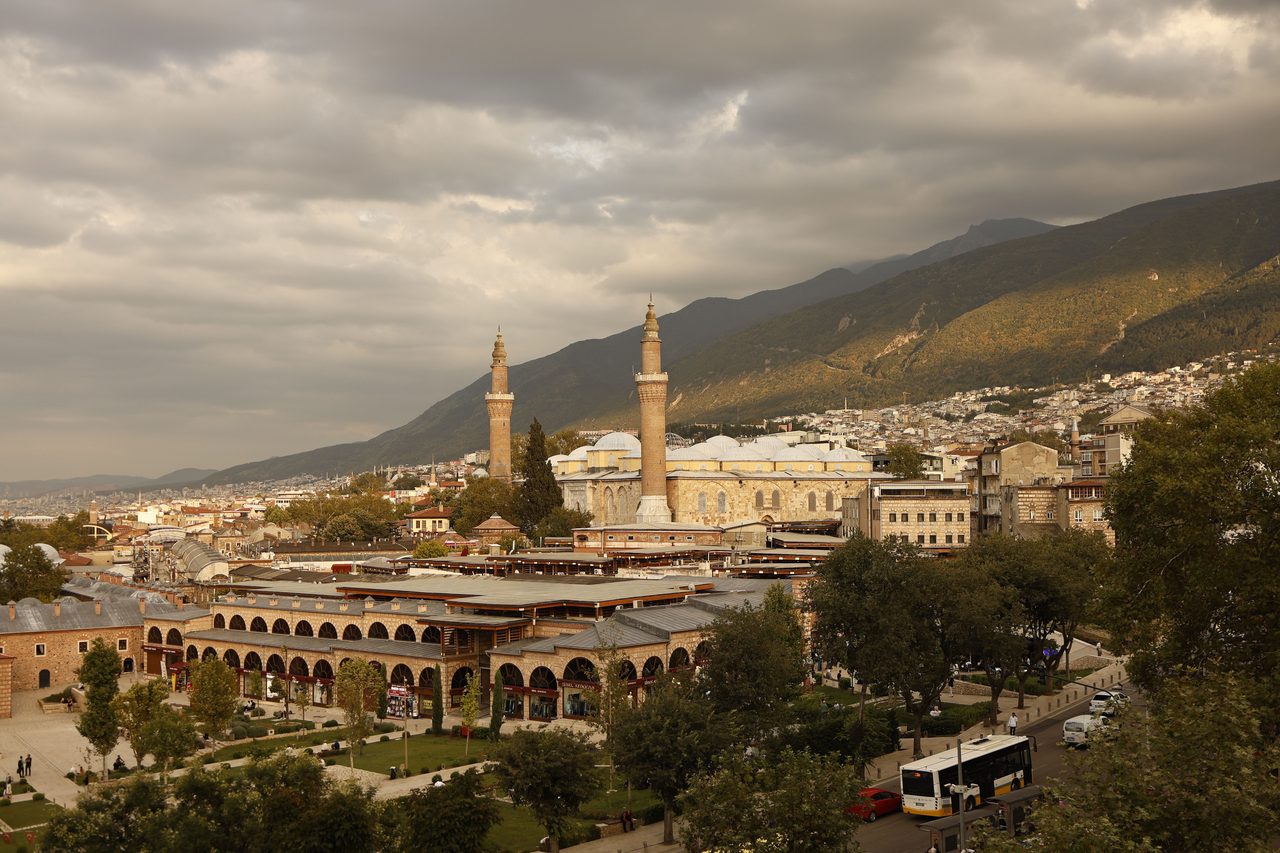
Bursa served as the first Ottoman capital from 1326 and retains an extraordinary concentration of 14th–15th century Ottoman monuments. The city's skyline is dominated by the Grand Mosque (Ulu Cami) with its 20 domes, while the Green Mosque and Green Tomb represent the pinnacle of early Ottoman architecture. Beyond its historic core, Bursa offers thermal baths in the Çekirge district, the UNESCO-listed Ottoman village of Cumalıkızık, silk and textile bazaars in Koza Han, and a cable car ascending to Uludağ — Turkey's premier ski and trekking mountain at 2,543 m. The İskender kebap, invented here in the 19th century, remains the city's signature culinary export.
The 22 destinations our editors recommend — from iconic landmarks to under-the-radar finds.
Ulu Cami (Grand Mosque)
Built in the 1390s under Sultan Bayezid I, this is the largest Ottoman-era mosque in Bursa and one of the earliest examples of the multi-domed Ottoman mosque plan, with twenty domes carried on twelve massive piers instead of a single central dome. Inside, the walls are covered with large-scale calligraphic panels rather than figurative decoration, and a şadırvan (ablution fountain) sits directly beneath a domed skylight in the middle of the prayer hall. It remains an active mosque in the middle of Bursa's commercial district, so it fills with worshippers at prayer times.
Yeşil Cami (Green Mosque)
Commissioned by Sultan Mehmed I and completed in the 1420s, this mosque marks the transition from the earlier multi-dome Ulu Cami style toward the more T-shaped, iwan-based plan that later Ottoman architecture built on. It's known for the green-blue Iznik and Bursa tiles that cover its mihrab and lower walls, unusually vivid for a building of this early period. The sultan's private loge above the entrance, faced entirely in tilework, is one of the more distinctive interior features from this construction phase.
Yeşil Türbe (Green Tomb)
This mausoleum holds the sarcophagus of Sultan Mehmed I, who commissioned the adjacent Yeşil Cami, and sits on a hill above it with a view down over that part of Yıldırım district. The exterior tiles seen today are largely 19th-century restoration work rather than original 15th-century tiling, but the interior retains original tiled panels and a large carved wooden door. It's a short, self-contained stop that pairs naturally with a Yeşil Cami visit since they're a few minutes' walk apart.
Uludağ National Park
Uludağ is the mountain overlooking Bursa, reachable by a cable car (teleferik) that climbs from the edge of the city to a plateau area used for hiking in summer and skiing in winter. The park itself is forested lower down, opening into alpine terrain higher up, and the cable car ride alone gives a long view back over Bursa and the plain below. In winter this is Turkey's most-visited ski area with a cluster of hotels near the slopes, while in summer it's mainly a cooler-air day trip from the city.
Koza Han (Silk Bazaar)
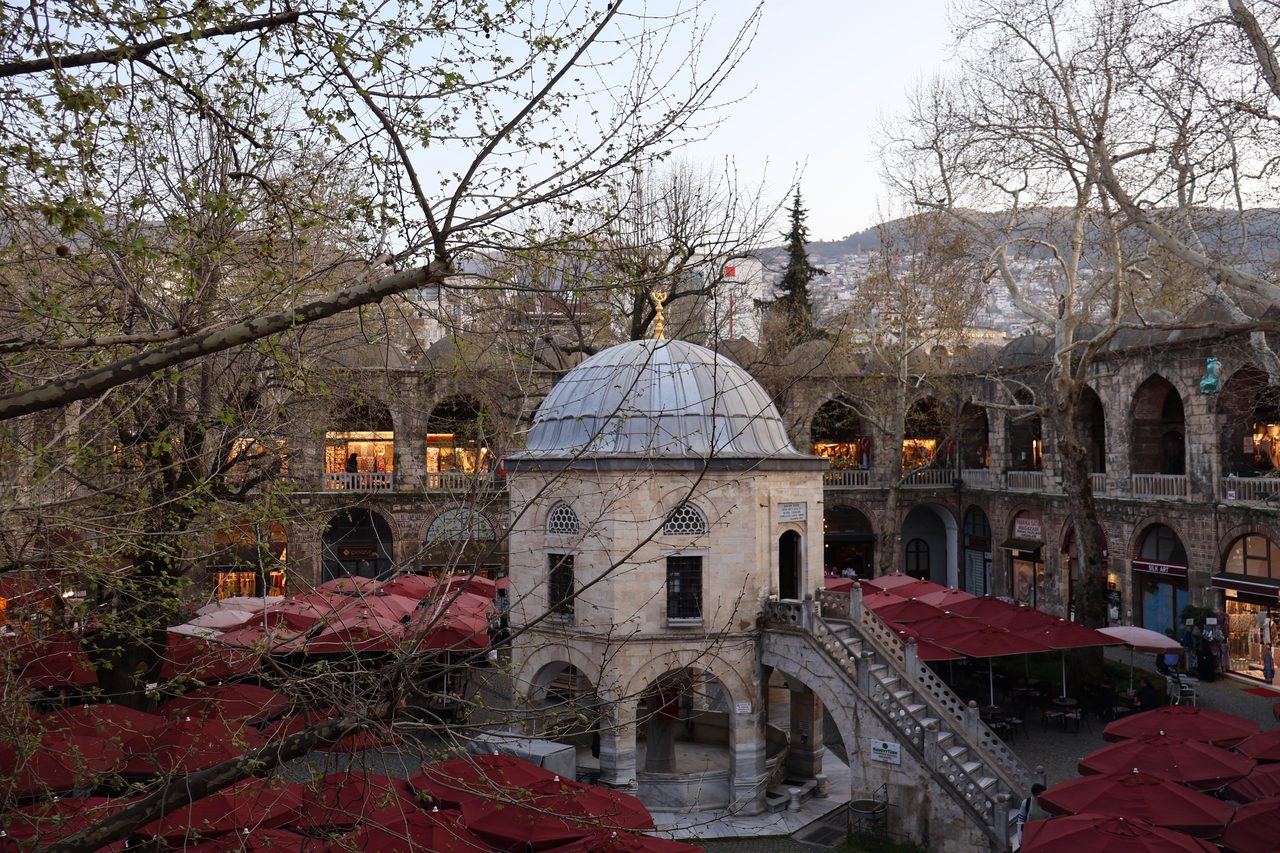
Built in 1491 under Sultan Bayezid II, this two-story caravanserai around a courtyard was built specifically for the silk cocoon trade, and Bursa's raw silk cocoon auctions were historically held in its courtyard. Today the ground-floor arcade and upper gallery are lined with shops selling silk scarves, fabric, and textiles, with a small mosque (mescit) on a raised platform in the middle of the courtyard. It sits right next to Ulu Cami, so it's an easy combined stop in the old commercial core.
Cumalıkızık Village
Cumalıkızık is a preserved Ottoman-era village at the foot of Uludağ, with timber-framed houses on stone ground floors lining narrow, sloped cobblestone streets, and it's part of the UNESCO-listed 'Bursa and Cumalıkızık' World Heritage site. Many houses are still lived in, and the village functions as a small working community alongside its tourism, with produce stalls and simple eateries set up along the main street. It gives a sense of pre-Republic Anatolian village layout that's largely gone from Bursa's own urban core.
Recommended itineraries
Pick a length, follow the route. Each itinerary balances headline sights with breathing room.
5-Day Bursa Explorer
Day 1Arrive in Bursa, explore city center
Day 2Visit top attractions and museums
Day 3Day trip to nearby highlights
Day 4Local markets and hidden gems
Day 5Final sightseeing, departure
7-Day Classic Bursa
Days 1-2Bursa city highlights
Days 3-4Regional exploration
Days 5-6Cultural immersion and local experiences
Day 7Return and departure
14-Day Ultimate Bursa
Days 1-3Bursa comprehensive city tour
Days 4-6Northern region exploration
Days 7-9Eastern highlights
Days 10-12Southern attractions
Days 13-14Return to Bursa, departure
Where to stay in Bursa
Three tiers, every traveller covered — from cost-conscious to flagship hotels.
Budget $30
Hostels, budget hotels, and guesthouses offer affordable stays without sacrificing experience.
Mid-range $75
Boutique hotels and well-located accommodations provide comfort and convenience at reasonable prices.
Luxury $200
World-class resorts and premium hotels deliver unforgettable experiences.
Hotel Çelik Palas
Çekirge, Osmangazi, Bursa · $$$$ — from ₺5,000 (~$145)/night
Bursa is most easily reached from Istanbul by ferry to Mudanya (sea bus from Yenikapı or Kabataş pier, ~1.5 hours) then bus into the city, or by intercity bus (~3.5 hours). The city has a well-developed metro (BursaRay) and bus network. The Uludağ Teleferik cable car connects the city to the mountain.
Metro (BursaRay)
Two metro lines covering main city corridors from Kestel to Emek
Cost: ₺18 (~$0.52)
City Bus (BURULAŞ)
Extensive bus network covering all districts; use KentKart contactless card
Cost: ₺18 (~$0.52)
Taxi
Metered yellow taxis; use BiTaksi app to book and see fare estimate
Cost: ₺40 base + ₺30/km (~$1.16 base)
Uludağ Teleferik
Cable car from Teferrüç to Uludağ summit in two stages
Cost: ₺450 round trip (~$13)
Ferry from Istanbul
IDO sea bus Yenikapı–Mudanya (~90 min), then bus to Bursa center
Cost: ₺280 (~$8.10) one way
Budget breakdown
Daily spend by tier in USD, broken out by category.
Category
Budget
Mid-range
Luxury
Accommodation
$15
$40
$120
Food (per day)
$8
$20
$50
Transportation
$3
$7
$15
Activities
$4
$8
$15
Daily total
$30
$75
$200
Best time to visit Bursa
Weather through the year in Turkey
Best timeShoulderWorth avoiding
Average daytime temperature in °C. Figures are for Turkey.
Spring and autumn offer mild temperatures ideal for sightseeing. January–March is peak ski season on Uludağ. Summer is warm and dry for city exploration.
Essential travel tips
Purchase a KentKart for public transport — available at metro stations for ₺50 (~$1.45) including credit
The ferry from Yenikapı (Istanbul) to Mudanya is the most scenic way to arrive
Many mosques close to tourists during prayer times; plan visits between prayer calls
İskender kebap is traditionally served with ayran (yogurt drink) and tomato sauce
Buy silk scarves at Koza Han for fair prices — authentic Bursa silk, not imports
Hidden gems
Off-the-beaten-path corners most travellers miss.
Cumalıkızık Village
A UNESCO-listed village of 270 Byzantine and Ottoman stone houses, virtually unchanged for 700 years, just 12km from central Bursa
12km east of Bursa city center
Irgandı Bridge Bazaar
A restored 15th-century Ottoman bridge over the Gökdere stream with artisan shops built on its arches — one of only four such bridges in the world
Osmangazi district, central Bursa
Mudanya Seafront
A quiet Marmara Sea waterfront town 25km from Bursa with fish restaurants, an Ottoman pier, and a ferry link to Istanbul
25km northwest of Bursa
Safety information
INFO
Use BiTaksi app to book taxis and avoid overcharging
INFO
Store valuables in your hotel safe; the covered bazaar area can be crowded
INFO
Dress modestly when visiting mosques — shoulders and knees must be covered
INFO
Carry cash as some smaller eateries and market stalls are cash-only
INFO
In winter, roads to Uludağ require snow chains or 4WD; check conditions before driving
Frequently asked questions
Is Bursa safe to visit in 2026?
Bursa is considered one of Turkey's safest major cities for visitors. Standard urban precautions apply: use the BiTaksi app rather than hailing taxis on the street, keep valuables secured, and dress modestly near mosques. Emergency services: police 155, ambulance/general emergency 112.
What is the best time to visit Bursa?
April–May and September–October offer the best conditions for sightseeing with mild temperatures (15–25°C). January–March is the ski season on Uludağ. Summer (July–August) is warm and dry in the city (28–33°C). Winter in the city is cold and occasionally snowy.
How do I get to Bursa from Istanbul?
The most scenic route is the IDO sea bus from Yenikapı or Kabataş pier to Mudanya (~90 minutes, ₺280/~$8), then a 30-minute bus to central Bursa. Alternatively, intercity buses from Istanbul's main bus terminals take 3–3.5 hours (₺150–250/~$4–7). Booking via obilet.com or directly at the terminal.
Do I need a visa to visit Bursa?
Entry requires a Turkish visa. Most nationalities obtain an e-Visa at evisa.gov.tr before travel. Some nationalities are visa-free for up to 90 days. Always verify your nationality's requirements on the official Turkish e-Visa portal before booking travel.
What is Bursa famous for?
Bursa is famous as the first Ottoman capital, home to landmark mosques including Ulu Cami and Yeşil Cami, the invention of İskender kebap, Uludağ ski resort, natural thermal springs in Çekirge, the UNESCO-listed Cumalıkızık village, and Turkey's historic silk-weaving industry centered on the Koza Han caravanserai.
What currency is used in Bursa?
The Turkish Lira (TRY) is the currency. ATMs are widely available throughout the city. Credit cards are accepted at hotels and most restaurants; carry cash for bazaars, street food, and smaller establishments. As of mid-2026, approximately 34.5 TRY = 1 USD.