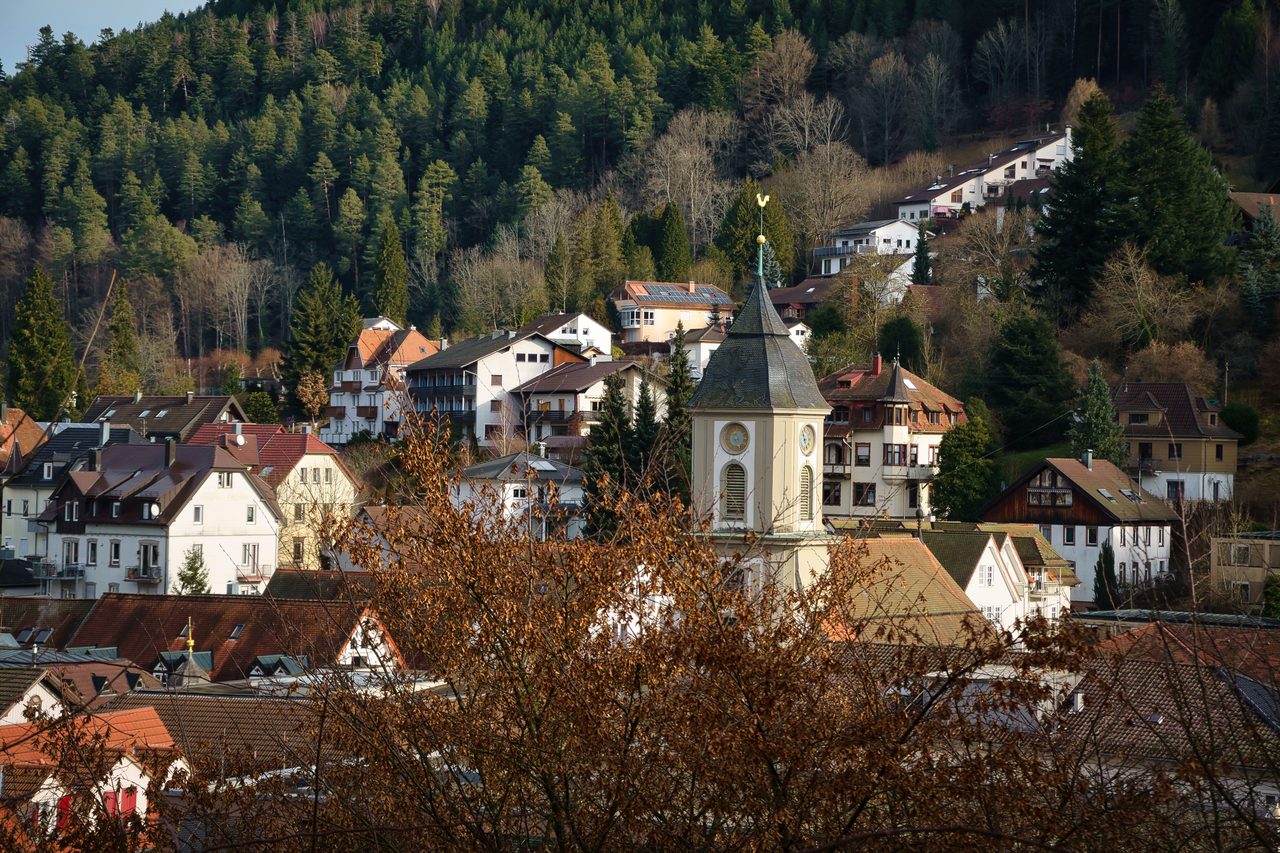
Stuttgart is the capital of Baden-Württemberg, a city of about 630,000 residents in a valley basin opening onto the Neckar river in south-western Germany. Vineyards and forested hills surround the city centre, which centres on the pedestrian Königstraße, the Schlossplatz with the Neues Schloss and the Staatsgalerie museum district. Stuttgart is the home of Mercedes-Benz and Porsche, and both companies run major museums: the Mercedes-Benz Museum in Untertürkheim and the Porsche Museum in Zuffenhausen. The Bad Cannstatt district has some of the richest mineral springs in Europe and hosts the Cannstatter Volksfest each autumn. The Stuttgart Christmas market is among the oldest and largest in Germany. The Stadtbahn, the S-Bahn and the Zacke rack railway serve the hillside districts under the VVS fare system. Stuttgart Airport (STR) is about 13 km south of the centre and reachable by S-Bahn in around 27 minutes; Tübingen, Esslingen, Ludwigsburg, Heidelberg and Baden-Baden are easy day trips.
Capital
Berlin (national capital); Stuttgart is the capital of Baden-Württemberg
Largest city
Stuttgart is the largest city of Baden-Württemberg
Population
About 630,000 (city of Stuttgart); about 2.8 million in the wider Stuttgart Region
The 17 destinations our editors recommend — from iconic landmarks to under-the-radar finds.
Schlossplatz and Neues Schloss
The central square of Stuttgart, framed by the Baroque and neoclassical Neues Schloss (built 1746-1807 and rebuilt after wartime damage), the Königsbau arcade and the Jubilee Column. Lawns and fountains make it the natural meeting point for the city, and the pedestrian Königstraße starts at its edge.
Altes Schloss and Landesmuseum Württemberg
The Old Castle began as a medieval moated fortress and was converted into a Renaissance residence of the Dukes of Württemberg in the 16th century, with a three-storey arcaded courtyard. Since 1948 it has housed the Landesmuseum Württemberg, whose collections run from Ice Age finds and the Celtic Hochdorf prince's grave to the Württemberg crown jewels and Kunstkammer pieces.
Stiftskirche (Collegiate Church)
The principal Protestant church of Stuttgart, with Romanesque and Gothic origins and a distinctive pair of towers of unequal height. It was severely damaged in 1944 and rebuilt in the following decades. The tomb figures of the Württemberg counts in the choir are among the best-preserved features.
Staatsgalerie Stuttgart
The state art museum of Baden-Württemberg, with an Old Masters wing and a postmodern extension by James Stirling opened in 1984. The collection covers medieval altarpieces to 20th-century modernism, with a strong holding of Oskar Schlemmer's Bauhaus work and Picasso.
Mercedes-Benz Museum
A double-helix building by UNStudio that opened in 2006, telling the history of the automobile from the 1886 Benz Patent-Motorwagen and Daimler's first vehicles through racing cars and Popemobiles. Visitors descend through nine themed Legend and Collection spaces; the audio guide is included in the ticket. A ticket gives a 25 percent discount at the Porsche Museum.
Porsche Museum
A monolithic building by Delugan Meissl that opened in 2009 above the Porsche factory, with about 80 vehicles on a floating exhibition floor. The story runs from the 1948 Porsche 356 No. 1 through Le Mans winners to current models, with a restaurant and shop in the same building.
Recommended itineraries
Pick a length, follow the route. Each itinerary balances headline sights with breathing room.
5-Day Stuttgart Explorer
Day 1Arrive in Stuttgart, explore city center
Day 2Visit top attractions and museums
Day 3Day trip to nearby highlights
Day 4Local markets and hidden gems
Day 5Final sightseeing, departure
7-Day Classic Stuttgart
Days 1-2Stuttgart city highlights
Days 3-4Regional exploration
Days 5-6Cultural immersion and local experiences
Day 7Return and departure
14-Day Ultimate Stuttgart
Days 1-3Stuttgart comprehensive city tour
Days 4-6Northern region exploration
Days 7-9Eastern highlights
Days 10-12Southern attractions
Days 13-14Return to Stuttgart, departure
Where to stay in Stuttgart
Three tiers, every traveller covered — from cost-conscious to flagship hotels.
Budget EUR 105 (about USD 121)
Hostels, budget hotels, and guesthouses offer affordable stays without sacrificing experience.
Mid-range EUR 230 (about USD 265)
Boutique hotels and well-located accommodations provide comfort and convenience at reasonable prices.
Luxury EUR 520+ (about USD 598+)
World-class resorts and premium hotels deliver unforgettable experiences.
Le Méridien Stuttgart is a 5-star luxury hotel at Willy-Brandt-Straße 30, 70173 Stuttgart (Stuttgart-Mitte (Schlossgarten)). Large upscale hotel facing the Schlossgarten park and a short walk from Hauptbahnhof and the Staatsgalerie.
Steigenberger Graf Zeppelin is a 5-star luxury hotel at Arnulf-Klett-Platz 7, 70173 Stuttgart (Stuttgart-Mitte (Hauptbahnhof)). Historic-style grand hotel directly opposite the Hauptbahnhof with a spa and restaurant.
Hotel Der Zauberlehrling is a 4-star boutique hotel at Rosenstraße 38, 70182 Stuttgart (Stuttgart-Mitte (Bohnenviertel edge)). Individually designed boutique hotel with a restaurant and bar close to the Bohnenviertel old quarter.
Maritim Hotel Stuttgart is a 4-star hotel at Seidenstraße 34, 70174 Stuttgart (Stuttgart-West border (Seidenstraße)). Large congress-style hotel west of the centre with a restaurant, bar and wellness area.
Stuttgart's centre is walkable: the Hauptbahnhof, Königstraße, Schlossplatz, Staatsgalerie and Markthalle are all within 15 minutes on foot. Beyond that, the Stuttgarter Straßenbahnen (SSB, ssb-ag.de) run the Stadtbahn, buses and the Zacke rack railway, while Deutsche Bahn runs the S-Bahn, all sold under the VVS fare system (vvs.de). Tickets are sold in the VVS Mobil app, at machines at stops and at the SSB and VVS customer centres in the Klett-Passage under the Hauptbahnhof. The Hauptbahnhof (Arnulf-Klett-Platz 2, 70173 Stuttgart) is a major ICE stop and a construction site for the Stuttgart 21 rail project; the new underground through station has been repeatedly delayed, so follow signs for temporary routes.
Walking
The Hauptbahnhof, Königstraße, Schlossplatz, Marktplatz and Staatsgalerie are walkable; the Bohnenviertel is a short uphill walk
Cost: Free
Stadtbahn, S-Bahn and bus (VVS/SSB)
Stadtbahn lines and the S-Bahn link the Hauptbahnhof with Bad Cannstatt, Untertürkheim, Zuffenhausen and the airport; buy tickets in the VVS Mobil app or at stop machines and validate paper tickets before boarding
Cost: Single ticket in the Stuttgart zone roughly EUR 3.50-4 (about USD 4-4.60); day ticket roughly EUR 7-8 (about USD 8-9); fares change each year, so confirm at vvs.de
Zacke rack railway (Zahnradbahn)
Historic rack railway from Marienplatz to Degerloch with views over the valley; runs under the VVS fare
Cost: Covered by a standard VVS ticket
Regional and long-distance trains
ICE and regional trains from Stuttgart Hbf serve Munich, Frankfurt, Karlsruhe, Heidelberg, Tübingen and Ulm; book on bahn.de or in DB Navigator
Cost: Advance ICE fares from about EUR 18 (about USD 21); Baden-Württemberg-Ticket about EUR 28 (about USD 32) for regional day travel
Deutschlandticket
Monthly subscription valid on all regional public transport nationwide, including VVS; useful for stays of a week or more
Cost: EUR 63 per month (about USD 72)
Taxi and ride-hailing
Taxis wait at the Hauptbahnhof and Charlottenplatz; Uber and FreeNow also operate in Stuttgart
Cost: Metered fares; a ride from the airport to the centre is typically EUR 40-50 (about USD 46-58)
Budget breakdown
Daily spend by tier in EUR, broken out by category.
Category
Budget
Mid-range
Luxury
Accommodation
EUR 55 (about USD 63)
EUR 140 (about USD 161)
EUR 320 (about USD 368)
Food (per day)
EUR 25 (about USD 29)
EUR 50 (about USD 57)
EUR 120 (about USD 138)
Transportation
EUR 8 (about USD 9)
EUR 12 (about USD 14)
EUR 25 (about USD 29)
Activities
EUR 17 (about USD 20)
EUR 28 (about USD 32)
EUR 55 (about USD 63)
Daily total
EUR 105 (about USD 121)
EUR 230 (about USD 265)
EUR 520+ (about USD 598+)
Best time to visit Stuttgart
Weather through the year in Germany
Best timeShoulderWorth avoiding
Average daytime temperature in °C. Figures are for Germany.
May to June and September to early October offer the best mix of weather and crowds.
Spring brings blossom and green vineyards; early autumn offers sunny days and grape harvest. Summer can reach 30C+ (86F+), while the Christmas market (late November to 23 December) draws large crowds.
Essential travel tips
Check the StuttCard at stuttgart-tourist.de, which bundles city transport with museum discounts; compare it with a VVS day ticket before buying.
Book hotels very early for the Cannstatter Volksfest, big trade fairs at the Messe Stuttgart and Advent.
Try a Weinstube (wine tavern) for Swabian dishes with Trollinger or Riesling from the surrounding vineyards.
The Mercedes-Benz Museum is a short S1 ride from the Hauptbahnhof to Neckarpark; the Porsche Museum is on the S6 line at Neuwirtshaus.
Most shops close on Sundays and public holidays; stock up on Saturday.
Hauptbahnhof construction can change platform and exit routes; allow extra time with luggage.
Hidden gems
Off-the-beaten-path corners most travellers miss.
Birkenkopf (Monte Scherbelino)
At 511 metres, the Birkenkopf is an artificial summit raised from about 1.5 million cubic metres of wartime rubble after 1945, now covered with trees and a memorial cross. Broken blocks of old buildings remain visible on the path, and the summit gives a wide view across the basin.
Stuttgart-West
Grabkapelle auf dem Württemberg
A neo-classical mausoleum built in 1820-1824 for Queen Katharina of Württemberg on the site of the ancestral castle of the Württemberg dynasty. It stands among vineyards with views over the Neckar valley.
Stuttgart-Rotenberg
Zahnradbahn Zacke (Marienplatz to Degerloch)
Line 10 is a narrow-gauge rack railway that opened in 1884 and still climbs from Marienplatz to Degerloch, covering about 2.2 km on a steep gradient. It is part of the standard public transit network and ends near the TV tower.
Stuttgart-Süd
Bohnenviertel (Bean Quarter)
A compact quarter of narrow lanes and low terraces, named for the bean farmers who once lived there. It has survived modernisation and now holds small bars, restaurants and wine taverns.
Stuttgart-Mitte
Hoppenlau-Friedhof
The oldest preserved cemetery in Stuttgart, opened in 1626 and closed to new burials in the 19th century, where poets, artists and merchants including friends of Schiller lie. Shaded paths between historic gravestones make a quiet pause in the city centre.
Stuttgart-Mitte
Safety information
INFO
Keep phones and wallets in zipped inner pockets on the Königstraße, at the Hauptbahnhof and at the Christmas market on Schlossplatz and Marktplatz, where crowds are densest.
INFO
At the Cannstatter Volksfest on the Cannstatter Wasen (late September to early October), keep valuables in front pockets and agree a meeting point if you lose your group.
INFO
Lock bicycles with two locks to fixed objects; bicycle theft is a common crime in German cities.
INFO
Genuine police officers do not need to inspect cash on the street; if people in plain clothes ask to check a wallet, ask for a uniformed patrol or call 110.
INFO
Late at night around the Hauptbahnhof area and the Theodor-Heuss-Straße bars, stay on lit, busy routes and keep an eye on drinks.
INFO
Use the night buses and S-Bahn that run on weekend nights, or taxis from the ranks at the Hauptbahnhof, rather than walking through quiet park paths or the Schlossgarten after dark.
INFO
Carry a photo ID or passport copy; German police may ask for identification.
INFO
Validate paper tickets before boarding S-Bahn, Stadtbahn and buses; inspectors check regularly and the fine for travelling without a ticket is EUR 60 (about USD 69).
INFO
Stay on marked paths on the Stäffele stairways and vineyard slopes, and wear sturdy shoes on steep, wet stone steps.
INFO
Temperature inversions in the Stuttgart basin can worsen air quality; check alerts at luftqualitaet.baden-wuerttemberg.de if you have breathing conditions.
Frequently asked questions
Do I need a visa to visit Stuttgart?
Entry follows Germany/Schengen rules. EU citizens need only a national ID card or passport; visitors from many non-EU countries may stay visa-free for up to 90 days in any 180 days; others need a Schengen visa. Check auswaertiges-amt.de.
What is the best time to visit Stuttgart?
May to June and September to early October offer mild weather; Advent is best for the Christmas market. Hotels cost more during the Volksfest and trade fairs.
How many days do I need in Stuttgart?
Two to three days cover the Mercedes-Benz and Porsche museums, the centre and Wilhelma; add a day for Ludwigsburg or Tübingen.
Is Stuttgart expensive?
Budget travellers need about EUR 105 (about USD 121) per day, mid-range about EUR 230 (about USD 265). Hotels are the largest cost and spike during fairs.
What currency and plugs are used in Stuttgart?
The euro (EUR) is used; 1 EUR is about USD 1.15 (approx.). Sockets are Type F (Schuko) at 230V.