World · 21 Places · Best April–June and September–October
Konya
Konya is one of Turkey's oldest continuously inhabited cities, lying at the heart of the Anatolian plateau at 1,016 m elevation. It served as the capital of the Seljuk Sultanate of Rum (1077–1307) and is revered worldwide as the birthplace and final resting place of the 13th-century Sufi mystic and poet Mevlana Jalal ad-Din Rumi. The Mevlana Museum — one of Turkey's most-visited sites — draws pilgrims and curious travellers alike to its turquoise-tiled dome. Beyond spiritual tourism, Konya offers an extraordinary concentration of Seljuk monuments, a lively bazaar district, and a regional cuisine famous for etli ekmek (elongated meat-topped flatbread) and firin sut (baked milk dessert). As a conservative, predominantly religious city, Konya offers a glimpse of traditional Anatolian life rarely found in Turkey's coastal resorts.
Konya sits on the broad Konya Plain (Konya Ovası), one of Turkey's most fertile agricultural regions, surrounded by gentle steppe and distant volcanic peaks. The city blends deep Islamic heritage with a modern university population — Selcuk University and Konya Technical University bring tens of thousands of students. Key historical periods include Hittite, Phrygian, Hellenistic (Iconium), Roman, Byzantine, Seljuk and Ottoman eras, each leaving architectural traces. Rumi's Mevlevi Order of whirling dervishes, though banned as a brotherhood in 1925, continues as a cultural performance tradition. The annual Rumi Commemoration Week (Şeb-i Arus) each December draws hundreds of thousands of visitors.
The 21 destinations our editors recommend — from iconic landmarks to under-the-radar finds.
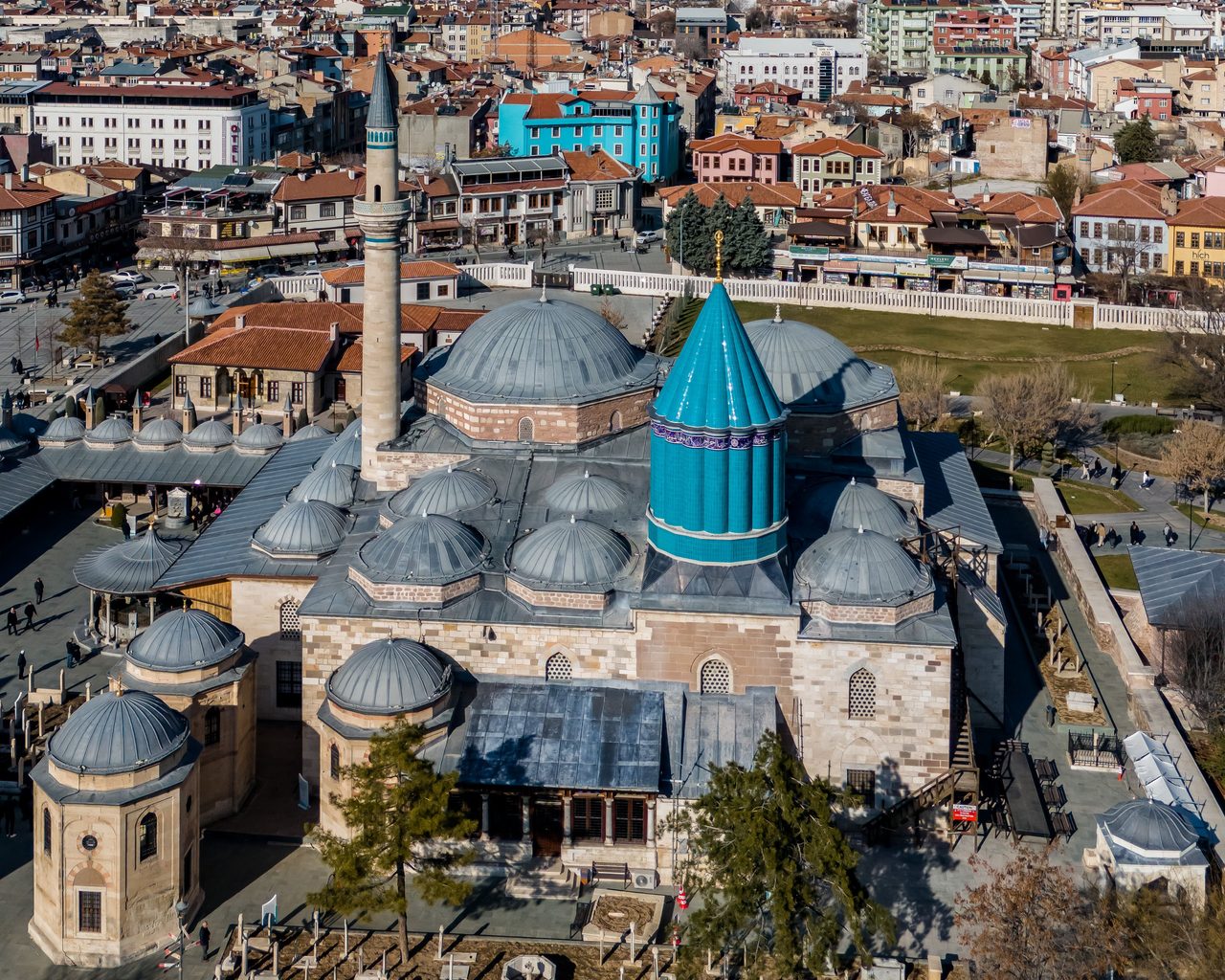
Mevlana Museum (Mevlana Müzesi)
Former lodge of the Mevlevi Sufi order and the burial place of Jalal ad-Din Rumi, the 13th-century poet and mystic whose followers founded the whirling dervish tradition. The building is identifiable by its fluted turquoise dome (Yeşil Kubbe) over Rumi's sarcophagus, and the surrounding halls display dervish cells, illuminated manuscripts of the Mesnevi, and prayer rugs and relics from the order's history. Visitors pass through rooms of tombs, calligraphy and ritual objects before reaching the mausoleum itself.
Alaeddin Mosque (Alaeddin Camii)
Konya's oldest mosque, built in stages by Seljuk sultans on top of Alaeddin Hill, the artificial mound that was the citadel of the Seljuk capital. The prayer hall uses rows of antique columns with mismatched capitals, some reused from earlier Roman and Byzantine buildings, giving the interior a patched-together, centuries-deep feel. Attached to the mosque is a conical brick türbe holding the tombs of several Seljuk sultans, including Alaeddin Keykubad I.
Karatay Medrese (Tile Museum)
A 13th-century Seljuk theological college built by the statesman Celaleddin Karatay, now a museum of Seljuk tile and ceramic work. The main draw is the domed central hall itself, where the transition zone and dome are covered in dark blue and turquoise tiles arranged in star and geometric patterns meant to evoke the night sky. The pieces displayed around the hall come from Seljuk palaces and mosques across the region.
Ince Minare Museum (Thin Minaret Medrese)
A Seljuk medrese named for its minaret, once far taller than the stub that survives today after a lightning strike destroyed the top in the 19th century. The building is entered through a deeply carved stone portal with Quranic inscriptions, among the finer examples of Seljuk stonework in Konya. Inside, the museum holds Seljuk and early Ottoman stone and wood carving, including tombstones, door panels and architectural fragments.
Çatalhöyük UNESCO Neolithic Site
A Neolithic settlement roughly 9,000 years old and one of the best-preserved examples of how people lived before cities had streets. Houses were built wall-to-wall with no doors or lanes between them; residents entered through openings in the roof and climbed down ladders into rooms decorated with wall paintings and bull-horn installations set into plaster walls. Excavation is ongoing, and covered dig shelters let you look directly down at exposed house walls and burials in place, alongside a small on-site exhibit.
Konya Archaeological Museum
A regional museum covering the area's archaeology from the Neolithic through the Roman period, with the collection weighted toward Roman-era stonework. Its best-known piece is a marble sarcophagus carved with reliefs of the Twelve Labors of Hercules, one of the more complete such sarcophagi to survive. Other galleries hold pottery, figurines and grave goods that give context to the Neolithic finds at Çatalhöyük.
Recommended itineraries
Pick a length, follow the route. Each itinerary balances headline sights with breathing room.
5-Day Konya Explorer
Day 1Arrive in Konya, explore city center
Day 2Visit top attractions and museums
Day 3Day trip to nearby highlights
Day 4Local markets and hidden gems
Day 5Final sightseeing, departure
7-Day Classic Konya
Days 1-2Konya city highlights
Days 3-4Regional exploration
Days 5-6Cultural immersion and local experiences
Day 7Return and departure
14-Day Ultimate Konya
Days 1-3Konya comprehensive city tour
Days 4-6Northern region exploration
Days 7-9Eastern highlights
Days 10-12Southern attractions
Days 13-14Return to Konya, departure
Where to stay in Konya
Three tiers, every traveller covered — from cost-conscious to flagship hotels.
Budget 600–1,500 TRY/day (~$18–$45 USD)
Hostels, budget hotels, and guesthouses offer affordable stays without sacrificing experience.
Mid-range 2,200–4,450 TRY/day (~$66–$135 USD)
Boutique hotels and well-located accommodations provide comfort and convenience at reasonable prices.
Luxury 5,800–14,000 TRY/day (~$175–$424 USD)
World-class resorts and premium hotels deliver unforgettable experiences.
Hilton Garden Inn Konya
Selcuklu district, 4 km north of city centre · 2,500–4,000 TRY/night (~$75–$121 USD)
Konya is connected by high-speed rail (YHT) from Ankara (1h 45min) and beyond. The city has a modern tram network (KonyaRay) and extensive city buses. Taxis are metered and affordable.
Budget breakdown
Daily spend by tier in Turkish Lira (TRY). 1 USD ≈ 33 TRY (2024 rate), broken out by category.
Category
Budget
Mid-range
Luxury
Accommodation
400–900 TRY/night (~$12–$27 USD) — hostels and guesthouses
1,500–3,000 TRY/night (~$45–$91 USD) — 3–4 star hotels
0–200 TRY/day (~$0–$6 USD) — most sites free or very cheap
200–500 TRY/day (~$6–$15 USD)
500–1,500 TRY/day (~$15–$45 USD) — private tours
Daily total
600–1,500 TRY/day (~$18–$45 USD)
2,200–4,450 TRY/day (~$66–$135 USD)
5,800–14,000 TRY/day (~$175–$424 USD)
Best time to visit Konya
Weather through the year in Turkey
Best timeShoulderWorth avoiding
Average daytime temperature in °C. Figures are for Turkey.
Spring brings mild temperatures (15–22°C) ideal for sightseeing. Autumn is clear and cool. Winter can be harsh on the Anatolian plateau but December's Rumi Commemoration is a unique cultural event.
Essential travel tips
The Mevlana Museum closes for internal prayer on Friday mornings — plan accordingly
December Rumi Week (Şeb-i Arus) requires advance hotel booking 3–6 months ahead
Konya is best explored on foot in the historic centre; trams serve the main boulevard
Most signs and menus in Konya are in Turkish only — a translation app is useful
Etli ekmek restaurants are typically outside the city centre; taxis are needed
Hidden gems
Off-the-beaten-path corners most travellers miss.
Sille Village
Ancient Greek Orthodox village 8 km northwest of Konya with cave churches and stone houses dating to the Byzantine period. Visitors can explore rock-cut chapels and stroll stone-paved lanes.
Eflatunpinar Hittite Spring Sanctuary
A 3,200-year-old Hittite sacred spring monument located 100 km west near Beyşehir, featuring carved reliefs of Hittite deities — one of the best-preserved Hittite outdoor monuments in Anatolia.
Sahip Ata Complex
A 13th-century Seljuk religious complex with a striking portal and turquoise tile interior, far less crowded than the Mevlana Museum but equally impressive architecturally.
Safety information
INFO
Dress modestly — cover shoulders and knees near mosques; women may wish to carry a headscarf
INFO
Alcohol is available in some restaurants and hotels but is not widely sold; respect local norms
INFO
Tap water is technically safe but bottled water is widely preferred
INFO
Keep copies of passport and travel documents separately from originals
Konya is one of Turkey's safest cities for tourists. Violent crime against visitors is extremely rare. The main concerns are standard urban issues: pickpocketing in crowded bazaars and the need for modest dress near religious sites. As a conservative Islamic city, visitors should dress appropriately
What is the best time to visit Konya?
The best time to visit Konya is April–June and September–October. Konya sits on the Anatolian plateau at 1,016 m elevation, producing a continental climate with hot, dry summers and cold winters. Average annual rainfall is about 330 mm — predominantly in spring and
What currency is used in Konya?
The currency in Konya is the Turkish Lira (TRY). ATMs are widely available in cities and tourist areas. Credit cards are accepted at most hotels and restaurants, but carry cash for markets and smaller establishments.
What language is spoken in Konya?
The main language(s) spoken in Konya: Turkish. In tourist areas, English is generally understood. Learning a few basic phrases in the local language is appreciated by locals.
What are the top attractions in Konya?
The top attractions in Konya include Mevlana Museum (Mevlana Müzesi), Alaeddin Mosque (Alaeddin Camii), Karatay Medrese (Tile Museum), Ince Minare Museum (Thin Minaret Medrese), and Çatalhöyük UNESCO Neolithic Site. Each offers a unique experience, from historic landmarks to natural wonders.